Tuesday, November 15, 2022

STRANGE WORLD NEW ENGLAND: ROAST BEEF

When I was a boy growing up North of Boston, one of my favorite things was roast beef sandwiches. It was, for me, wonderful comfort food. But one day we moved to the west coast and there I tried ordering a roast beef sandwich at a local shop. Not only was it not the same, it was a whole other category of roast beef sandwich. The beef tasted as if someone had just taken cold cuts and put them on bread. It was a literal roast beef sandwich but not a true roast beef sandwich. 

I tried roast beef elsewhere and I couldn't find anything like I had in Massachusetts. Unable to learn from my mistake I continued ordering roast beef sandwiches, thinking I would eventually find a place that made them right. Wrong. They simply didn't make the roast beef the proper way. One might say they didn't really make roast beef at all. 

A few years later, I moved back to Boston and found the same delicious roast beef waiting for me as if I'd never left. It was like the time me and my cousin got lost in the woods and wandered for hours before we finally found our way back to his parents cabin. Except it wasn't a cabin, it was a roast beef sandwich.  

I do not believe I can convey in words the difference between the cold, soulless roast beef of California and Boston's hot volcano of flavor. One is like a hearty meal of tender meat made for a king, the other is like dying inside. 

The North Shore roast beef is a local speciality. It isn't deli meat and it's not ordinary bread. It is a cut from an actual roast, warm, placed on a soft bun (usually something a little sweet like an onion roll), and it only has three possible toppings. 

Truly there are just three toppings. You can order other toppings if you want. No one will stop you. But you'd be ordering incorrectly. No one will say anything. They'll keep to themselves and judge you silently while you eat your roast beef with layers of lettuce and pickles like a savage. 

The three toppings are: cheese, a tangy sauce and mayo. You can get them individually, you can combine two together, or you can get all three, in which case you order a roast beef "three way". If you laugh when ordering your three way roast beef, you will be outcast from the commonwealth. Personally I hate mayo, so I just get with cheese or with sauce, sometimes plain, sometimes both. 

The beef itself needs to be roasted and warm, then sliced thin. It should also be rare. North Shore Roast beef is mostly pink buttery slices of meat. 

There are many places you can go around Boston for a roast beef sandwich. In recent years some higher end options have opened up as well though traditionalists will say too much culinary innovation causes the sandwich to lose its essence even if it objectively tastes good. The most famous is probably Kelly's in Revere (which has locations in other towns as well). I always loved Kellys because the sandwiches are good and they have plenty of other options like fried clams and lobster rolls. But it is one of those places whose fame is something of a double edged sword for locals and if you ask around, many people will tell you to avoid Kelly's and to go to a more hidden spot. There are also roast beef places on every corner. My uncle swears by King's Roast Beef in Salem. I know people who prefer Minos in Lynn. 

Other popular places are Bill and Bob's Roast Beef in Peabody. I always found them reliable but it was never my number one place to go. Bill and Bob's Famous Roast Beef in Salem is good too, but even better after midnight (they are open late, till about an hour after the bars close). But I think the place I consistently hear get the most local praise (and I would agree with it) is Nick's in Beverly. I used to deliver in the Beverly area and that was always a nice place to stop for a roast beef sandwich. 

Incidentally this is a very coastal North Shore-centric overview. I know places in Lynn, Revere, Salem, Beverly, even Peabody, but west of that my knowledge drastically diminishes and there are a probably a number of great roast beef places in that direction that are completely off my radar. 

Monday, November 14, 2022

BOOKS AS RANDOM TABLES

I've mentioned in several posts the idea of using books as random generators. This is an idea that has long appealed to me outside of gaming. I first encountered it when I learned about the conversion of Saint Augustine, how he heard a child sing "take up and read" and he opened a bible reading the first passage he saw, which was Romans 13:13-14. It was explained to me that randomly selecting a passage and reading it was a way people sought guidance and meaning at the time, and it was also explained that people generally read out loud as well (the latter isn't that relevant to this post, but something I found interesting as I always read things out loud in my head). I found myself doing this with a variety of books over the years, mostly to amuse myself or stumble on random thoughts and ideas. But eventually it became something I incorporated into my gaming. In this post I will describe the approach I take, which I call the random book method. 

The Random Book Method 

This is really a very simple way to generate random results and ideas in an RPG. You can use it the same way you use random tables. When a moment arises in the game where you want to introduce something or see if and how something occurs, you simply pick up a book, turn to a random page, find the first passage that catches your eye and use that as inspiration for what happens in the game. If for some reason the passage seems to have no relevance, you can either treat that as nothing happening or go to the next passage you find that is relevant. 

This does take a little practice to get comfortable with but it opens up a lot of doors because every type of book can be used and which books you choose to incorporate will shape the style and tone of the results. 

I

You will want to practice with this approach just like you probably played around with random tables before using them live in your first game. It is one thing to roll on a table and get a result and another thing to make that result come alive. And this method requires reading a paragraph each time. With books what you are looking for is inspiration and for something to help guide your decision making process. The result might be literal (i.e. you turn to a page that describes a sea serpent so you decide to have the party encounter a sea serpent), or it could be more of a starting point (i.e. you encounter a passage that describes the innovation of the gazetteer genre in 12th century Song China, so have them encounter an official gathering information for a gazetteer he is working on, or a group of bandits attacking such a person or carrying a cart of stolen gazetteers). You can take things even further if you like, the important thing is to see the passage, get a few thoughts but also an immediate sense of where to go (because the idea is you are still trying to make this random, and not just use it to put something down you were going to do anyways). 

For practice, because it can be a little tricky at first, I suggest using the random book approach between sessions while doing prep, before introducing it into a live game. This way you will see if it suits you (like any method, this isn't going to be something that resonates with everyone) and it will get you accustomed to working with random book passages (which span a huge spectrum of being directly relevant to being something you have to think about a bit to make relevant). 

II

For the random book method any book can be used, a novel, a history book, the bible, another religious text, philosophy books, etc. However you should have some idea of how you are going to use the book before incorporating it into your game. And you probably should be familiar with the book or the genre it belongs to so it makes sense to you and so you can have a sense of what sections might be best to randomly turn to (you don't need to target sections but there are times when this will be helpful to you). 

You should also have more than one book. You can even use a whole shelf if you want, but personally I recommend selecting about three books that cover a variety of topics so you can choose something likely to yield a gameable result. 

I like history, and I am probably most comfortable with history books, so I usually have a mix of different types of history books on hand. As an example, I might have a book on trade, a book that is just an overall history book of a given period, and a book on daily life. I may also include a primary source that could be handy (in a wuxia campaign, the Analects for example) and sometimes use short story anthologies, books about folklore, and the bible. 

But you can use whatever books you want. 

III

This can be used for everything from encounters to adventure ideas to NPCs personalities and histories. Most often I use it for random encounters but I also use it to see what players find when they go somewhere I didn't expect. 

Here is an example of how I might use it in a session. My characters are a group of martial heroes in the city of Yu Zhing, a place I haven't used in a long time, and have rough notes and a sketch of in one of my old binders. There is also a short entry on the city in the Wandering Heroes of Ogre Gate rule book on page 255. So there is enough detail but also a lot of open space to be explored. The city is under the grip of the cruel General Dee and the players want to form an alliance with local heroes to wage a rebellion against him. One of the players asks if there are any notable heroes in the area. 

This is a good opportunity to try the random book method. 

I am using one of my favorite books, The Song Transformation of China, and randomly choose a page and passage. The first thing I read is "Trade guilds flourished in Hangzhou...." and it goes on to describe the role of guilds, the basic structure and the naming conventions. I see a list of the kinds of guilds and "....dried salt fish trader's guild at Turbid Water Gate" catches my eye. These guilds had headman who served as middlemen between them and the government, and helped regulate prices. So I decide one of these headman is sympathetic to the plight of the workers in Hu Qin (there are many exploited workers in this city) and leads an informal group of heroes drawn from the salt fish trader's guild merchants and through a network of fisherman and transport ships. I need a name and don't see any on this page so I flip until I find a surname, and see Zhai on the next page. 

So I take all this and tell the players after they do some investigation that "You learn about a man named Zhai, who is the headman of the dried salt fish traders guild at Immaculate Water Gate." 

I then want to flesh out Zhai a bit so I turn to another random page and the first passage I see is a verse of poetry, and I also see one of the lines mentions hair turning grey. So I decide Zhai is also a talented lyric writer with a good command of music, but that he is quite old, and despite being a skilled master has kept his abilities hidden from the general. 

This is just a starting point but it gives me a sense of the kind of person they may be dealing with, as well as the sorts of people he has supporting him, what other kinds of martial heroes are likely to be in his ranks, and some of the risks he is exposed to. I can also complicate the situation further using this approach to develop rivals and allies in the city. 

IV

Normally at this point I pin down details in my note pad. So I would write "Zhai, headman of the dried salt fish traders guild. Old. Talented poet, martial hero and musician.Sympathetic to workers and against General Dee." I may also assign a Qi rank and then randomly generate his stats (or flesh them out quickly on the fly). But I also know from experience when players go to meet with an NPC, especially one they want a working relationship with, it's important to know what that character wants, both generally and specifically. These kinds of interactions are likely to involve negotiations and there is nothing more dull than an NPC negotiating who has no motivation. I may have enough from what I've already pinned down, to extrapolate some wants. I know he likes music and I could elaborate on that (perhaps he is hoping to recruit skilled musicians, find antique musical instruments, etc). And I know he is in opposition to General Dee, but he so far has been doing so with secrecy and tact. A group of bold new martial heroes might make him nervous unless he trusts their skills. 

So one option is to do another random passage to check for any wants he might have that could be important during the player's dealings with him. I have a book called Commerce and Society in the Sung China (which I talk about a lot because it has so much gameable material). It has much that could be immediately relevant to Zhai, so I open up a random page and the first passage is about paper manufacturing. At first I consider the possibility of a dispute between the guilds, but decide instead to make it more personal because I already know that Zhai has an interest in music and poetry. So I decide he has a personal grudge with the head of the paper manufacturers guild over something very petty like a rival love interest or a perceived slight in one of Zhai's poems (I go with the perceived slight). As a consequence, rival headman has made it clear that no one who sells paper or prints books in the city is to give Zhai access to top grade paper (something Zhai resents because he likes printing fine copies of his poetry to gift to people, so any books he prints locally have to be with inferior quality grades). 

I like this kind of motive because its more involved, a fun motive and more social than something like wanting an item in a particular location (not that that can't be viable too). But this leads to further exploration of the city, its power groups and its politics. Which not only is helpful for the players but helps me as a GM to create more and more of the city. 

*

This is something you can try in your own campaign. Hopefully I have expressed clearly how I make use of it, as I do find it a very effective random tool (and a fun one to use). Feel free to test it, see if it works for you. Or perhaps you devise a modified approach that works even better. 

Sunday, November 13, 2022

RANDOM NPCS USING THE EGO AND VILLAINS TABLES

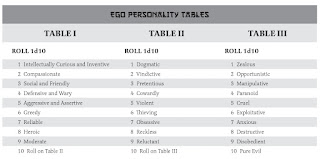
In my current campaign using the Sons of Lady 87 sandbox, I am making a point of using the Bedrock App to create random NPCs as they come up. I realized though I would like to use some tables to help flesh out the NPC a bit. Over the course of the campaign I hope to put together a full list of tables that help me make a compete NPC as quickly and randomly as possible. Today I want to talk about something I was thinking about this past week, using the Ego Personality Table from the Wandering Heroes of Ogre Gate core book to roll an NPC's personality. 

The Ego Personality Table is somewhat obscure so it probably requires explanation. In Wandering heroes of Ogre Gate the default race for the setting is human. But the book provides four optional humanoid races for GMs and players who want more fantasy elements. One of these races are the Kithiri, who have up to six distinct personalities. Because their ego personalities can get thrown out of balance in times of stress, leading one to dominate, knowing the individual egos is important so we included an Ego Personality Table to be rolled during character creation. 

However, the Ego Personality Table can work well for NPCs too. You can see the table more closely here: 


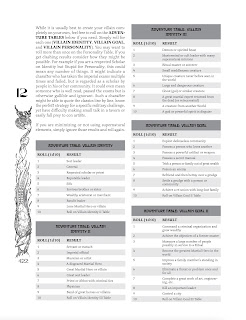
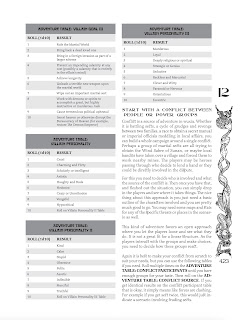
My plan in upcoming sessions is to roll on part I of this table anytime a random NPC comes up. When a real villain emerges though I will roll on the Villain portion of the Random Adventure Tables (I also plan on rolling on the random adventure tables but I anticipate needing to modify these for my Celestial Plume campaign to fit the gangster style). One alteration I am considering is having result 10 on TABLE III (pure evil) mean a roll on the Villain table itself: 

I don't always rely on Random tables in games, but I do like to employ them because they force me to introduce challenges, adventures, and characters I might normally steer away from. I think GMs develop favorite monsters, favorite NPC types, and so on. There isn't anything wrong with this. I love throwing Toad Demons at players for example. For some reason, I am just always inspired by that particular monster. But it is good to mix things up and for the GM to be surprised as well. 


Saturday, November 12, 2022

THE CELESTIAL PLUME MASTERS CAMPAIGN SESSION ONE

I am running a short campaign for Wandering Heroes of Ogre Gate where all the characters are members of the the Celestial Plume Masters, with one player being a Master in the group, and the others Disciples. The basic premise is they've been given freedom to head beyond the region controlled by Celestial Plume Masters, and expand the group's power and influence (and the celestial plume market) how they see fit. 

For this campaign I am not doing any prep, but using only material from the Sons of Lady 87 book (occasionally drawing on the other Ogre Gate Books when relevant) and using the Bedrock App anytime I need to improvise an NPC. I also plan to use what I call the random book approach. With this I just have a few key history books next to me and when I need an important detail, plot event, location, etc., I pick up the book that looks most appropriate then randomly open a page and find the first thing that is relevant and useable. As the campaign goes on, I may make some more tables to better facilitate the no-prep style. 
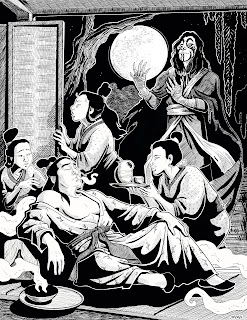
Before the campaign we established personal ties for the player characters. Each player was able to roll on the martial world personality tables to find a sect or person they were connected to in a way that is personally beneficial to them, but they also had to roll for someone with whom they had a more dramatic and tense relationship (and if at any point during the campaign they resolve that relationship, they gain a free level). The characters all started out with a grudge as well. These are listed in their entries below. 

I am using footnotes for information that isn't meant for the players my campaign. 

PLAYER CHARACTERS 

Wei Ziying: A skilled poisoner and physician, with ties to the Relentless Corpse Sect, Wei Ziying is a disciple of the Celestial Plume Masters. He also has a longstanding friendship with Kuo Qingzhao, who wishes to know more about the poisons that killed his wife (poisons Wei Ziying knows the secrets of). Grudge: Ravenous Nun Xuanji (for the murder of Red Eagle)

Wang Haoyang: A master of stealth, Wang Haoyang is one of the Celestial Plume Master disciples. He has a lifelong friendship with Pei Ye of the Vermillion Bird Teahouse, but has attracted the affection of another member of that organization, Fan Zhen'er (he does not return the affection but wishes to avoid creating friction within the Vermillion Bird Teahouse, and possibly creating enemies). Grudge: Guan Nuan (for a duel he escaped, she feels she lost face because he was weaker than her and should have been an easy victory)

Hei Ling: A one-eyed chief in the Celestial Plume Masters, Hei Ling is the father of Li Liang, whom he wishes to cease practicing her Toad Style kung fu because of the physical toll on her body. He had Li Liang with Qixia the candied fruit in his youth and since then Qixia has grown hostile. He has a working relationship with the Wu Sisters. Grudge: Qixia the Candied Fruit Vendor (of Hai'an). Grudge: Qixia (many reasons related to their pre-existing relationship)

SESSION ONE: NO LOOSE ENDS

Hei Ling decided that the Celestial Plume Masters were not doing enough to destroy the grip of the 87 Killers, so, without any order to do so, he concocted a plan to wipe out Lady 87's organization. They would attack and kill a high ranked member of the order, but put the blame on Demonic Venom Sect, creating a war between Lady 87 and a very powerful, but relatively low key, group in the region. 

The first step was to find medallions or regalia of the Demonic Venom Sect so they headed to Own Hill intending to sneak into the sect's headquarters. Hei Ling waited in Tie Cheng at the Owl Hill Inn while his men conducted the operation. 

On their way to the sect headquarters, Haoyang and Ziying had a chance encounter with 10 men from the Demonic Venom Sect. Most were low rank, and they were visibly hungry after returning from an arduous raid in the forest. Upon seeing the players they demanded food and any wealth the PCs carried. They both handed over all their rations and money, and convinced the men to let them leave. Ziying's rations are always poisoned, so they used abilities like Stealth of the Spider demon to hide and watch. Half the men consumed the poisoned rations, the other half consumed Haoyang's unpoisoned rations. As the first signs of illness hit half the men, Ziying surprised them with Venom of the Fly Whisk spraying more poison on the rest of the men. The effect of this poison wasn't death but made them physically ill enough to impose a -2d10 penalty on all their abilities (death would possibly come after about ten minutes). Within moments the players had dispatched them all easily and found two demonic venom sect medallions (they also found a camel bone inlay Pipa of fine quality, 10 of their ox tail swords and some golden taels. 

Meanwhile Hei Ling was at the Owl Hill Inn**** some miles away being served goat stew by the proprietors Sun Shaonan and Sun Shuxin (a brother and sister). However Sun Shuxin took a strange interest in Hei Ling and began asking him a series of questions (his name, his affiliations with sects, etc). Irritated he answered her questions but mentioned no sect affiliation, saying only he was from the Banyan. This made her angry and she accused him of being a liar. But a glare from Sun Shaonan calmed her temper and she sat down to apologize. A moment later, as Hei Ling was responding to her apology, she tried to use a palm strike on his chest, but he noticed the motion. Feeling she was weaker than him, he allowed her to make the attack with the intent of countering it. He caught her fingers between his chopsticks and threw tipped her to the ground. She departed in a huff, and Hei Ling began tasting his goat stew noticing a bitter flavor. Sensing Hei Ling's wincing eyes, Sun Shaonan rushed over and apologized for his sister's behavior, saying she is overly suspicious of people and lacks proper manners. He also politely said that the goat stew was not well prepared by the staff and he would bring him a fresh bowl (which Hei Ling agreed to). His second bowl tasted fine, he ate it, then retired to his room for the night, during which Haoyang and Ziying reported back to him about their success. 

They then gathered intelligence, learning that Brother 56 (Hua Yu) would be traveling to a meeting at the Fox Spirit Inn*. They planned an ambush for him on the road intending to attack him using the weapons of the Demonic Venom sect members, and leaving behind a medallion of the sect. As Hua Yu and 5 of his men approached with a large hand drawn cart, they took him by surprise. Wei Ziying killed the five men with his Flowing Stroke technique, then Wang Haoyang assailed Hua Yu with his Blade of the Dancing Fox technique, killing him. As the battle raged, Hei Ling noticed a flicker of light reflecting off a distant hill (he made a TN 10 Detect roll). He glanced at the hill and said to Wang Haoyang "No loose ends". Wang Haoyang obeyed and went to deal with the person on the hill. 

The hill was quite far and time was an issue, so for every Stealth of the Spider Demon roll he made (a technique that makes you unseen to enemies unless they make 2 consecutive Detect rolls), I also requested a survival roll. While it was unlikely, he failed the first roll. So I rolled on the encounter table and he happened upon a tiger. The tiger pounced but was unable to harm him, so Wang Haoyang stabbed it through the head and left it behind. However he also failed his second roll, and this time he came upon an encampment of constables and a sheriff. 

Leaning into Slapstick (GM Note): At this point, things got rather silly. Failing one roll and having an encounter with a tiger was already a lot, but then immediately bumping into a group of encamped constables, made it veer into near slap stick. I think your instinct as a GM is to fight this when it happens, but I find leaning into it is best because it can take the game in unexpected directions but also because this is, after all, a game. So the kind of excitement these unexpected encounters generate can be fun for everyone, the GM included. But it also forces radical shifts in tone you might not expect. And I think, even if something that has the potential to take a more serious game into zany territory emerges, it should be welcomed because those tone shifts really help mark out different events and moments. Whereas when it's all one tone, at least for me, everything blends together. 

Wang Haoyang stumbled into the clearing and the sheriff stood asking "why are you roaming the woods in a mask?" (Haoyang wore a mask as part of the disguise to put blame on Demonic Venom Sect). He replied that he wore the mask because he was hideously disfigured and ashamed of his own appearance. He asked the sheriff to forgive him for not revealing his face and explained he was just trying to reach the Fox Spirit Inn (which was nearby). This was a moment I felt required a Deception roll, because I was not sure how the Sheriff would respond to the lie (it seemed like a reasonable excuse but one that could land differently with different people). He made his roll and the Sheriff expressed sympathy for his situation, warned him to be careful because bandits had been seen in the area and pointed to the best trail for reaching the inn. 

Haoyang followed the trail then veered back on course to find the hill with the glint. However he also failed his roll on his Stealth of the Spider Demon (but this time made his Survival Roll). There he found a smoldering fire, a pot with tofu and a sack with iron ingots. He also found tracks which led to Fox Spirit Inn. Peering inside the inn he saw a number of patrons and a strange bald man with a robust beard sitting at a table with crates*. Haoyang scaled the wall and saw a woman in one of the rooms who he believed to be the person spying from the hill. He once again used his Blade of the Dancing Fox technique**, killing her fairly quickly. In her room he found a well crafted box and a backpack. 

Haoyang returned and Hei Ling instructed him to retrieve the tiger once he made his report. That night Hei Ling used the organs from the tiger to make a health elixir for his men (this boosted their Hardiness by 1 for 2 days)***. After feasting on the tiger meat they examined the contents of the backpack and found a painting, with no stamp and no words, that seemed to be a likeness of Hei Ling. In the box they found 30 candied fruits, which Hei Ling knew to come from his ex-lover Qixia the Candied Fruit Vendor. He told his men not to eat the candy then instructed them to prepare to make their way to Tung-On. 


*Hua Yu was going to Fox Spirit Inn to meet a rising figure in the martial world named Huo Lei. I randomly generated this character using the Bedrock App. His chief weapon came up as a Firelance so from that I decided he made heavy use of gunpowder and was meeting with Hua Yu to trade some to him in exchange for money and information. Later Haoyang would see Huo Lei inside the inn. 

**This is a good example of the evolving martial world approach I talk about in the books. He is using this technique because it is one of the most effective ones in the book, but as he does so word is going to spread and people will seek a means to counter it. The counter for this exists in one of the supplements. But a new counter could also be devised by someone who learns of his Blade of the Dancing Fox or who has an encounter with him and sees it in use (the latter should be more likely to lead to a counter because you know a character now has first hand knowledge of it). 

***This was an ad hoc thing, but seemed like a reasonable use of the animal's organs and the player's Medicine Skill (there was some discussion if Alchemy would be more appropriate but as this was more of a health elixir than anything transformative, we agreed Medicine worked: one of the other players had Alchemy so it was just a matter of who would make the roll anyways). 

****I rolled on the grudge encounter table at the start of the session and this event was prompted by that (but I decided to have the source of the grudge working through a nearby intermediary, who ended up being Sun Shuxin


Tuesday, November 8, 2022

THE WANDERING HEROES APP

For those who haven't seen this, there is an app, called the Bedrock App, that is a character generator for Wandering Heroes of Ogre Gate (it is also a Sertorius character generator and a database of kung fu techniques). This App was designed by Ryan Turner who is one of the designers of Wandering Heroes of Ogre Gate. He has also been in most of my campaigns and run his own, so he knows the system very well. That was all very useful for making the app as relevant as possible for the needs of players and GMs. 

The app is designed to make GMing and playing easier. I want to go over some of the features to show how useful it is. 

This is the main menu of the App. Using it you can open up the Kung Fu Techniques or Sertorius Spells data bases. And at the bottom right is the button for generating characters. 


If you click Wandering Heroes of Ogre Gate Kung Fu, it will take you to the a comprehensive list of Kung Fu Techniques (this includes all the techniques from every book, except for Sons of Lady 87; but those should be in there soon). 


You can see this provides a full alphabetical list of techniques. That is just the start of it, if you scroll down it reveals hundreds more. If you click on one of the entries, for example, Abbess Bao-Yu's Deflecting Strike, it shows you the description of the technique and it will also draw your attention to key requirements. 


There is also a pull down menu for Profound Techniques, Evil Techniques, Immortal Powers and Immortal Insights. 


But the one of the most useful features of the app is the character generator. If you select Characters on the Main Menu, you go to a page with a pull down option listing Sertori, Martial Heroes and Hybrids. The Martial Heroes button will take you to the page for making Wandering Heroes of Ogre Gate Characters. Sertori makes characters for Sertorius, and Hybrids makes characters that blend both systems (this last option is surprisingly useful). 


If you click the X button (marked with an arrow bow), it brings up the option to manually generate, to import or to randomly generate a character. Today I will do a randomly generated character. 


After you click generate randomly you can choose the Qi Rank of your character or NPC (this can be used to make profound and immortal level characters too). I am going to make a Qi Rank 2 character. 


It generated a character named Pei Hou, who is pretty well balanced across martial disciplines and is good at fighting with a stick (these are some of the best Kung Fu techniques in the game). 


And you can scroll down to see more information about the character. Here we see the character has Stunning Stick Strike for example, but other techniques as well like Finger of Supreme Disruption. 


And if you click on any of the kung fu techniques listed, it will show them just as it did from the data base section. 

As a GM my favorite feature is the copy stat block (which appears when you scroll to the bottom of the character). This copies the stat block so I can paste it into a word program, which is great for prepping adventures. Below is an unformatted stat block (all I did was put some carriage returns between sections to make it easier to read). 
For players this app is great because it makes character creation a breeze (Ogre Gate character creation can take time otherwise). It also makes it easy to store character information, level your character, etc. It also helps with tracking Kung Fu technique information. For GMs it makes prep so easy. Having the technique database right there is handy as well (as GMs have to juggle the techniques of NPCs), but I usually use it to make on the fly opponents for my players. It also stores all your characters. 

You can find the Bedrock App HERE. 


Monday, November 7, 2022

THE SOUNDS OF SONS OF LADY 87

Every time I work on a project, I put together a playlist to help keep my mind in the right space for the atmosphere and tone. Sometimes I post them here so people can use them in their own games if they want. I never listen to music while I write, but do listen to music before writing or when I am just thinking about ideas (I like to sit and think for periods of time between writing). 

Big Sister Hong Na (illustrated by Jackie Musto)
This is the playlist I used for the Sons of Lady 87 book. When I put together a playlist I'm usually looking for songs that address the themes and topics I am working on or, more importantly, have the emotional feel of what I want the book to be. For me, whether I am watching movies or reacting to music, I am most interested in the emotion it makes me feel. Musical genre or place of origin isn't a priority, I'll include pop, rock, heavy metal, music from any country, etc, all that matters is that the overall feel reflects the writing I want to do. 

This playlist has a pretty broad range. I was seeking music that felt like it belonged in a gangster, wuxia or heroic bloodshed movie and had a real moving quality to them or created a strong sense of tensions, longing and atmosphere. Because mobster movies were a big influence, there are songs in like Speak Softly, Love. But there is also stuff like Bjork (which was the theme I used for the Big Sister Hong Na character). The lyrics for Speak Softly, Love actually appear somewhere in the Sons of Lady 87 book but I won't reveal where.

The ordering of the tracks isn't especially important to me. I just play the playlist, sometimes shuffling it. But I placed a song by Pongsit first because I feel the mood of that song captures the Sons of Lady 87 best. Pongsit is a Thai musician with writes amazing songs, and has one of the most emotional and powerful voices I've heard (and he's just as good live). I can't speak very much Thai, but the lyrics have been explained to me as being about an assassin for hire who works for a mobster and is eventually told to kill someone he doesn't want to kill, so he turns his gun on the person who hired him. I may have the details off here, as I am just going by what I was told the song is about. 


Sunday, November 6, 2022

GUIDE TO OGRE GATE

With the release of Sons of Lady 87: an Ogre Gate Campaign, I thought it would be a good time to provide an overview of the Wandering Heroes of Ogre Gate system and setting landscape. 

The core book is Wandering Heroes of Ogre Gate. It is a wuxia rules system based on d10 dice pools, skills and a vast number of Kung Fu techniques. The core d10 mechanic is sleek and works pretty quickly too. You simply roll your pool, take the single highest result and compare it to the target number to see if you succeeded. Characters advance by gaining ranks in Qi, which happens when they meet certain thresholds for experience (i.e. finding or stealing a martial arts manual, fighting an opponent more powerful than themselves, growing their reputation, etc). It is set in a fantasy world inspired by Song Dynasty China. The book itself is 492 pages, with a large portion devoted to Kung Fu techniques and setting. It also includes sects, NPCs, everything you need to make a character and a sample adventure. There is also crucial GM advice, including guidance on using the Grudge Encounter system (which really helps emulate the feel of a jianghu setting). It is the only book you need to play Ogre Gate, and it is available as a pay-what-you-want HERE, and available in print HERE. 

The next most important book for the setting is Ogre Gate Inn and the Strange Land of Li Fan. This provides a full description of the client kingdom Li Fan, a host of sects, NPCs, maps (including Yao Gong Palace), a large adventure inspired by the Dragon Inn films, new Kung Fu techniques and monsters. The adventure takes up three chapter of the book and the book itself comes in at about 190 pages or so. There is a ton of adventure material to draw on in this one. It also has a bit more supernatural horror in it. Ogre Gate Inn and the Strange Land of Li Fan is available in print and in PDF. 

And of course there is the Sons of Lady 87 Campaign Book. This provides an overview of the imperial prefecture of Fan Xu. It also is focused on criminal organizations with an emphasis on the 87 Killers. It is available in PDF and will be available in print soon. 

The next two books are adventures. 

The first is The House of Paper Shadows. This one is a pure blend of wuxia and horror. It takes the players to the House of Paper Shadows, a mysterious organization in the Qi Xien setting, where they face all kinds of horrors and can be transported back in time to the dark events that created the House of Paper Shadows in the first place. The house of Paper Shadows is available in print and PDF and is100 pages. 

The next adventure is called Tournament of Daolu. This is just a fun book. It spans time and place as well, starting with an adventure in the southen wilderness, but culminating in a tournament in the city of Daolu, where the players may find themselves back in time meeting Sunan and Sun Mai. The city is well fleshed out, and the tournament is structured providing the GM with a clear way to manage elimination and competitors. The Tournament of Daolu is only available in PDF.

After that there is the sects of the martial world series, which has 6 entries. These are PDFs that each include one new sect. Presently they are: Maidens of the Jade Blue Sky, The Silken Robe Society, Crocodile Sect, Relentless Corpse Sect, Temple of the Jade Mercies, and The Glorious Death Cult. Each PDF is just 50 cents. 

In addition this blog contains a number of useful Ogre Gate books. The first is War of Swarming Beggars. This is a campaign and setting book that describes Hai'an, a land in the south that is still independent from the empire. You can find it HERE. There is some really great stuff in it in my opinion. Originally I was going to put it out as a print and PDF book but other projects became more important to prioritize. So this is pretty much a full module, it just hasn't been through the normal editing process and it has no art. 

The Blood Stained Roads of the Martial World was also meant to be a book, but it got sidelined as other projects vied for the pipeline. It is essentially an encounter book but the encounters are quite fleshed out. Think of it as one big encounter table with the encounters fully described. 

The Profound Masters is also on the blog. This goes into more depth with profound sects and abilities. 

Journey to the South provides a description of the lands south of Hai'an. This is pretty useful and includes my hand drawn map. I ran a number of campaigns that ventured into this territory so most of the stuff here comes from those sessions. 

There is also an official Ogre Gate novel called Legends of Ogre Gate, which describes the rise of the ancient heroes Sunan and Bao (important figured mentioned in the setting history of the core rulebook). This was written by Jeremy "Deathblade" Bai, who co-wrote Tournament of Daolu, Righteous Blood, Ruthless Blades and was a part of many of the early Wandering Heroes of Ogre Gate campaigns. At the time Jeremy was translating xianxia novels so he was able to bring that knowledge to the setting. It is a large book, at 808 pages with nearly 100 chapters. 

There are also two Ogre Gate adjacent books out there. The first is Strange Tales of Songling, which is a Bedrock Games book that was inspired by Strange Tales from a Chinese Studio and similar stories. I decided to make the game after I went through the penguin edition of Strange Tales of Songling (which is shorter than the multivolume sets) and did one entry on the blog for every story in the book. Each entry was Ogre Gate content inspired by that particular story. It was so much fun, I made a simplified version of the Ogre Gate system specifically for a setting inspired by Pu Songling's stories and similar anomaly accounts. Strange Tales of Songling is available in PDF and in print. 

Then there is Righteous Blood, Ruthless Blades published by Osprey Games. It is available in print and PDF. I co-designed this with Jeremy, and it is quite different from Ogre Gate, but uses the same core mechanics. Unlike Ogre Gate it is set in historical China and it is specifically emulating the wuxia style of Gu Long. I'm very proud of how this one came out. It really captures what we were going for. One thing I love about it is it does a great job of emulating the genre while still remaining highly gameable. Also where Ogre Gate is sect-focused, the Jianghu of RBRB is places greater priority on individual characters. There are still sects, of course but the emphasis was more on unique characters who populate the martial world and their relationships with one another.