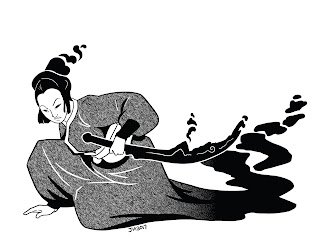
Showing posts with label WUXIA INSPIRATION. Show all posts

Saturday, June 27, 2026

MAINTAINING WUXIA CAMPAIGN LONGEVITY PART ONE

This is part of an ongoing series on long lasting wuxia campaigns (and a casual Saturday post while I recover from being sick). I have been running regular Wandering Heroes of Ogre Gate campaigns since we started work on them in 2014, and before that I ran a  number of wuxia campaigns using other systems. When we started work on Ogre Gate, one of my goals was long term play, and I tried to incorporate the things I had observed added to long term play. Here are key things that helped me. 

D&D-ISMS

While I would not compare Ogre Gate to Dungeons and Dragons, or claim it is an OSR game, it does have some D&D-isms. In general these were things I felt were shared by D&D and wuxia (like inns for example). I think it is important to get into because I often see online discussion about wuxia or horror campaigns dismiss D&D or D&Disms. But D&D is a great game and can work for genres like wuxia and horror (I've seen it work for years). Obviously there are system concerns people may have around emulation, and that is a topic unto itself which I might get into later (because I believe Ravenloft was a highly effective Gothic Horror campaign world using the D&D system). But today I just want to focus on features of D&D that can help add longevity to your campaign, not focus on system issues. 


D&D has a lot of features that lend themselves to long term campaign play. You have large tomes of monsters, pages of spells, magic items, etc. It also has concepts like the dungeon, wilderness exploration, random encounter tables, etc. It is a highly gameable approach to play, and I think one of the reasons D&D and its various iterations (whether they be official or clones) is something about its core ingredients and adventure structures, function well for week to week play. When I was working on Ogre Gate, while it wasn't a retroclone or d20 system, and in many ways the polar opposite of D&D, I made a point of not shying away from D&D-isms I felt contributed to healthy campaigns. I had run a number of wuxia campaigns using 1E and 3E Oriental Adventures for example and had noticed certain things lent themselves to long term play but also to reducing GM burnout in terms of how you prep. 

Having some fantastical elements definitely helps. And chief among these is monsters. That is one reason why Ogre Gate has a robust monster section. What having monsters in the setting allows for is a change of pace from human-centric play. Monsters are challenges, they can serve as the basis for an entire adventure. A haunted house for example, almost writes itself once you start with the monster. Anyone who follows my session logs probably sees most adventures are not about monsters, but they crop up from time to time. And I think this element of the setting breathes life into the campaigns. It makes it so it isn't always just about sects and feuds. While monsters are generally not common features of wuxia, there are exceptions, but this is one area where I think leaning into other source material like Pu Songling is helpful. One of the key moments of development for me with Ogre Gate was when I started intentionally using Pu Songling as inspiration for adventure ideas. 

Other elements of D&D are much more at home with the wuxia genre itself. Random encounters for example can help emulate a living martial world. Wilderness exploration certain fits with characters in wuxia stories going on long adventures, often to exotic and dangerous places. But my favorite D&D adjacent feature of wuxia is the dungeon. 

Everyone seems to understand that wuxia has a strong character driven element. Many efforts to emulate the wuxia genre, including my own, Wandering Heroes of Ogre Gate, put great emphasis on character and sect conflict and the drama that can flow from that. But I think people often tend to see wuxia as being less at home with dungeons or classic adventure structures you might find in traditional RPGs like D&D. One thing I tried to do with Wandering Heroes of Ogre Gate was embrace tried and true approaches alongside the more character driven approach. Wuxia often features things like love triangles, sect politics and stories about torn loyalties. But it is also an adventure genre. Even melodramatic wuxia films like The Thundering Sword, have plenty of adventure tropes like the aforementioned Thundering Sword and a trapped tomb where said sword is located. 

Dungeons are perfectly at home in wuxia. Whether it is finding a manual in the tomb of an ancient master, or a complex that is part of a sect headquarters, dungeon exploration adds another dimension of play to your wuxia campaign and helps produce a more robust martial world. 

WEEKLY PLAY

As much as possible, I think weekly play is one key to successful long term campaigns. Life can be challenging, so sometimes sessions have to get rescheduled, but overall I find a schedule of once a week, much better than once every other week or once every month, for maintaining the momentum of a campaign. 

THE CYCLE OF GRUDGES AND VIOLENCE 

This is incredibly important element of my long term campaigns. In wuxia characters are often motivated by a desire for revenge, grudges need to be settled. And these can span generations sometimes. Toward this end, Grudge tables are essential to my campaigns. 

Grudge tables have several ways they can work but the core idea is anytime the players kill an NPC, upset a sect or group, or even embarrass another martial hero, there is always the chance a grudge arises. Generally this should be up to the GMs judgement based on what he knows about the group or characters in question. Once it is established there is a grudge, they are put on a 2d10 table. As each grudge is handled, the grudges move position. The GM then rolls regularly before play to see if a grudge encounter happens that session (and encounter tables have entries for Grudge Encounters as well so they can come up during a random encounter as well). 

Grudges give the game focus. Even if the players are meandering or not following a clear path, a grudge introduces a problem they eventually have to deal with. And the GM can get quite creative with grudges. A grudge encounter can simply mean the players have a run in with the disciples of a rival sect or a specific person they have a grudge with. But sometimes sects and enemies hire assassins. And sending waves of increasingly colorful and skilled assassins when grudge come up is a fun way to liven up play (assassins are just enjoyable to make). 

They also give the game fuel. It draws the players into the cycle of violence in the martial world, which can often be quite endless. 

NOTE TAKING

If you don't take notes, long term campaigns are impossible to maintain. You need to know very basic things, like which NPCs are alive and dead, but also you have to track changes that have occurred to the setting as the campaign has gone on. 

I think note taking has other benefits for wuxia that might not be obvious. I've mentioned in this in previous discussions about 'pinning it down' but frequently in wuxia characters have encounters with random martial experts or thugs, and these are always stark characters of the martial world, people with signature kung fu and weapons, often strange personality quirks. Note taking skills can help you when you need to make NPCs like this on the fly. Through note taking I became very good at inventing techniques, weapons and overall personalities for groups of martial experts...all in the moment. So not taking helps your campaign not just by tracking what happened, but giving you a tool for instant prep when unexpected things come up. And when you write it down that makes it more objective than if you don't. 

RUN CHARACTER BASED CAMPAIGNS

My campaigns tend to be character based. Occasionally, when I am running shorter campaigns for horror RPGs, I may do more monster of the week style adventures, but when I am running Ogre Gate, I always start each session asking the players what they want to do, without any real plan of my own. I may have prepped details I knew were important, NPCs in the setting might be plotting or planning things of their own, but I am not working to fold what the players are doing into any of these things. My campaigns are about letting the players decide what they want to do, who they want to deal with, etc. There is always a back and forth as things go, so if they piss off a sect, adventure might come to them in the form of a grudge, and if they grow their reputation, people may ask for their services, but there is never any obligation for the players to do so. And the adventures they go on just flow from what happens. I don't think in terms of paths or needing to pace things a certain way. That means things never go off the rails, but also that I never get overly burned out. Path adventures, and this is not a knock on them, take a lot of prep. Doing that week to week can burn you out (I know because I did it for years). But a more open character based approach, means you as the GM basically prepare like an hour between each session. You might work on more at your leisure, but that is mostly just world building stuff. It can be more prep before the campaign begins, but once things get started it's about treating the players, NPCs, sects, etc as live things in the setting: a living adventure. 

I don't think this is the only way to do things. But it is a way that has consistently worked well for me. 

PARTING THOUGHTS

As I said, this is what worked for me. I find everyone has a different idea of what wuxia should be at their game table. Not everyone is going to want monsters in a wuxia campaign for example (and if you don't, but like Ogre Gate, you can just push monsters to the side or try the grittier Righteous Blood Ruthless Blades system I co-wrote with Jeremy Bai). What I have learned though is deal with the table have before you. Worry about your game table, what makes things work for you, and make the wuxia campaign you want to make (don't make a wuxia campaign to impress someone on the internet you don't even game with). I will try to get back to this topic in the near future. 

In the meantime, if you found this post helpful, check out my Wuxia Sandbox posts HERE


Saturday, June 20, 2026

THE STAR-CROSSED BLADES OF THE GREEN PEONY SESSION VIII

This is the Eighth session of our Star-Crossed Blades of the Green Peony campaign for Wandering Heroes of Ogre Gate (session I can be found HERE, session II can be found HERE, session III can be found HERE, session IV can be found HERE, Session V can be found HERE, session VI can be found HERE, Session VII can be found HERE). It is set in Zhang Chang prefecture (which I hope to release a blog entry for). In this campaign, every player rolled randomly to determine who their family are, how many siblings they have and whether individual family members are still alive. The players also gave very rough sketches of their background (no more than a few sentences) and I secretly added a "20-year" backstory to each one. I have implemented a special rule in this campaign that every encounter has a 3 in 10 chance of being connected to their secret backstory in some way. Note in this session I was play testing a specific scenario and the players were made aware prior to play.

CHARACTERS

QI YUN: A roaming martial expert who has secretly learned his martial arts from two different masters (and the masters have no knowledge of one another). 

XING GE: A traveling pipa player and the son of Lu Guiying the Iron Flower. His father died when he was five, and his mother married Gongsun Yuan, the chief of Black Parrot Society. Gongsun Yuan despises Xing Ge. 

TU JIN SHI (THUNDER LEGS): A wandering fighter seeking to be the strongest and most upright hero in the region. His father, Tu Haitao sent his mother away when he was young, after being consumed by grief over the passing of Jin Shi's brother, Tian. Shortly after his father died consuming a lethal concoction in a misguided effort to become immortal. 

LU LI (THE UNFILIAL ARCHER): A traveling physician who comes from a family of successful fishermen. 


THUNDER LEGS 

The party continued toward their destination and, after a brief encounter with a constable patrol, came upon disciples of Huo Long Cavern sect, all armed with butterfly swords. The head disciple, who announced himself as Wan Di, demanded they hand over Xing Ge.

"Why should we hand over our companion to you?" Asked Qi Yun.

"He is an enemy of Lady Yi Huang, and the son of the vile, disgusting Gongsun Yuan. You must hand him over!" Said Wan Di.

"He is not the son of Gongsun Yuan," Said Tu Jin Shi.

"This is true," Said Lu Li. "We can confirm there is no blood relationship between them. 

"I do not care if he is related by blood. Do you deny that he is the Iron Flowers son? And that Gongsun Yuan is his stepfather? He does the work of the Black Parrot Society."

"You are mistaken that he is working for the Black Parrot Society," Said Tu Jin Shi. "While they may technically be his family, they are our enemies. They sent an assassin against us recently and we killed him. We plan to address this matter when we can but we're not just going to hand over our friend to you."

"Then you will have to forgive us if we seem ruthless!" Said Wan Di. 

Qi Yun taunted them by reading a passage from the record he had been keeping of the party's exploits*. 

Wan Di strode up to Tu Jin Shu and and made a potent stab, but his target used Weapon Stride to land on his blade and deliver an attack of his own. 

Qi Yun leapt into the trees, using his Tree Bounding Strike technique to bend and slam the trees upon the other six disciples. Four of them whirled away from the attack but two were hit. 

Leaping into the air, Tu Jin Shi used Kick of the Chaos Star to deliver several attacks to the disciples, knocking out four of them. The two left standing ran away. But Tu Jin Shin said he would keep fighting them if they fled, so they froze. 

When Wan Di realized his men were defeated and that two had tried to flee, he acknowledged that the party had won and began backing off. 

"This isn't over Thunder Legs!" The man shouted. 

"You really need to learn to make your own judgements and not listen blindly to other peoples' words. Even I know this, and I am an idiot!" Said Tu Jin Shi. 

RETURNING LADY WANG PENG TO YUE MANOR 

The men departed and the party went on their way, continuing to Xi An. After an an uneventful encounter with more constables, who seemed to be checking what goods people were transporting, they eventually reached Yue Manor and were received by Wang Shan who thanked them for escorting his wife, Wang Peng. They explained why it took them so long and he was untroubled, even grateful. He gave them each a gift. To Tu Jin Shi, he gave a saber with a jade hilt. Qi Yun he gifted a parasol with a beautiful depiction of Supreme Judge Yu on the surface. Xing Ge he presented a pipa made from rare wood, with ivory and onyx inlays. Lu Li was given a bow with fine carvings of deer and wolves. He then said they were welcome at Yue Manor any time. 

NORTH TO FACE GOLDEN MONKEY

The party headed north, to make Tu Jin Shi's appointed duel with Golden Monkey in Niaojing, but along the way they stopped at Clearwater Lake to see his master. As they traveled Qi Yun saw a Zhen Bird following them in the sky, and recognized it as Red Beak, his master, Jade Priestesses pet. When they reached clear water lake, he left the group and found Jade Priestess near a tree. 

She asked about his travels and was pleased by what he told her. Then she said "I want you to befriend Prefect Diao Yue. He has agents all over the prefecture and you should be able to find a channel to communicate with him through them."

She didn't explain any further, but Qi Yun indicated he would obey. Before he left, she instructed him in Life Stealing Blue Claw technique, informing him the technique required sacrifices to the Five Ghosts. 

At Clearwater Lake, Tu Jin Shi found his master, Lady Jade, still wearing a mask. He showed her his new saber and told her about their exploits. She trained him in a technique called Cleaving Sabre and was pleased by his mastery of it within a short time. Tu Jin Shi, discerned something like pride in there demeanor**. However she said the saber looked unfamiliar in his hands and that he should spend time making the weapon an extension of his body.  

The group headed towards Niaojing, but when Lu Li realized his hometown, North River Village was along the way, he decided to stop in and check on his younger siblings (the eldest was 17 but the youngest was only nine and he wanted to make sure they were okay as his parents had been abducted by Black Leopard Villa some time ago). 

They found the children were being watched by the oldest woman in the village, Gu Jing. Lu Li explained what had happened with his parents, and the woman rebuked him, spitting on the floor and calling him Unfilial. She said he should have gone and saved them. The party tried to explain that it was not possible to do so and they needed to make preparations to face the organization. Qi Yun even read passages from one of his books that painted Lu Li's conduct in purely heroic terms. She left in disgust and began telling the other villagers what happened***.

The second brother, Lu Lin, grabbed a rusty sword and stormed off to save his parents but the party obstructed him. Eventually he was convinced it would be too dangerous, but they taught him some kung fu and told him to practice so he could help when the time came. Lu Lin tried to kowtow to the whole party as his masters but they refused. However, Lu Li decided to take Lu Lin and his other siblings (Lu Yun, Lu Yi, and Lu Linfung) with him to watch Tu Jin Shi's match with Golden Monkey. 

When they reached Niaojing they found Singing Scholar Gao, and paid for information about Thundering Scorpion. They found out that it was unclear whether Thundering Scorpion was a reformed bandit or still up to his old ways. But he told them another man, White Scorpion, might be sullying his reputation deliberately. They also found out that the merchant who hired them to deal with Thundering Scorpion had ties to the criminal underworld. 

Before the match, Lu Li spent time mastering a technique called Burning Beetle's Airborne Oppression. Qi Yun mastered Life Stealing Blue Claw. 

At the Crystal Teahouse, Golden Monkey and Tu Jin Shi had a rematch. Confident, Golden Monkey let Tu Jin Shi have the first strike. He used his new Turtle Snaps its Jaws technique, clamping his hands loudly against Golden Monkey's ears. 

"You have gotten better," Said Golden Monkey. "Now I won't hold back!"

He leapt into the air with a spinning elbow and was surprised when Tu Jin Shi countered with Guiding the Crashing wave, throwing him with tremendous force to the floor. Tu Jin Shi then launched an attack with Cleave of the Sabre, but missed due to his lack of familiarity with the weapon. 

Lu Li and Qi Yun could see that Golden Monkey was nervous as he spin into another elbow attack, crashing sharply against Tu Jin Shi's forehead. While he could easily have killed him, he controlled his power and merely knocked Tu Jin Shi out. 

Again, Lu Li and Qi Yun could see a look of relief on Golden Monkey's face. When Tu Jin Shi came too, he asked if they could fight again in a month. 

"No," Golden Monkey said, his lack of confidence clear to Tu Jin Shi's companions. "I think you need more time to recover. I gave you a good trashing. We better make it six months from now."

This is where the session ended. 


*Qi Yun has been keeping 'double books' of their travels, one is more truthful, the other paints everything they have done as heroic 

**This was the product of an Empathy roll. He didn't specifically discern pride, but picked up on a swell of emotion which was interpreted that way due to context. 

***At this point in the campaign, people began calling Lu Li The Unfilial Archer. Characters can pick their own martial nicknames at character creation or they can emerge over the course of the campaign. We opted to have this arise out of campaign events. Their exploits are significant enough that people know who they are and will start using nicknames to refer to them. 


Monday, June 8, 2026

GAMEMASTERING WUXIA: LETHALITY AND BALANCE IN OGRE GATE AND RBRB

Wandering Heroes of Ogre Gate and Righteous Blood Ruthless Blades both take an approach to design that embraces lethality and kung fu techniques that vary considerably in power (even at the same Qi Rank). Balance is not the point of the techniques. This can be contrasted with the parent system, Sertorius, where balance was a goal (and many of our earlier games before that as well). The reason for this shift was two-fold. First, we wanted to emulate the carnage you see on screen in wuxia films like Golden Swallow and Killer Clans. Second, less balance proved more fun in playtest. This was something we initially realized when working on the the first Book of the Archon for Sertorius, where we created a spell expansion that had spells unrestricted by balance consideration. We found they made the game more exciting and when players were offered the balanced versus the unbalanced option, they almost always chose the unbalanced one. It is also much more emulative of the source material. In wuxia and kung fu movies and novels, there are spikes in power. Some characters are amazing, others are not. And we wanted to capture that. None of this is to say there isn't a kind of balance in the game, but for the most part, what balance exists arises organically in the setting and still largely unforgiving. 

Related to this is a central concept introduced in Ogre Gate: The Evolving or Changing Kung Fu Landscape. This is meant to reflect what you see so often in wuxia media: the martial world going through periods of chaos and disruption then returning to equilibrium as new Kung Fu emerges to contend with powerful techniques that upset the balance. Here is the text from the core book:

And I clarified this point further in the Sons of Lady 87 Book here: 

A perfect example of this in the books, and in my own campaigns, is the technique Blade of the Dancing Fox. This was very powerful and players quickly discovered how useful it was. When it first emerged, and started to become known in the campaign, not only did several players start taking it, they soon found NPCs were emerging who knew it as well. This is one way balance can be achieved (a technique simply becomes more ubiquitous as its fame grows and sects covet it). But eventually someone devised a counter: Swift Reply of the Fox (this technique appears in War of Swarming Beggars). Usually that is what begins to occur. The martial world evolves over time, so that there is a natural balance in the world. This doesn't mean characters don't get killed by super powerful technique or some characters don't have better techniques than others, but it means eventually even the most powerful hero with a great technique like Blade of the Dancing Fox, eventually meets their match or eventually the presence of their power alone attracts enemies in larger numbers (whether it is heroic sects uniting to deal with a threat, or challengers seeking to prove they can beat the most powerful people in the martial world). 

As you can see this is crucial to managing powerful techniques in the game. And this is meant to emulate something that happens in both wuxia and Kung Fu: a powerful martial arts technique or weapon is introduced that rocks the martial world by creating a huge power imbalance, but eventually a solution arises to nullify or counter the technique. For this to work the GM needs to understand this principle and be open to new techniques emerging from player characters and NPCs in response. 

Another thing the GM should keep in mind is the sects and NPCs. Many of the more powerful Kung Fu techniques belong to equally powerful sects. So even acquiring them, puts a player character in danger, and using them once acquired can attract the attention of the sect. This doesn't mean the GM is meant to simply spam problems at a player because they have a good technique, but it highlights an important aspect of power in the martial world: everything has consequences and power itself can become its own headache. This by the way was an aspect of Sertorius as well. Players becoming powerful is not really a problem. It can be fun, even its own source of adventure. But the GM needs to understand how it produces complications, as those complications will be things that become a focus in the campaign. 

Characters in wuxia and kung fu films are not always equal in power, some are very weak, some are very strong, and while sometimes this is due simply to the point in training a character is at, often it boils down to individual martial arts techniques being much better or worse than others. The game also doesn't assume or guarantee that characters become great heroes of martial artists. That is often what protagonists in wuxia are, but my approach has been more to emulate the world of Condor Heroes or Heroes Shed no Tears, not the plot lines. One of the things I enjoy about playing is finding out who the players are over the course of the campaign. Do they become one of the greats like Guo Jing, a villain, or simply someone who dies, perhaps giving others reason to get revenge? 

While both games lean into drama, neither leans into story structure, so what this brings in terms of emulation is not a guarantee that your character will survive as a hero or survive to die spectacularly at the end. It does mean, because death is on the table, there are ample opportunities for drama. Death almost always produces drama. A good way to think of it is you never really know who or where you are in the story. You could just be a bit player meant to die under a henchman's sword, and that might launch the real story of your brother coming for revenge. It isn't about story structure it is about situations, drama, bloodshed, etc. 

Take the Venom Mob film Crippled Avengers as an example. At the start of this movie, the entire party of characters is maimed in some way. One is deafened, the other blinded, another has his legs cut off, and one is even made into an idiot when they crush his head in a vice. This all happens at the start of the movie. It is essentially a TPK with an asterisk. And it launches the heroes on their path to training around their new disabilities so they can confront the father and son who maimed them. That is how lethality operates in a Wandering Heroes of Ogre Gate or Righteous Blood Ruthless Blades campaign (particularly the later where maiming is probably more common). Now there is no guarantee they will survive, this is very much a play to find out what happens kind of system. But whatever it is, it will be a solid evening of swordplay. It is also why back-up characters are crucial. 

Generally Wandering Heroes of Ogre Gate is more forgiving than Righteous Blood Ruthless Blades, because it is a bit easier for players to gauge how many more hits they can take in a given fight, but this isn't always the case. Character deaths happen for all kinds of reasons in campaigns and this is something built into the game's design. I am not personally a fan of giving PCs plot armor, and that is something that has been constant in all our games (whether it is Terror Network, Servants of Gaius or Wandering Heroes of Ogre Gate). Sometimes that means characters meet anti-climactic ends because the system is not loaded for only dramatic outcomes in that respect and the GM is not supposed to tip the scales. You are playing to discover what happens, which I think is more exciting and also acknowledges that this is a game using random dice rolls. Fighting against random dice to achieve story goals can be a terrible exercise in frustration for all. 

There is another element that these games embrace, particularly Ogre Gate, which is some of the gonzo quality in many wuxia. Everything in wuxia feels heightened, the characters, the battles, the situations, etc. Some movies and books leans into this in a very heavy way, like Web of Death or Holy Flame of the Martial World, and those influences are certainly there. But it is also present in more typical examples like The Condor Heroes trilogy or Smiling Proud Wanderer. Or take some of the film versions, like Swordsman II* or Brave Archer Series. One of the things that makes these films so exciting is how wild and inventive they are, and the kind of plot turns they lean into. 

Something I discovered taking this approach from the early playtests to now (with Ogre Gate in particular as that is the primary system I run week to week), is this really lends itself to long term campaigns. And making long-term, sustainable, wuxia campaigns was a major goal from the outset. When you get out of the mindset of plot armor and hinging the story on a single character, even if their stories are important while they live, it opens the game up to more durable sources of fuel and attention. A total party kill for example is not the end of the campaign, it is a great beginning. An important character dying, can mean an exciting new direction for the campaign. A character obtaining an overpowered technique puts them at the center of conflict in the martial world, the adventures start to write themselves as other clans seek to deal with that person. Characters who find themselves weak or feeble, have solid motivation for finding a solution to that weakness. They may seek out a powerful technique/weapon or die trying. When you combine this with many of the other classic elements I have discussed before (sect conflict, wuxia dungeons, etc) it has given me campaigns that last for years. 

I will talk more about Gamemastering wuxia campaigns future posts based on my own play at the table. Feel free to send me a message or comment about something you would like to see me discuss.


*By part III of this series the movies deviate wildly from the books, so I mention this one as it is well regarded by many fans because it was marketed in the west as a stand alone movie under titles like The Legend of the Swordsman. 


Thursday, June 4, 2026

THE ANGRY RIVER REVIEW

Released in 1971 The Angry River is directed by Huang Feng and stars Angela Mao. It is about a woman whose father is poisoned by the Moon Cult's Seven Deadly Thorn. To save him she must travel far across the Angry River, into a dangerous valley where the only remedy, Ganoderma Atrum, is protected. She faces the temple's guardians and discovers to leave the temple to bring her father the cure she must let the guardians disable her Kung Fu. What unfolds is a story of a martial hero, stripped of her powers, braving a long journey home, while in possession of a highly prized herb that not only cures the Seven Deadly Thorn poison, but increases a person's martial abilities. By making the hero so vulnerable for such a long duration of the film, we see how strong her will and character truly are. It also reveals the virtue and vice of everyone else around her. 

Huang Feng made several Angela Mao films, including Lady Whirlwind (1972), Hapkido (1972), The Tournament (1974) and When Taekwondo Strikes (just to name a few). And he directed The Crimson Charm (1971), which I reviewed HERE. The others I have covered on the podcast, and I recommend all but would single out Hapkido as my favorite. 

Angela Mao is known to all I am sure, but for those who haven't seen her movies, she brings real martial arts to the screen and is well known for her kicks. Her movies don't always get the level of quality her talents deserve but as a former Taekwondo practitioner myself, I adore her kicking and the overall explosiveness of her martial arts. The Angry River isn't a kung fu movie though, so this is not the kind of performance we see from her in When Taekwondo Strikes or Hapkido. It is closer to a movie like Broken Oath (1977) or The Invincible Eight (1971). 

There is some confusion over whether this is the first Golden Harvest movie or not, as the title also seems to be taken by The Invincible Eight. Similarly there is confusion over whether this is Angela Mao's first role. It seems The Angry River was the first Golden Harvest production, but The Invincible Eight was released first. Also Angela Mao was in the The Eight Bandits in 1968, so it appears her first role was actually years earlier. 

The Angry River is an impressive film. It is a bit sharper than many other early Golden Harvest Movies, both in terms of visual presentation and in style (some of this could be due to the transfer being clear). It has one-foot firmly planted in that late 60s Shaw Brothers wuxia era, but still feels like a refreshing change. I think it is one of the their best efforts and sure to please anyone who loves the classic wuxia style, but is open to more fantasy elements. 

The music is great, it freely samples from On Her Majesty's Secret Service for wonderful effect for example. And the incidental music all adds to the mood. 

There are plenty of practical effects and some work great, others not so much. I rather enjoyed the giant lizard man in a rubber suit scene. It is what it is, but fun and surprising. But the rope crossing, which is essential because it takes place over the Angry River itself, was something of a disappointment. It looked like very shoddy blue screen (or something similar). 

The Angry River was an interesting threat. It wasn't entirely clear what its full nature was, but anything that fell into it, caught on fire. So that felt suitably dangerous. However it is less central to the plot than one might think from the title. More of an important threshold for the hero to cross. 

As mentioned this is a movie where the heroine loses her kung fu. That is a genre staple, though it is more typical for side characters to be the recipients of this fate. Here it works, and reminded me of a later film, Superman II. I loved it for many of the same reasons I enjoyed that movie as a kid. I won't spoil anything, but I will say when she loses her powers she is told if things get too disastrous, she can restore her Kung Fu and regain her powers by eating the Ganoderma Atrum. This would mean there would not be any left for her father, but it puts the possibility on the table of her regaining her abilities at some point. 

What is interesting is just how much loss of martial ability affects her. It does not only impacting her fighting. It affects her ability to endure the long journey itself, to ward off illness, etc. The film makes the point that Kung Fu is about more than just swords and fists, these characters are exceptional in all kinds of other ways, which explains why they can stand so easily outside of normal social convention sometimes. But here, she is suddenly vulnerable and often reliant on the good will of other heroes. We see this clearly in the contrast between her journey to the Angry River, which is fairly effortless, and the long, painful trek home. 

We also don't know who she can trust, because once it is known she is powerless and carrying this valuable and coveted herb, characters who once seemed righteous, suddenly behave differently. I found myself on the edge of my seat from set-ups as simple as her recovering at an inn after nearly dying from a long journey. Righteous heroes turn into vultures and any time she is resting, or weak from travel, I was worried someone would steal the herb from her. There is even a hero who almost rises to the level of love interest, and becomes her protector, but in the back of my mind, I wondered if he could be trusted. 

The fights are solid. This is an early Angela Mao film, and she only gets sharper with time, but here the performances work and the fight choreography, by Han Ying-Chieh and Sammo Hung work great. It is worth mentioning I discussed them in my review of The Invincible Eight as they served as martial arts directors for that movie too. And the fight with Pai Ying's King of Hell is awesome (in some ways it reminds me of his performance in Dragon Inn). The fight scene are are a little more old-fashioned than the later Golden Harvest movies, particularly post Bruce Lee films, but anyone familiar with late 60s Shaw Brothers action should enjoy this. 

This film looks great too. Not just in the filming itself, but the sets, the costumes. With the exception of the aforementioned rubber lizard man suit, everything looks stellar. I strongly recommend The Angry River. Not only is it notable as the first Golden Harvest Production, it is an important Angela Mao film and has a unique take on the protagonist losing their martial arts, which allows it to tell a much different story. 

Monday, June 1, 2026

THE INVINCIBLE EIGHT REVIEW

The Invincible Eight is a 1971 Golden Harvest  wuxia film directed by Lo Wei. It stars Nora Miao, Tang Ching, Angela Mao, Paul Chang Chung, Lee Kwan, James Tin Chuen, Lydia Shum, Pai Ying, Patrick Tse Yin, and Han Ying-Chieh. It is about a group of eight revenge-seeking heroes whose fathers were killed by the corrupt and cruel General Hsiao. 

The movie was recently released in Blu-ray by 88 Films, which is the version I am using for this review. This appears to be Lo Wei's first Golden Harvest film, and possibly the first Golden Harvest release as well: there is some confusion over this which I will get into in my review of The Angry River (1971). But it seems The Angry River was the first to go into production and this was the first to see release. 

The Invincible Eight is built around a large ensemble cast. That can often go either way for me in wuxia. If things get too big and become more about events than the characters, that go south. But films like The Brave Archer trilogy (1977-1981) and The 14 Amazons (1972) are examples where I think it is handled well. Here the large cast works. It is never confusing, each person is clearly drawn and they function together like a proper troupe. And while there is a political element to the story, the movie doesn't get bogged down in court politics or larger events. The focus is on the characters and swordplay. The result is a solidly entertaining movie with great performances from an ensemble cast, thrilling action and memorable characters. 

Lo Wei is a great story teller in my opinion. And I like the way the film sinks into its location, and allows the story to emerge largely through pieces of backstory revealed in dialogue. Most of the movie is set at General Hsiao's fortress where the would be assassins are taken prisoner. There we also find two other people, Miss Chiang, the adopted daughter of the general, played by Nora Miao, and Hai Tao, played by Patrick Tse Yin. The latter is an adopted son of the general, and his number two, but as the story progresses we learn things are more complicated for both of them. 

Another element of Lo Wei films that stands out here is telling the story through action and alongside the action. The movie effectively begins with a sword fight, and from that point on, we get sword fight after sword fight, with rests in between where characters are introduced and developed. 

And the swordplay is all well choreographed by Han Ying-Chieh and Sammo Hung. Sammo Hung probably needs little introduction here as his name is widely known, but he often did martial arts direction while also serving as an actor in these early Golden Harvest films, including a number featuring Angela Mao. Han Ying-Chieh is not only a veteran actor whose face you have surely seen, but he is responsible for the fight choreography in films like Come Drink With Me (1966), Dragon Inn (1967), A Touch of Zen (1970), The Big Boss (1971), and Fist of Fury (1972). 

Both marital arts directors appear in this movie. Sammo Hung is one of the whip masters, but Han Ying-Chieh plays General Hsiao. The latter is a very smart choice as the General serves as the final boss and needs to sell a fight against eight heroes. Not only is Han Ying-Chieh a great fight choreographer, he looks dangerous and believable on screen. 

The secondary villain, Wan Shun, played by Pai Ying, is rather interesting. And here I am going to get into spoilers in order to talk about him, so I recommend viewing the film before reading this paragraph. While he is initially presented as one of a number of subordinates who the general trusts, it is revealed he is the mastermind behind the general's rise, and in private he speaks down to the general like he is the one truly in charge. It is not unlike Samuel L. Jackson's character in Django Unchained (2012). The shift in perception of his power is even handled in a somewhat similar way and feels like a dangerous shift, because this mere lackey is suddenly shown to be so much more powerful than anticipated. 

For those not familiar with Pai Ying, he often plays antagonists, and was notably the Eunuch in Dragon Inn. He also played Hell King in The Angry River and folks might also recognize him from Royal Warriors (1986). He is genuinely frightening here. The man has a presence and an ability to radiate menace and power. While General Hsiao is the ultimate foe in the end, as he is the one the eight finally face off with, it is Pai Ying's Wan Shun who creates the greater sense of threat and unease through most of the movie. 

The Eight are all well cast. Everyone is good in their own way. Angela Mao really stood out with her Kuei Chien Chin, who dresses as a man to infiltrate the fortress. Something interesting here is everyone around her realizes she is a woman, and it is discussed behind her back, which adds a little twist to the trope. Nora Miao is also wonderful. She plays one of the more formidable characters as the general's adopted daughter, and I thought they captured her lightness martial arts nicely. She also just had the right look for the character. Tang Ching is always a solid performer and he works well here as Feng I Fei. He is skilled at portraying heroes with an emotional depth, often characters who seem haunted by their past or a burden of duty. Here he helps ground the film. And the man can brood while remaining stoic. For great examples see The Jade Raksha (1968) or The Black Enforcer (1972). Lee Kwan as a kind of hapless chef, who ultimately proves to have more grit than we first think, helped balance out the movie with light comedy. Lydia Shum, who plays the loud-mouthed Chiao Hsiu Hu, was memorable and also helped give the movie a more comedic tone from time to time. But her volatility and unpredictability also injects a sense of risk. None of the comedy overwhelms the seriousness of the story, it just added some contrast. James Tin Chuen plays a hot-tempered axe wielder whose fury pairs nicely with Lydia Shum's sharp tongue and temper. Paul Chang Chung brought level-headed gravitas to the movie as Swordsman Ho. 

Something gamers might appreciate about The Invincible Eight is the way the heroes deal with the whip masters at the general's fortress. The whips prove to be a formidable weapon and in order to counter it, they create special shears with a pair of duel-wielded swords. But because there are eight of them, they need 16 blades in total, which they have to take time to forge. This felt like something that would arise organically in a wuxia campaign. 

I give this movie an enthusiastic recommendation. I think it has something for everyone. One element that is missing is a love story, but with such a big cast it would have been hard to give attention to that. This is very much about characters on a clear mission. Lo Wei is a highly consistent director who never disappoints me. I might recommend people first check out Vengeance of a Snowgirl (1971) or Fist of Fury (1972), but I think this is also a perfectly worthy point of entry, and a notable film in the Golden Harvest timeline. 


Friday, January 27, 2023

CELESTIAL PLUME MASTERS SESSION TEN

This was the tenth session of my Wandering Heroes of Ogre Gate wuxia sandbox campaign, the Celestial Plume Masters using the Sons of Lady 87 book, which was just released in print. You can see the first session HERE. You can see the Ninth session HERE

PLAYER CHARACTERS 

Wei Ziying: A skilled poisoner and physician, with ties to the Relentless Corpse Sect, Wei Ziying is a disciple of the Celestial Plume Masters. He also has a longstanding friendship with Kuo Qingzhao, who wishes to know more about the poisons that killed his wife (poisons Wei Ziying knows the secrets of). Grudge: Ravenous Nun Xuanji (for the murder of Red Eagle)

Wang Haoyang: A master of stealth, Wang Haoyang is one of the Celestial Plume Master disciples. He has a lifelong friendship with Pei Ye of the Vermillion Bird Teahouse, but has attracted the affection of another member of that organization, Fan Zhen'er (he does not return the affection but wishes to avoid creating friction within the Vermillion Bird Teahouse, and possibly creating enemies). Grudge: Guan Nuan (for a duel he escaped, she feels she lost face because he was weaker than her and should have been an easy victory)

Hei Ling: A one-eyed chief in the Celestial Plume Masters, Hei Ling is the father of Li Liang, whom he wishes to cease practicing her Toad Style kung fu because of the physical toll on her body. He had Li Liang with Qixia the candied fruit in his youth and since then Qixia has grown hostile. He has a working relationship with the Wu Sisters. Grudge: Qixia the Candied Fruit Vendor (of Hai'an). Grudge: Qixia (many reasons related to their pre-existing relationship)

Iron Tiger: The newest member of the party, sent by Night Thorn to help them expand. He has a longstanding friendship with Iron Beggar Sun Kang, whom he wants to leave his lap of luxury in the House of Flying Lanterns so he can train with the Nature Loving Monks and improve his Kung Fu. Iron Beggar in turn wants Iron Tiger to leave the Celestial Plume Masters. Grudge: Pei Ye (he murdered her favorite client, Golden Cobra). 

A DEAD MAN MAKES WEI ZIYING A RICH MAN 

Upon arrival in Tung-On they found Iron God Meng still training with venomous snakes and someone named Duo Na waiting for Wei Ziying in a partitioned area of the gambling hall. 

Duo Na was dressed in expensive robes and said he worked for Wei Ziying's friend Kuo Qingzhao of the Red Owl Society. He brought news that Kuo Qingzhao died in his sleep* and had bequeathed his wealth and his title of Chief of the Red Owl Society to Wei Ziying. 

Wei Ziying explained the situation and headed to the Red Owl headquarters to see the body and people in mourning (and to inspect his new residence). There he saw only hired mourners, and was himself the closest thing to a friend or loved one. While he observed the mourners, a strange woman surprised him and introduced herself as Fan Heng. She had a black sword and was dressed in Hai'anese fashion. As he led her to an audience chamber to speak privately he noticed an unnerving black mist emanating from beneath her robes.

Fan Heng by Jackie Musto 

She asked "You are the new chief of the Red Owl Society?"

"I am," Wei Ziying replied. 

Fan Heng asked "And you have inherited all the powers, responsibilities and obligations of the Red Owl Society, and all the promises it has made?"

"I have," he replied. 

"I represent an organization that he promised something very precious to: The Sword of Time. We gave him so much for this promise and have grown tired of waiting for him to make good. Now that he is dead, it is your responsibility."

"I will look into this matter and see what I can do for you," He said. 

"Kuo Qingzhao made a deal with us, and the price for breaking that deal is not small. You will obtain the Sword of Time."

"What is your organization?"

"I speak for Feng Yin of the House of Paper Shadows."***

Not knowing who the House of Paper Shadows were he thanked her and promised to do his best, then went to find out more about the situation. 

HEI LING TENDS TO BUSINESS 

Hei Ling tended to his treasury to inspect the money from Rong E'hua, then he sent a message to Jinsa asking Iron Tiger to procure the body of Qixia (Hei Ling's daughter Li Liang wanted to use the bones to make a handle for her weapon).  

He then decided to place Fan Zhen'er in charge of managing the Red Owl Society information network in their absence. 

WEI ZIYING FINDS THE SWORD OF TIME 

Going to Iron God Meng's he conveyed what he learned to Hei Ling, who then spoke with Iron God Meng and learned that the House of Paper Shadows was powerful, used dark magic, and not a force Wei Ziying could contend with. But he also was told that Yao Chaoyun of the Yao Family Pawn Broker Shop might have information on the sword. 

They went to the shop and found Yao Changyun, his wife, some hired muscle and a crying baby. They spoke with him about the sword of time and explained that Wei Ziying was the new chief of Red Owl Society. 

"Well I happen to have the Sword of Time, I had procured it for Mr. Kuo and was looking for another buyer when I heard he died but it seems I can sell it to you."

They asked how much and he told them 20,000 spades. They decided to make the purchase, as it would still be valuable as an antique even if it was fake. 

Wei Ziying brought it to Fan Heng, who inspected it and said it was a forgery. 

"How can I tell if it is a forgery or not?" He asked

"It is like looking at a sword through an opaque stone. You have two months to bring me the real Sword of Time." 

WORDS OF THE VERMILLION BIRD 

Hei Ling went to the Vermillion Bird Teahouse to pay Hua Yin her four hundred thousand spades and to see if she knew anything about the Sword of Time. Hua Yin accepted the payment graciously and agreed to the new terms (he would owe no more money or service, except the promise of finding her son). He asked about the Sword of Time and she told him she knew a thing or two about it. 

He asked if she knew where it was. 

"This information is valuable, more costly than your payment for Fan Zhen'er. At least twice as valuable as Fan Zhen'er," she said. 

Hei Ling agreed to pay her 800,000 spades for the information and she informed him that the Sword of Time was in the possession of Master Zhan at the Temple of Supreme Righteousness. She also warned him that Master Zhan was extremely powerful, beyond anything either of them had contended with, nearly an immortal. 

Hei Ling thanked her but left with grave concerns. On his way out Hua Yin said "As this is the sword of time, it is possible that the sword exists in two places, perhaps more, at once." 

NIGHT THORN

They decided to travel to Celestial Plume headquarters in River Village to pay tribute. On the way they discussed their options. They agreed things were grim that contending with either the House of Paper Shadows or Master Zhan seemed quite beyond their abilities. They hatched a plan to have Wei Ziying feign betrayal of the Celestial Plume Masters, so that he could worm his way into the 87 Killers. The goal would be to rise as quickly as possible and hope that when the House of Paper Shadows came for him, he could bend their wrath towards the entire 87 Killer sect. 

When they reached River Village they were greeted by Night Thorn but did not see their other master. He accepted their tribute and then listened to their plan. At first he was cautious saying that he worried the House of Paper Shadows might simply kill Wei Ziying in his sleep and do nothing to Lady 87 or her men. But they explained that just as Wei Ziying had inherited the promises made by Kuo Qingzhao, if he were to die Lady 87 would also inherit this responsibility**. Night Thorn decided that it was worth the risk once they explained, as it only seemed to sacrifice one person for the possibility of taking out the 87 killers entirely. He agreed to their plan.

They also suggested they could ambush the 87 Killers by having Wei Ziying feed information about the school in Jinsa, but have Iron Tiger and Emerald Cobra ambush them when they attack. He supported this idea as well. 

He then told Hei Ling to recruit more men and to form more alliances so they could bring a greater force against the 87 Killers. 


*Last session Wei Ziying performed the Wealth Attainment ritual and this is the fruit of that magic 

**This was just speculation on their part. 

***The proper name of the organization is the Society of Leather Shadows but she employed the colloquial term to get maximal intimidating effect: which didn't work initially because he did not know who they were. She also invoked Feng Yin, rather than the House of Paper Shadows nominal director, which I opted for because she was trying to be as intimidating as possible and Kuo Qingzhao was a member of the organization who would have known about Feng Yin. 


Sunday, January 22, 2023

ELIXIR CATASTROPHES

In my wuxia sandbox campaign using the Sons of Lady 87 book, one thing that has started to come up is the use of external alchemy to create transformative substances. These are very setting appropriate but present balance issues the more open I am as a GM in adjudicating their creation (and I like to be open to things the players try to do in game).

Transformative substances are one of the more interesting parts of play for me in Wandering Heroes of Ogre Gate. They can work in a variety of ways but basically use external alchemy to produce pills, elixirs, etc that can change things at a fundamental level. Usually the changes are temporary but can increase over time with regular use (there are some substances though that produce more long term effects). An example of a transformative substance is the Human Forming Essence, which can be used by animals, demons and other creatures to take human form. 

Recently one of the players has been using his Alchemy skill to produce a substance that improves the performance of his minions by radically accelerating cultivation (in mechanical terms his aim would basically increase Qi Ranks). 

The 1993 film Green Snake 

There is precedent for this in the system because I introduce a pill based on Monkey King's background in Journey to the West. This item is called the Heavenly Pill and there are extraordinary conditions surrounding its use, so that will be a very big natural limit should the player pursue making this substance. But this got me thinking about ways to introduce a table to use when players want to make a very powerful substance that could achieve great benefit but might be counterbalanced by some of its side effects (generally speaking I like to give transformative and longevity substances side effects). 

This table is meant to be used anytime a powerful transformative substance is created as its inherent drawback: 

Like the tables I shared the other day this one is still very preliminary. I will likely make some adjustments over the course of my Celestial Plume Masters campaign. 

I am still working with the player to determine what this might look like in the end (and not settle whether this table would apply to the substance he is attempting to discover). It will likely have heavy side effects or be temporary, granting an increase in Qi that goes away after a period of time and is followed by recovery (perhaps through lost Hardiness points). 


Saturday, June 23, 2018

THE ENCHANTRESS DISCUSSION

On the latest Wuxia Weekend podcast we talk about Chor Yuen's The Enchantress, a 1983 film that blends wuxia and ghosts to interesting effect. It is about a ghost named Shui Tianjiao, who was killed when her husband joined forces with her enemies in a sect war 18-years ago. Now she uses her daughter (born shortly before her death) to get revenge on the entire martial world. 

While everyone enjoyed the movie, opinions differed on how good it was. Most of us agreed the strength of the film was its atmosphere and ghostly special effects. The story is good when you understand it, but it could have used more screen time (with perhaps less screen time being dedicated to the near-30 minute final battle). Still it is a very nice mixture of supernatural and martial arts, where it fully commits to both. There are lots of characters, lots of fights, and some very interesting spooky moments. 

Unfortunately The Enchantress is difficult to obtain these days (I've only ever been able to find it on VCD). So if you want to watch it, you might have to search around for a good deal. We do recommend it if you like Chor Yuen and want to see his take on Ghosts and Wuxia together. However, if you are not as familiar with Chor Yuen, you might want to start with some of his other films like Death Duel, Web of Death, Magic Blade, Intimate Confessions of a Chinese Courtesan or Duel for Gold

Wednesday, September 6, 2017

GAMING STRANGE TALES FROM A CHINESE STUDIO 55-56: KING OF THE NINE MOUNTAINS AND THE FOX OF FENZHOU

I have been making NPCs, monsters and scenarios inspired by Pu Songling's Strange Tales from a Chinese Studio. For each entry I take two or more stories from the Penguin Edition translated by John Minford and make gameable material. You can see my previous entry HERE

Today I am doing King of the Nine Mountains (#55) and The Fox of Fenzhou (#56). 

King of the Nine Mountains is about a scholar official named Li who rents out his garden to an old man only to find he's invited a family of thousands of fox spirits into his home. He resolves to kill them and uses saltpeter and fire to burn the creatures. The old man is outraged and vows revenge for the deaths of his fellow foxes. Years later Li encounters a fortune teller who tells him he has the mandate of heaven, and offers to help him lead an army to take the throne. He wages a rebellion against the Empire with the help of the fortune teller (who becomes his marshal). In the end it turns out the marshal is the vengeful fox spirit, setting him up for a fall. 

The Fox of Fenzhou is another story about a fox spirit, but this time it falls in love an official named Zhu and the two have a relatively happy life together. However Zhu is promoted and then must go to mourn his mother when she dies. To reach his mother he must cross a river and it is explained that the fox is unable to cross bodies of water. It seems the lovers are going to have to part, when the fox is able to persuade the local river god to let her pass. 

I added in headers separating the content by story this time. That way it is easier to see where the ideas are coming from. This doesn't mean they are pure models of the material. In some cases I just took inspiration and went a different direction to fit it to the setting or make it more interesting. However with King of Nine Mountains, I made a direct translation into game mechanics. I simply decided to continue the Fox Marshal's tale beyond his initial revenge (which is what the story deals with) and turn him into a figure roaming the setting. 


THE KING OF NINE MOUNTAINS
THE FOX MARSHAL 
Not all Fox Spirits desire only to feed or to love, some have lost family and loved ones to the cruelty of man. When this happens they burn with a desire for vengeance and use their powers to wage war against humanity. The Fox Marshal is one such Fox Spirit. His entire family was killed by a wicked scholar named Li. Years ago, The Fox Marshal and his family of thousands had moved into a wing of Li's residence for 100 taels. Li discovered they were Foxes and burned the whole clan with hundreds of pounds of saltpetre. The Fox Marshal bided his time and returned to the man in the guise of an astrologer, claiming he was destined to rule the empire. He then raised an army of thousands and became Li's Marshal, all with the aim of abandoning Li as he was on the brink of victory. As a result all of Li's family perished by execution. 

Satisfied with his revenge, but still burning with rage, The Fox Marshal realized he still had an entire army at his command. Now he leads his group through the land, razing villages, conquering cities and basically doing whatever he can to inflict misery on humanity. He often remains in one conquered place for months, before growing bored and moving to the next target of his vengeance. 
Defenses: Hardiness 6, Evade 6, Parry 7, Stealth 7, Wits 9, Resolve 8
Key Skills: Bite: 3d10 (2d10 Damage), Arm Strike: 3d10 (5d10 Damage), Medium Melee: 3d10 or 2d10 with Ox Tail, Speed: 7d10, Detect: 5d10, Persuade: 4d10, Command: 3d10, Deception: 3d10, Endurance: 2d10, Muscle: 2d10, Empathy: 3d10, Trade (Architecture and Engineering): 3d10, Talent (Disguise): 2d10, Talent (Poetry): 2d10, Talent (Singing): 2d10, Talent (Theft): 2d10, Institutions (Military): 3d10, Classics (The 26 Stratagems of Jiang Laozi): 3d10, Read Script (Feishu): 3d10, Language (Daoyun): 3d10, Classics (The Book of Fortunes): 3d10
Max Wounds: 13
Equipment: Ox Tail Dao (4d10 Damage, -1d10 Accuracy)
Powers
Drain: Fox Marshal feeds by drinking the blood of his foes. He normally does this on the battlefield, where his soldiers find it an acceptable practice. Whenever he makes an Arm Strike roll, do Normal Damage plus drain 1 Hardiness. Anyone reduced to 0 is completely drained and dies. Every 100 people he completely drains, he gains 1 Max Wound. 

Misleading Voice: The Fox Marshal can convince men of his lies and earn their loyalty by saying what he believes they want to hear. This power can work on whole groups of men, even armies, at a time. To Convince People, make a Deception Roll against Wits. On a Success what he says seems obviously true to the target (s). 

Compelling Voice: He can also use his voice  to impel people to take action, but it only works on those with no cultivation (anyone with ranks in Qi is immune). Roll Command against Resolve. On a Success he can cause all affected to take a desired action in the next day. This could be anything from going to war to having a drink at the local wine shop.

Forms: The Fox Marshal can take human form, or the form of a Fox. He can also grow claws or teeth as needed for attacks. 

Houses of Splendor: Even in a small space, Fox Marshal can create intricate and comfortable living spaces. He can spring forth a whole miniature city with his mind. This enables him to provide luxurious accommodations for his men on the road. To do this he needs an enclosed space, such as a cave, a courtyard, a small glen. Then he can produce any accommodations he desires within the enclosure. To use this ability he must make a Trade (Architecture and Engineering) TN 7 Roll. 

Saltpetre Vulnerability: Fox Marshal is vulnerable to saltpetre. The substance does 1 Extra Wound when used in any attack against him. Any use of Divine Fire does 2 Extra Wounds against him. 

Kung Fu Techniques (Wiajia: 3, Neigong 1): Blade of the Dancing Fox, Blasting Blade, Breath of Fury, Blade Pinch (Counter), Whirling Dodge (Counter)


THE FOX'S ARMY (10,000)
Defenses: Hardiness 3, Evade 3, Parry 3, Stealth 6, Wits 6, Resolve 6
Key Skills: Grapple: 0d10, Throw: 0d10, Arm Strike: 0d10, Leg Strike: 0d10, Light Melee: 0d10, Medium Melee: 0d10, Heavy Melee: 1d10, Small Ranged: 0d10, Speed: 1d10, Muscle: 0d10
Max Wounds: 1

Weapons: Qiang (2d10 Damage or 0d10 Damage), Leather Lamellar (-1d10 Damage against blunt weapons)
THE FOX OF FENZHOU
TAN LAN THE GOD OF SOUTHERN FEI RIVER
Tan Lan is said to be a kindly old man who regales local orphans with his stories by the river. However in truth he is a greedy and avaricious river god. The orphans he speaks to, slowly turn into dragons as he tells his tales. He then sends them into the river to collect gold and treasure from hapless travelers. He can be kind when he wishes and will respond to offerings of wealth by keeping his waters calm, letting landbound fox spirits and other creatures pass, and providing ample water during drought. 


Defenses: Hardiness 10, Evade 8, Parry 8, Stealth 6, Wits 6, Resolve 10
Key Skills: Bite: 4d10 (6d10 Open Damage), Smash: 4d10 (4d10 plus 3 Extra Wounds*), Grapple: 5d10, Arm Strike: 6d10, Leg Strike: 4d10, Light Melee: 4d10, Medium Melee: 7d10, Speed: 4d10, Swim: 6d10, Fly: 3d10, Muscle: 5d10, Endurance: 4d10, Meditation: 4d10, Divination: 4d10, Persuade: 4d10, Detect: 3d10, Read Scripts (All): 3d10, Languages (All): 3d10, Religion (All): 2d10, Institutions (Bureaucracy of Heaven): 3d10, Talent (Poetry): 3d10, History (All): 3d10, Talent (Theft): 5d10

Qi: 30
Max Wounds: 61
Flaw: Greedy 

Key Kung Fu Techniques (Dianxue 3, Qingong 3):
Tan Lan knows all Dianxue and Qinggong Kung Fu Techniques
Profound Techniques: Celestial Seal, Great Transference, Ride the Cloud, Sleeves of Frost, Roar of the Dragon, Wave of Frost
Powers
Beast Strength (x40)
Bite: With his enormous jaws in Dragon form he can bite up to 8 targets at a time with a swooping attack, doing 6d10 Open Damage. 
Smash: His body can slam into buildings and crowds, covering a 150 foot long and 10 foot wide area. Roll 4d10 against Evade. On a Success anyone hit takes 4d10 plus 3 Extra Wounds. On a Total Success they take 6d10 plus 4 Extra Wounds. 
Immunity: Tan Lan can only be harmed by Kung Fu Techniques, Profound Kung Fu Techniques, and Immortal Powers. However, he can never be permanently killed (this requires a decree from the Enlightened Goddess). If he takes 61 Wounds he vanishes and reappears in one day in the Enlightened Goddesses’ Court.

Regeneration: Tan Lan regenerates 1 Wound every round.  
Control River: Tan Lan has complete control of the river. He can cause the waters to flow with great speed, increasing the Swim or Sail to TN 10 or lowering it to TN 1. He can also control local weather near the river, creating rain, wind or small storms. 
Transform Orphans to Dragons: Tan Lan takes pity on orphans and views them as his children. When he speaks to them, roll Persuade against Resolve. On a Success any orphan (no matter how old) turns into one of his Little Dragons forever. 
Change Form: Tan Lan can take the form of an old man or of a great river dragon. In his river dragon form he can bite with tremendous force and smash the land around him. 

TAN LAN'S LITTLE DRAGONS
Tan Lan's little dragons are easily mistaken for crocodiles but they are actually small dragons. They were once human orphans who were transformed by the river god into their present state. Now they roam the Southern Fei River in search of riches for Tan Lan. When they see anyone with wealth or valuables, they attack and steal them. 
Defenses: Hardiness 5, Evade 6, Parry 6, Stealth 6 (10 in water or forest), Wits 7, Resolve 6
Key Skills: Bite: 4d10 (Damage 4d10 Open), Claws: 3d10 (3d10 Damage), Tail: 2d10 (Damage 1d10 plus 1 Extra Wound), Swim/Fly: 4d10, Speed: 4d10, Muscle: 4d10, Detect: 3d10, Athletics: 4d10, History (All): 1d10, Meditation: 2d10, Divination: 2d10, Talent (Theft): 3d10
Max Wounds: 20
Equipment: Silver Spear (6d10 Damage, +2d10 Accuracy)**
Powers
Beast Strength (x2)

Flight: Little Dragons can move through the air like water.
Human Form: The Little Dragons can take human form. 
Kung Fu (Waijia 2, Qinggong 2): Spear Swipe, Tai Lan's Staff Strike, Flying Swan Kick, Graceful Retreat (Counter)
**In human Form

LANDBOUND FOXES
Landbound Foxes are usually affectionate and kind toward humans, draining them but not to the point of death. Therefore they are less out of favor with the gods. 


Defenses: Hardiness 3, Evade 6, Parry 7, Stealth 7, Wits 10, Resolve 7
Key Skills: Bite: 3d10 (2d10 Damage), Speed: 7d10, Detect: 5d10, Muscle: 1d10, Empathy: 3d10, Persuade: 4d10, Deception: 4d10, Knowledge and Talent (Any 4): 3d10, Divination: 3d10
Max Wounds: 10
Powers
Enervation: Landbound Foxes cultivate by draining ejaculate. If they do this at least once a month for a year, they gain 1 Max Wound. Each time they drain a person the target is temporarily drained of 1 Hardiness (returns at rate of 1 per week). The target must be willing. 

Enchanting Form: The true form of an Landbound Fox is a fox, but to most people they look like beautiful women. Anytime a person first sees the Landbound Fox, roll 4d10 against Wits. On a Success the target only sees a beautiful woman. On a failure the person sees a trace feature of the fox's real form (a bushy tail, yellow eyes, whiskers, etc). This is brief, as the Landbound Fox can roll 4d10 against Wits immediately to restore the illusion in the person's mind. Once an Landbound succeeds against a target, they will always see her as a beautiful woman unless they actively attempt to check for evidence to the contrary (in which case another roll is called for). 

Favored: Rituals and magic that normally affect Spirits and Demons suffer a -2d10 Penalty against Landbound Foxes. They also gain a +2d10 bonus to break out of any magical containment. 

Landbound: Landbound Foxes cannot cross bodies of water. Doing so instantly kills them. 

Petition: Landbound Foxes can use Divination to petition local deities for an audience.