
 Posts
Posts


For anyone in need of a quick adventure, I would point them to Head of the Teahouse which I put on the blog a couple of years ago, or to the four sample adventures in the rulebook. You can also check out The Starlit Inkstone, which is a small sandbox I put together for the game. For those who want to make original adventures but are having trouble, this section is provide some guidance. What follows is simply what has worked for me, so feel free to try it, but ultimately use what works for you.
Also a note on availability. The PDF is available HERE, while the print version can be found HERE (our PDFs and our print books are on different sites which has created some confusion on where to find the print editions).
What is Strange Tales of Songling?
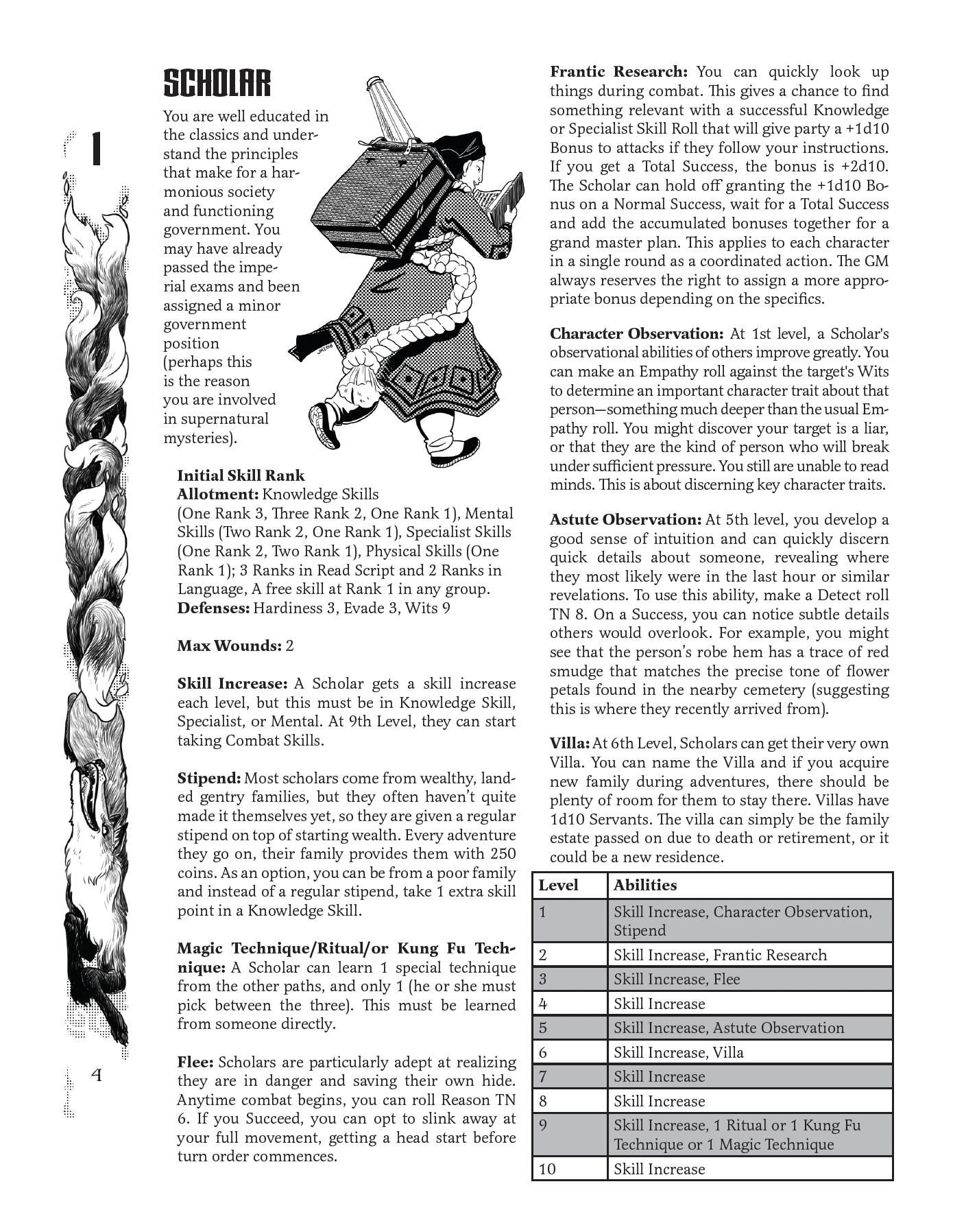
It is designed to be played as monster of the week. The game is packed with monsters and while each individual adventure allows for maximum freedom, for the purpose of making one shots and short term horror campaigns more feasible, it is assumed there will be an adventure that everyone buys into that evening. I sometimes called this approach a contained sandbox because it doesn't have any expectations beyond the starting point. The characters can spend the whole adventure running from the threat screaming or engaging all the elements, it doesn't matter. Generally it is meant to be played either as a one shot or as a 10 session campaign (and longer campaigns string together many ten session campaigns that are multi-generational).
Making Adventures for Strange Tales of Songling
I get asked a lot about making adventures for Strange Tales of Songling. I don't know why, it is not one of our better known games I believe, but when I hear from people, this is normally what they ask me. They also often express reluctance because they worry they don't know enough about the genre or history to run an adventure. I am going to address both these concerns here.
I
First on not knowing enough. I studied history in school and one thing I like to do with history is take a positive approach where people are encouraged to learn but aren't fearful of making mistakes. One of the worst ways I saw history taught was being overly critical, belittling people for their lack of knowledge or draining any enthusiasm they had by stealing their confidence and excitement. It is also a critical tendency I can fall into myself (especially if I am watching a movie for instance that has notable historical errors). With time I learned to relax more about this stuff and as a result, I became better at learning history. To be clear I am not an expert in history, I was merely a history student and continued to maintain an interest in history after I graduated.
This kind of thinking, especially with gaming, unless it is fueling your excitement and driving you to really dive deep into research, isn't necessarily good for getting a campaign off the ground nor is it good for developing interest in a topic.
Don't get me wrong, I think its good and important to learn history as well as you can, and to understand what you don't know, but I also think everyone comes to it at different experience levels and with different areas of knowledge. I generally read more history books than novels, but one thing that makes me keenly aware of is just how much I don't know (sometimes it is like the more you learn, the less you realize you understand about the depth of a topic).

It is also important to remember you don't need to position yourself as an expert to the group. This is something I hear a lot from people. They feel like they must be an expert in a topic to run a game around it. It is good to research, but I've also seen many people never start down the road of learning about a genre they had a budding interest in, because they were afraid of this. You are the GM, but you can be honest with your players about your level of knowledge. When I first started running classic horror games at 14, I knew only a fraction of what I came to know about the horror genre, gothic literature and classic horror movies that I came to know over the course of my campaigns. When I ran Call of Cthulhu for the first time, I had only just started reading Lovecraft. If you know about the genre and the topics that relate to it, then that's great, it will definitely give you a huge leg up. But there isn't anything wrong in my opinion with learning about a genre on the job (and running a campaign is a good way to learn history because you will be more curious as you read and you will have active questions that arise from the campaigns that you can take into your reading and give it better focus).
I mention all of this because Strange Tales of Songling is inspired by Chinese anomaly accounts and by its history. It sets things in a surreal dreamscape realm inspired by China, which is intended to make things easier for GMs, but it is also clearly taking inspiration from real history. Even in a fantasy analogue, GMs not well acquainted with the history, have expressed reluctance. So I encourage people to relax, understand they can learn while they are running the game, that they can draw on the knowledge of their players as well if they are worried about disrupting peoples suspension of disbelief by getting some cultural detail wrong. You'll get better as you go, you can work with your group together to support the campaigns overall foundation of knowledge.
All that said there are great resources out there if you do want to research more before starting. I always recommend reading survey books covering the period you are interested in emulating (so pick a dynasty for example and get a book that covers the history of that dynasty), reading a general survey book or a two volume survey book of Chinese history (so you can get the larger picture) and then read what you can about government, institutions, etc. If you are less of a reader, you can try documentaries.
Additionally you should read Strange Tales from a Chinese Studio. I would also suggest viewing the movies that Strange Tales from a Chinese Studio has inspired (films like A Chinese Ghost Story, Painted Skin, The Enchanting Ghost, etc). You can also watch movies like Legend of the Demon Cat, The Bride from Hell, and Legend of the Mountain. And there are more recent remakes of many of the above too. For example there is a 2011 version of A Chinese Ghost Story, and there is even a 2020 version I believe (I haven't seen the 2020 version but have heard about it). In addition the original A Chinese Ghost Story has 2 sequels which are both great. In Strange Tales of Songling I provide a more in depth list of films, but you can probably find many more possibilities doing searches for Chinese horror online and by looking up lists of media inspired by Strange Tales from a Chinese Studio. Some films are hard to find copies of or for rent in digital form (it took me forever to obtain The Enchanting Ghost for instance). It also looks like streaming services are getting more of this content.
II
The basic way I made adventures for most of my Strange Tales of Songling campaigns was to read an anomaly account (this could be from Strange Tales from a Chinese Studio or from another writer), then use that anomaly account as inspiration for an adventure. The reason I do this is because when I originally started reading Pu Songling's Strange Tales from a Chinese studio to find inspiration in my Ogre Gate campaigns, I noticed that each story worked so well for generating a supernatural adventure idea. They are the perfect length (most aren't too long) and they are more interested in describing the strange and conveying a concept than in telling a story with a clear structure (some do have a structure but some just describe an unusual occurrence).
I got more mileage out of Pu Songling's stories than any other single source, and that is why I wanted to write Strange Tales of Songling. They just work well for helping the GM come up with adventure ideas. It isn't necessarily a 1-1 translation from the anomaly account to the adventure, but they serve as excellent starting points. In each one you are going to find something, whether it is strange magical item, a place, a monster, a villain or scenario.

Once I read the story I took about twenty or thirty minutes to think about it and shape it into something gameable. I intentionally started reading one story a few hours before a session to force myself to come up with adventure content before the games. What I found happened is either the story presented the perfect monster for an adventure as written, or it sparked an idea for a monster or situation.
As one example, when I read the story The Monster in the Buckwheat, it gave me the idea for Physician Jixian, in the Starlit Inkstone, who transformed his wife into a creature resembling the one from the story, that haunts the fields around his house to protect him.
Because this is monster of the week, try to read with the aim of finding a villain or monster. The story itself might not have a monster. For example, there is a story about a man who becomes obsessed with a rock, and it is only vaguely supernatural by the end. But it gave me the idea for an adventure for Ogre Gate where a man was in love with a spirited stone and it led to this scenario.
Other times I would read one story, get inspiration from one or two elements, then read another and combine them. You can also do this with other media, for example watching something like Black Magic and weave that into a Pu Songling account.
Another approach is to simply start with a monster from the Strange Tales of Songling book. A good piece of advice for adventures, but especially horror adventures is: start with the villain. If you find a monster that inspires you, then already have half of what you need for an adventure. It is just a matter of creating a scenario around that monster. And as with combining Pu Songling stories, you can combine monsters in a scenario.
Once you have your monster you can flesh out a backstory, which shouldn't be too long but should inform everything else. You will probably grow a small cast of NPCs by doing this. Not every adventure has the same number of characters but usually there are other people involved which will help make for a more interesting session. You might want to strive for simplicity though with your first session: i.e. a small village or temple with a monster that has been contained for centuries but recently unleashed by some fools actions.

One thing you might want to do, especially if you are overwhelmed by cultural details and feel like you don't have enough information to bring your scenario to life, is focus on one mundane aspect of the time period. For example, you could read about apothecary shops and just learn the details that you can about those. That way you are not trying to bring everything into the adventure and you aren't researching dozens of topics.
A good way to find topics is in survey books. Usually there will be section on daily life and in those sections starting points for things you might want to explore. As an example I just opened a random page in Dieter Kuhn's The Age of Confucian Rule (a book about the Song Dynasty), and came to a paragraph about suburban life and one about the Traveling up the River at the Qingming Festival painting. The first paragraph describes the scroll painting of Kaifeng. Something like this is a great resource for a GM to draw on (you can look up the Qingming Scroll). And the next paragraph talks about how scholar officials were engaging in commerce through front men, so they could rent out property, guesthouses and start companies. A detail like this is great to bring into an adventure. You can create a scholar official and the merchant serving as his agent, and perhaps a property like an Inn or a shop, or even some other business venture. You will need to do more research on commerce but at least you know what to research and you aren't burdening yourself with more than one big topic for this adventure. This will help give you places and NPCs beyond just your monster.
One of my favorite books is Commerce and Society in Sung China. It is very dry, but has all kinds of information on trade, transportation of goods, and markets. One of my favorite things to do for an adventure was to look up a particular topic like a specific trade good such as sugar, and use that to help establish details in my adventure. The section on rice for instance includes information about cultivation, rice brokers, transport and rice shops (and later in the book there is a section on types of markets). So if I wanted to do an adventure about a river vessel haunted by ghosts, I would have a lot of information to make that believable. And perhaps more important than believable it would help me identify gameable challenges, conflicts, etc.
Again, you don't need to spend days or weeks researching for a three hour adventure. You might not have that kind of time, but you still may be interested in slowly bringing in these kinds of details. If that is the case, but you still want to bring in something historical, look up a single short article on any topic close to your period and read it with the intent of finding some detail you can include and build upon (you can get a free JSTOR account which will allow you to read three articles at a time, or you can go to your local library or use its digital database).
III
Once you have all your material, you need to put it together in a way that is gameable and in a way that functions well on its own at the table. So figure out who your antagonist is, what characters are working with that antagonist, if any, what characters are in opposition to that antagonist, if any, etc.

Most important is your antagonist's motivations and goals. This is true in any horror story but I think one of the things that does set Chinese Horror apart is how much it tends to this. The ghosts and monsters are quite well fleshed out, and often have interests and drives that are more like humans. This is a setting where not all monsters need to be enemies of your player characters.
If you need to you can bring in anachronisms to fill in details. Movies to do this all the time. Sometimes because it is useful for plot reasons, but other times, you need something familiar to stand on because you don't know what would have been there. If you are looking at an adventure you need to run in two days, and you had all these other details you need to sort out, and can't figure out how morning markets work, draw on something you know just for the purposes of having something (for example a farmers market).
In terms of time, I think you should strive to get your prep to under 3 hours. Your first few adventures will probably take more time, but you ideally get to the point where you can put something gameable together in three hours. For Strange Tales of Songling, because each adventure can just be a scenario surrounding a single monster if you need it to be, more than that is not only necessary but you might be creating too many details to be remembered during play. Simple is usually better.
Also because the game doesn't emphasis adventures unfolding in any particular way: it just kind of drops players into a situation or scenario involving the supernatural, and allows them to tackle it from whatever angle, that frees you up a lot. You don't have to worry about planning out sequences of events. You just need to know what is going on and build things well enough so you can adapt as the players make their choices.
IV
I touched on this in the above sections but I think creating a sense of place is very important for the atmosphere of these adventures. My very first Strange Tales adventure was inspired by a story about a family of foxes awaiting an impending disaster. I used this and blended it with a region modeled after the mountain area in Legend of the Mountain. I populated it with an inn, a house where the foxes lived, and tried to create a dreamy mountain landscape for the adventure. Keep in mind this first adventure was in the afterlife (I originally intended Strange Tales of Songling to be a system I used when characters died as a way of having a method for them to fight their way back to the world of the living).
The fated disaster was a powerful martial hero who was going to appear and annihilate the foxes at an appointed time on the evening the player arrived. It was extremely simple, but it had a sense of place and even a small ecosystem with just those two little locations fleshed out on the map (there may have been a small village too but I can't remember). There were also other key places like dangerous bridges between yawning drops in the mountains. This was just meant as the characters entrance into the afterlife where he would make an important decisions over whether to protect this fox family and face a foe more powerful than himself (he lost all his Ogre Gate powers and started as a level one Strange Tales character in the afterlife).
V
The adventure isn't what you prepare, it is what occurs at the table. So what you prepare should lend itself to responding to the players actions. If the players try to negotiate with the Hanging Ghost, you will need to have an idea what that ghost wants and what it values so you that it is easy to react smoothly.
Also you will get things wrong, you will run adventures that don't work how you planned, you will also have off nights. I think the best way to approach this is to relax when that happens, remember this is just a game, the stakes are extremely low, and try to learn from those moments when they happen. Even a skilled GM can have trouble when playing with a new group of players. It takes time to find what works and what doesn't. So if you start to bomb running a session, then make a point of staying calm and trying to analyze why the session is bombing.
There are also two basic types of adventure for Strange Tales of Songling, and I used to alternate between them: adventures out in the world of Songling, and Adventures that come to the players at their abode. The system assumes players spend their time back at their residence between adventures. So I alternate each level, first having them go on a monster of the week adventure out in the world, then having an adventure come to them (whether that be a ghost who haunts their house, strange happenings with a mad sorcerer come to ask for employment, etc). This works well because even in the small 10 session campaign structure if gives the players a sense of belonging, and increases the stakes. It also allows you to explore things like the player characters family.
VI
To summarize: relax, don't worry about being an expert, but also don't become too rigid when you do start learning more; start by reading one story to inspire each adventure, then build it around a particular monster or villain, create a sense of place and a backstory. Use the advice above for things like conducting research, managing your time, and identifying the easiest ways to have a solid map foundation for your adventure.
*Note that there are many translations of Strange Tales from a Chinese Studio. The Penguin Classics version linked is highly digestible but not comprehensive (and aims more for beauty of language than accuracy of terms). If you want a more complete translation with greater emphasis on accuracy you can look into the Chinese Classics four volume edition. There are quite a few others available as well.

