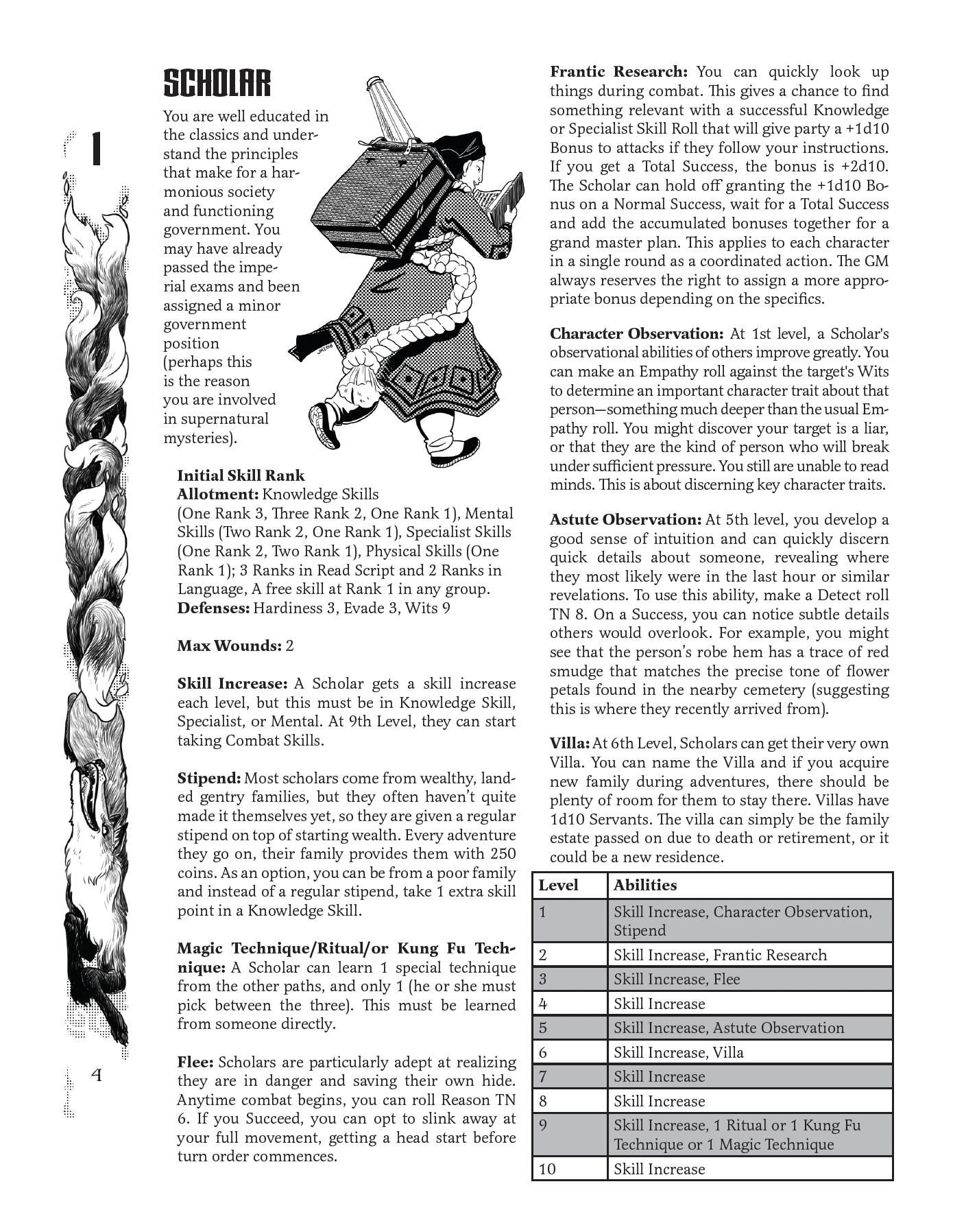
Showing posts with label RPG. Show all posts

Saturday, October 3, 2026

STRANGE TALES INSPIRATION: WIDOW'S BAY

Widow's Bay is a wonderful new show set in a small New England island. It is unclear in the series whether this is in Maine or Massachusetts, but it is a bit of a throw back to classic horror and classic shows. It is rare I come upon a new show I enjoy so I was skeptical going into this one. Created by Kate Dippold, Widow's Bay is a seamless blend of comedy and horror, with pitch perfect atmosphere for a small New England town. It is also a perfect fit for Strange Tales of New England. 

After my first viewing of the show, I posted by initial thoughts on the podcast (HERE).  I was very impressed, but had fallen asleep in sections because I watched it late at night. Since then I have finished the series and rewatched most of the episodes where I missed things. Going back and rewatching just strengthens my impression of the writing and direction, as well as the performances. I also have to amend my criticism of the accents. When I first watched it, I was a little disappointed at the lack of New England accents in the show. I understand one of the reasons they gave for not including them as much (that the Boston accent is so associated with humor and parody it would affect the tone), but the other explanation (that the accent is basically going away) didn't seem justified (it is a fading accent but still quite prevalent, especially in old isolated towns like this one). But I n
oticed that there are more accents than I caught at first, primarily among the local townies (the show refers to them as hicks, but townies is more the word you would hear in this region I think). 

I decided to do a Widow's Bay inspired one-shot for Strange Tales of New England. I know the basic background, and that the adventure will be a mystery with ticking stakes. I am going to employ an approach to mysteries I have been calling the sediment layer model. This is just an easier way for me to wrap my head around the backstory and clues, where instead of doing a trail of clues chart, I am going to draw a diagram that is a cross-section of sediment layers with the bedrock at the foundation (this is where the backstory and history go). Each layer builds on further history and clues. For example if the bedrock backstory is the spirit of a woman who drowned at sea, perhaps in one of the layer layers, a local writer penned a poem about her (this would serve as a potential clue). This will help me track clues over time as well. It is basically just a visual guide I intend to use for the timeline of strangeness in town over the years. If that doesn't work, I may just use a literal timeline, but this seems like it will give me more space to provide a sense of geography to things. 

Something else I want to incorporate, which was directly inspired by the show, is rumors about the PCs themselves. The adventure is a mystery and so investigation and finding rumors in town are key. The players will be able to go to a local pub and gather gossip. But people will also gossip about them, because this is a provincial Massachusetts town (I am going to use Marblehead as my location). This is what I have so far for handling rumors about the party: 

RUMORS ABOUT THE PCS

Not much has changed since the witch trials in the region. Rumors are silent forces that can bring harm, even death, to the characters. The more they interact with the community, the more they displease locals, the greater the chance people whisper about them. You should use your judgement in deciding what rumors spread and their effects, but you can roll on the following table, sliding results up the more positive an interaction is (so a very positive interaction might be +5). Below are descriptions of different levels of rumor, with an example of what it might mean 

1               Terrible Rumor: The players have committed crimes while in town, perhaps even murder 

2

3               Very Bad rumor: The players are outsiders come to cause problems or dig up dirt to sew discontent 

4

5               Bad rumor: Players are untrustworthy outsiders 

6               Good rumor: The players are reputable and not here to cause problems  

7

8               Very Good rumor: The players are here to help the town

9

10            Great rumor: The players have been making life better for the town since their arrival 

I decided to have my central evil be based on real events. This has opened up a number of interesting possibility for handouts. For example there is a history book about Marblehead written in 1880 that directly mentions the events, and so I will use a portion of this as a handout, but the players can also have access to the book and inspect it for themselves because it is available online. And there was a poem written about the events in the 20th century, which can also serve as a clue that helps create atmosphere. I am going to be playing around with history here, leaning into darker readings of the events to make them more fitting for a horror adventure. 

After the session I should be able to post the adventure itself here. 

Friday, January 27, 2023

CELESTIAL PLUME MASTERS SESSION TEN

This was the tenth session of my Wandering Heroes of Ogre Gate wuxia sandbox campaign, the Celestial Plume Masters using the Sons of Lady 87 book, which was just released in print. You can see the first session HERE. You can see the Ninth session HERE. 

PLAYER CHARACTERS 

Wei Ziying: A skilled poisoner and physician, with ties to the Relentless Corpse Sect, Wei Ziying is a disciple of the Celestial Plume Masters. He also has a longstanding friendship with Kuo Qingzhao, who wishes to know more about the poisons that killed his wife (poisons Wei Ziying knows the secrets of). Grudge: Ravenous Nun Xuanji (for the murder of Red Eagle)

Wang Haoyang: A master of stealth, Wang Haoyang is one of the Celestial Plume Master disciples. He has a lifelong friendship with Pei Ye of the Vermillion Bird Teahouse, but has attracted the affection of another member of that organization, Fan Zhen'er (he does not return the affection but wishes to avoid creating friction within the Vermillion Bird Teahouse, and possibly creating enemies). Grudge: Guan Nuan (for a duel he escaped, she feels she lost face because he was weaker than her and should have been an easy victory)

Hei Ling: A one-eyed chief in the Celestial Plume Masters, Hei Ling is the father of Li Liang, whom he wishes to cease practicing her Toad Style kung fu because of the physical toll on her body. He had Li Liang with Qixia the candied fruit in his youth and since then Qixia has grown hostile. He has a working relationship with the Wu Sisters. Grudge: Qixia the Candied Fruit Vendor (of Hai'an). Grudge: Qixia (many reasons related to their pre-existing relationship)

Iron Tiger: The newest member of the party, sent by Night Thorn to help them expand. He has a longstanding friendship with Iron Beggar Sun Kang, whom he wants to leave his lap of luxury in the House of Flying Lanterns so he can train with the Nature Loving Monks and improve his Kung Fu. Iron Beggar in turn wants Iron Tiger to leave the Celestial Plume Masters. Grudge: Pei Ye (he murdered her favorite client, Golden Cobra). 

A DEAD MAN MAKES WEI ZIYING A RICH MAN 

Upon arrival in Tung-On they found Iron God Meng still training with venomous snakes and someone named Duo Na waiting for Wei Ziying in a partitioned area of the gambling hall. 

Duo Na was dressed in expensive robes and said he worked for Wei Ziying's friend Kuo Qingzhao of the Red Owl Society. He brought news that Kuo Qingzhao died in his sleep* and had bequeathed his wealth and his title of Chief of the Red Owl Society to Wei Ziying. 

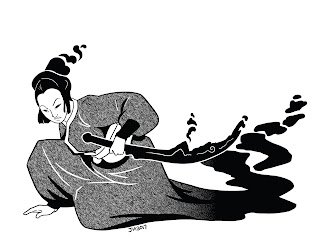
Wei Ziying explained the situation and headed to the Red Owl headquarters to see the body and people in mourning (and to inspect his new residence). There he saw only hired mourners, and was himself the closest thing to a friend or loved one. While he observed the mourners, a strange woman surprised him and introduced herself as Fan Heng. She had a black sword and was dressed in Hai'anese fashion. As he led her to an audience chamber to speak privately he noticed an unnerving black mist emanating from beneath her robes.

Fan Heng by Jackie Musto 

She asked "You are the new chief of the Red Owl Society?"

"I am," Wei Ziying replied. 

Fan Heng asked "And you have inherited all the powers, responsibilities and obligations of the Red Owl Society, and all the promises it has made?"

"I have," he replied. 

"I represent an organization that he promised something very precious to: The Sword of Time. We gave him so much for this promise and have grown tired of waiting for him to make good. Now that he is dead, it is your responsibility."

"I will look into this matter and see what I can do for you," He said. 

"Kuo Qingzhao made a deal with us, and the price for breaking that deal is not small. You will obtain the Sword of Time."

"What is your organization?"

"I speak for Feng Yin of the House of Paper Shadows."***

Not knowing who the House of Paper Shadows were he thanked her and promised to do his best, then went to find out more about the situation. 

HEI LING TENDS TO BUSINESS 

Hei Ling tended to his treasury to inspect the money from Rong E'hua, then he sent a message to Jinsa asking Iron Tiger to procure the body of Qixia (Hei Ling's daughter Li Liang wanted to use the bones to make a handle for her weapon).  

He then decided to place Fan Zhen'er in charge of managing the Red Owl Society information network in their absence. 

WEI ZIYING FINDS THE SWORD OF TIME 

Going to Iron God Meng's he conveyed what he learned to Hei Ling, who then spoke with Iron God Meng and learned that the House of Paper Shadows was powerful, used dark magic, and not a force Wei Ziying could contend with. But he also was told that Yao Chaoyun of the Yao Family Pawn Broker Shop might have information on the sword. 

They went to the shop and found Yao Changyun, his wife, some hired muscle and a crying baby. They spoke with him about the sword of time and explained that Wei Ziying was the new chief of Red Owl Society. 

"Well I happen to have the Sword of Time, I had procured it for Mr. Kuo and was looking for another buyer when I heard he died but it seems I can sell it to you."

They asked how much and he told them 20,000 spades. They decided to make the purchase, as it would still be valuable as an antique even if it was fake. 

Wei Ziying brought it to Fan Heng, who inspected it and said it was a forgery. 

"How can I tell if it is a forgery or not?" He asked

"It is like looking at a sword through an opaque stone. You have two months to bring me the real Sword of Time." 

WORDS OF THE VERMILLION BIRD 

Hei Ling went to the Vermillion Bird Teahouse to pay Hua Yin her four hundred thousand spades and to see if she knew anything about the Sword of Time. Hua Yin accepted the payment graciously and agreed to the new terms (he would owe no more money or service, except the promise of finding her son). He asked about the Sword of Time and she told him she knew a thing or two about it. 

He asked if she knew where it was. 

"This information is valuable, more costly than your payment for Fan Zhen'er. At least twice as valuable as Fan Zhen'er," she said. 

Hei Ling agreed to pay her 800,000 spades for the information and she informed him that the Sword of Time was in the possession of Master Zhan at the Temple of Supreme Righteousness. She also warned him that Master Zhan was extremely powerful, beyond anything either of them had contended with, nearly an immortal. 

Hei Ling thanked her but left with grave concerns. On his way out Hua Yin said "As this is the sword of time, it is possible that the sword exists in two places, perhaps more, at once." 

NIGHT THORN

They decided to travel to Celestial Plume headquarters in River Village to pay tribute. On the way they discussed their options. They agreed things were grim that contending with either the House of Paper Shadows or Master Zhan seemed quite beyond their abilities. They hatched a plan to have Wei Ziying feign betrayal of the Celestial Plume Masters, so that he could worm his way into the 87 Killers. The goal would be to rise as quickly as possible and hope that when the House of Paper Shadows came for him, he could bend their wrath towards the entire 87 Killer sect. 

When they reached River Village they were greeted by Night Thorn but did not see their other master. He accepted their tribute and then listened to their plan. At first he was cautious saying that he worried the House of Paper Shadows might simply kill Wei Ziying in his sleep and do nothing to Lady 87 or her men. But they explained that just as Wei Ziying had inherited the promises made by Kuo Qingzhao, if he were to die Lady 87 would also inherit this responsibility**. Night Thorn decided that it was worth the risk once they explained, as it only seemed to sacrifice one person for the possibility of taking out the 87 killers entirely. He agreed to their plan.

They also suggested they could ambush the 87 Killers by having Wei Ziying feed information about the school in Jinsa, but have Iron Tiger and Emerald Cobra ambush them when they attack. He supported this idea as well. 

He then told Hei Ling to recruit more men and to form more alliances so they could bring a greater force against the 87 Killers. 


*Last session Wei Ziying performed the Wealth Attainment ritual and this is the fruit of that magic 

**This was just speculation on their part. 

***The proper name of the organization is the Society of Leather Shadows but she employed the colloquial term to get maximal intimidating effect: which didn't work initially because he did not know who they were. She also invoked Feng Yin, rather than the House of Paper Shadows nominal director, which I opted for because she was trying to be as intimidating as possible and Kuo Qingzhao was a member of the organization who would have known about Feng Yin. 


Tuesday, January 24, 2023

CELESTIAL PLUME MASTERS SESSION NINE

This was the ninth session of my Celestial Plume Masters campaign using the Sons of Lady 87 book, which was just released in print. You can see the first session HERE. You can see the Eighth session HERE. 

PLAYER CHARACTERS 

Wei Ziying: A skilled poisoner and physician, with ties to the Relentless Corpse Sect, Wei Ziying is a disciple of the Celestial Plume Masters. He also has a longstanding friendship with Kuo Qingzhao, who wishes to know more about the poisons that killed his wife (poisons Wei Ziying knows the secrets of). Grudge: Ravenous Nun Xuanji (for the murder of Red Eagle)

Wang Haoyang: A master of stealth, Wang Haoyang is one of the Celestial Plume Master disciples. He has a lifelong friendship with Pei Ye of the Vermillion Bird Teahouse, but has attracted the affection of another member of that organization, Fan Zhen'er (he does not return the affection but wishes to avoid creating friction within the Vermillion Bird Teahouse, and possibly creating enemies). Grudge: Guan Nuan (for a duel he escaped, she feels she lost face because he was weaker than her and should have been an easy victory)

Hei Ling: A one-eyed chief in the Celestial Plume Masters, Hei Ling is the father of Li Liang, whom he wishes to cease practicing her Toad Style kung fu because of the physical toll on her body. He had Li Liang with Qixia the candied fruit in his youth and since then Qixia has grown hostile. He has a working relationship with the Wu Sisters. Grudge: Qixia the Candied Fruit Vendor (of Hai'an). Grudge: Qixia (many reasons related to their pre-existing relationship)

Iron Tiger: The newest member of the party, sent by Night Thorn to help them expand. He has a longstanding friendship with Iron Beggar Sun Kang, whom he wants to leave his lap of luxury in the House of Flying Lanterns so he can train with the Nature Loving Monks and improve his Kung Fu. Iron Beggar in turn wants Iron Tiger to leave the Celestial Plume Masters. Grudge: Pei Ye (he murdered her favorite client, Golden Cobra). 

BOUQUETS OF ORCHIDS 

Wang Haoyang, Wei Ziying and Hei Ling went to ambush an incoming caravan of celestial plume sent from Hai'an to Qixia's organization (they were acting on information acquired last session). They saw a cart flanked by 10 members of the Golden Heroes Sect. Stopping them they demanded to know if there was plume inside and one of the Golden Heroes said it was none of their business, that they should let them pass to make their delivery. 

The party sprung into its attack, with Wei Ziying and Wang Haoyang striking from the shadows*. While the Golden Heroes saw Wei Ziying before he struck, they did not see Wang Haoyang. While the Golden Heroes put up a fight, they were dispatched in the end, with one of their leaders attempting to flee, then attempting to play dead, before being stabbed through the spine. 

Peeking into the cart, the characters found nothing but bouquets of orchids piled against the walls and filling the entire space. On top was a note addressed to Qixia, filled with sentimental expressions of longing, love and devotion. 

THE EMERALD COBRA 

Iron Tiger had decided to remain at the residence as the rest of the party dealt with the plume caravan. They were building a martial arts school to help recruit more men to their cause against the 87 Killers and he wanted to give it attention. As he was giving instruction, a man in green robes with a very serious looking gaze asked for entrance and said he had heard there was a master with highly impressive Kung Fu here, that he would like to test his skills. When asked his name, he told Iron Tiger he was Emerald Cobra^. 

The two faced off, with Emerald Cobra attempting a tornado kick that Iron Tiger countered. Iron Tiger followed with his Iron Tiger Strike, breaking Emerald Cobra's leg, who gave up after the injury but expressed interest in learning the style when he recovered. 

The rest of the party started returning and Wei Ziying recognized Emerald Cobra as the former lover of Relentless Corpse Queen. Fan Zhen'er also knew of him, and confirmed he was a member of the Cobra Clan, a group who resided on Mount Fone, between the Empire and the Kushen. 

This information concerned Iron Tiger who felt Emerald Cobra could be seeking revenge for the Golden Cobra (who was also a member of Cobra Clan). So he took him to a wine shop and spoke to him of his plans to make his school number one in the martial world. He also asked about Golden Cobra, expressing clearly his worry about the past. He asked, and Emerald Cobra agreed, that they become sworn brothers to cement their loyalties. 

NEWS OF THE MARTIAL WORLD 

Leng Ziying arrived at their temporary residence and seemed interested in the new plume source. He told Hei Ling that the 87 Killers and the Jade Owl Bandits had formed an alliance after fighting with one another, and that a marriage was involved to help seal it. This news was troubling as the party had heard recently that Long Ma Hall also had chosen to ally with the 87 Killers. 

Good news did also come with Leng Ziying. Rong E'hua's robbery of the bank in Mai Cun was a success and she gave 2 million spades to their treasury. She had also burned down several of Lady 87's storage units (these were filled with valuable trade goods). 

Meanwhile, Iron Tiger, who had written to Yang Chun asking for more men, received a message informing him there were not enough men to spare, that he had assigned Iron Tiger to work with Hei Ling so the two could form alliances, recruit and form a strong front against the 87 Killers. 

THE DRUNKEN TOAD 

Still suffering the effects of Qixia's poison, Hei Ling weighed his options. He knew that her lover, Fragrant Sword, probably held the antidote (as she had placed it with him when they were 'together'). But Fragrant Sword was in Dee, which is far to the south and they likely wouldn't make it in time. So instead they headed back to Tung-On thinking that Sima Hao might help. 

Iron Tiger remained in Jinsa, sending word for skilled physicians and animal handlers, whom he offered to pay well. 

Hei Ling found his daughter in Gao Cun, Li Liang, at an open air wineshop in a drunken stupor. He could see she had been badly injured but on the road to recovery. He asked what happened and she said a man disguised in a mask** attacked her and broke a number of her bones. She was angry and depressed at the loss and no longer wished to pursue training. 

Hei Ling rebuked her and expressed some shock she was so easily giving up*** saying "Come on, you can't give up after one big loss. Particularly to a man too afraid to show his own face. I thought you were better than that."

She slammed her fist on the table and said he was right, that the man was a coward and she would train harder so that she could find him and kill him. 

Hei Ling told Li Liang that he had killed Qixia, her mother then gave the letter she had addressed to her, which read: 

Your father is a bad man. His crimes are countless. He killed my sister and threatened to kill you if I ever showed motherly affection. My heart aches for the pain he made me cause you. He has no regard for social mores and would exploit you for his own gain. Do you trust him. You must kill him!

Li Liang did not believe the message, as she knew her mother's personality well. She only expressed anger at her mother's passing, but the anger was directed at Qixia, not Hei Ling. She told her father to have his men gather her body so she could make a new handle for her giant mace. 

Hei Ling then told her he was suffering from Qixia's Five Dragon Venom. Li Liang told him to take a seat and used her curing palm to expel the venom from his body. 


*They have been using stealth to their advantage as a tactic in fights, with Wang Haoyang getting an extra boost by using his Stealth of the Spider Demon ability. 

**The man was Iron Tiger who donned a disguise and attacked Li Liang to shake her morale before she trained for the upcoming duel with her father. 

***In this instance, I asked for the player to make a Command or Persuade roll because I was a little unsure of how Li Liang would respond, and he got a 10. 

^Iron Tiger Killers a man in Da Guan named Golden Cobra and this detail would later become important as he would vet the man for his loyalty. 


Sunday, November 6, 2022

GUIDE TO OGRE GATE

With the release of Sons of Lady 87: an Ogre Gate Campaign, I thought it would be a good time to provide an overview of the Wandering Heroes of Ogre Gate system and setting landscape. 

The core book is Wandering Heroes of Ogre Gate. It is a wuxia rules system based on d10 dice pools, skills and a vast number of Kung Fu techniques. The core d10 mechanic is sleek and works pretty quickly too. You simply roll your pool, take the single highest result and compare it to the target number to see if you succeeded. Characters advance by gaining ranks in Qi, which happens when they meet certain thresholds for experience (i.e. finding or stealing a martial arts manual, fighting an opponent more powerful than themselves, growing their reputation, etc). It is set in a fantasy world inspired by Song Dynasty China. The book itself is 492 pages, with a large portion devoted to Kung Fu techniques and setting. It also includes sects, NPCs, everything you need to make a character and a sample adventure. There is also crucial GM advice, including guidance on using the Grudge Encounter system (which really helps emulate the feel of a jianghu setting). It is the only book you need to play Ogre Gate, and it is available as a pay-what-you-want HERE, and available in print HERE. 

The next most important book for the setting is Ogre Gate Inn and the Strange Land of Li Fan. This provides a full description of the client kingdom Li Fan, a host of sects, NPCs, maps (including Yao Gong Palace), a large adventure inspired by the Dragon Inn films, new Kung Fu techniques and monsters. The adventure takes up three chapter of the book and the book itself comes in at about 190 pages or so. There is a ton of adventure material to draw on in this one. It also has a bit more supernatural horror in it. Ogre Gate Inn and the Strange Land of Li Fan is available in print and in PDF. 

And of course there is the Sons of Lady 87 Campaign Book. This provides an overview of the imperial prefecture of Fan Xu. It also is focused on criminal organizations with an emphasis on the 87 Killers. It is available in PDF and will be available in print soon. 

The next two books are adventures. 

The first is The House of Paper Shadows. This one is a pure blend of wuxia and horror. It takes the players to the House of Paper Shadows, a mysterious organization in the Qi Xien setting, where they face all kinds of horrors and can be transported back in time to the dark events that created the House of Paper Shadows in the first place. The house of Paper Shadows is available in print and PDF and is100 pages. 

The next adventure is called Tournament of Daolu. This is just a fun book. It spans time and place as well, starting with an adventure in the southen wilderness, but culminating in a tournament in the city of Daolu, where the players may find themselves back in time meeting Sunan and Sun Mai. The city is well fleshed out, and the tournament is structured providing the GM with a clear way to manage elimination and competitors. The Tournament of Daolu is only available in PDF.

After that there is the sects of the martial world series, which has 6 entries. These are PDFs that each include one new sect. Presently they are: Maidens of the Jade Blue Sky, The Silken Robe Society, Crocodile Sect, Relentless Corpse Sect, Temple of the Jade Mercies, and The Glorious Death Cult. Each PDF is just 50 cents. 

In addition this blog contains a number of useful Ogre Gate books. The first is War of Swarming Beggars. This is a campaign and setting book that describes Hai'an, a land in the south that is still independent from the empire. You can find it HERE. There is some really great stuff in it in my opinion. Originally I was going to put it out as a print and PDF book but other projects became more important to prioritize. So this is pretty much a full module, it just hasn't been through the normal editing process and it has no art. 

The Blood Stained Roads of the Martial World was also meant to be a book, but it got sidelined as other projects vied for the pipeline. It is essentially an encounter book but the encounters are quite fleshed out. Think of it as one big encounter table with the encounters fully described. 

The Profound Masters is also on the blog. This goes into more depth with profound sects and abilities. 

Journey to the South provides a description of the lands south of Hai'an. This is pretty useful and includes my hand drawn map. I ran a number of campaigns that ventured into this territory so most of the stuff here comes from those sessions. 

There is also an official Ogre Gate novel called Legends of Ogre Gate, which describes the rise of the ancient heroes Sunan and Bao (important figured mentioned in the setting history of the core rulebook). This was written by Jeremy "Deathblade" Bai, who co-wrote Tournament of Daolu, Righteous Blood, Ruthless Blades and was a part of many of the early Wandering Heroes of Ogre Gate campaigns. At the time Jeremy was translating xianxia novels so he was able to bring that knowledge to the setting. It is a large book, at 808 pages with nearly 100 chapters. 

There are also two Ogre Gate adjacent books out there. The first is Strange Tales of Songling, which is a Bedrock Games book that was inspired by Strange Tales from a Chinese Studio and similar stories. I decided to make the game after I went through the penguin edition of Strange Tales of Songling (which is shorter than the multivolume sets) and did one entry on the blog for every story in the book. Each entry was Ogre Gate content inspired by that particular story. It was so much fun, I made a simplified version of the Ogre Gate system specifically for a setting inspired by Pu Songling's stories and similar anomaly accounts. Strange Tales of Songling is available in PDF and in print. 

Then there is Righteous Blood, Ruthless Blades published by Osprey Games. It is available in print and PDF. I co-designed this with Jeremy, and it is quite different from Ogre Gate, but uses the same core mechanics. Unlike Ogre Gate it is set in historical China and it is specifically emulating the wuxia style of Gu Long. I'm very proud of how this one came out. It really captures what we were going for. One thing I love about it is it does a great job of emulating the genre while still remaining highly gameable. Also where Ogre Gate is sect-focused, the Jianghu of RBRB is places greater priority on individual characters. There are still sects, of course but the emphasis was more on unique characters who populate the martial world and their relationships with one another. 

Sunday, October 30, 2022

MAKING ADVENTURES FOR STRANGE TALES OF SONGLING

A couple of years ago I released a game called Strange Tales of Songling, a horror RPG inspired by Strange Tales from a Chinese Studio* and movies like Mr. Vampire and A Chinese Ghost Story. I'm currently working on a new game using the same system. That won't be out for a while, but in the mean time, Strange Tales of Songling makes a perfect Halloween one-shot (or even a short campaign) and I wanted to give some adventure design advice for it as that is a question I am frequently asked about. 

For anyone in need of a quick adventure, I would point them to Head of the Teahouse which I put on the blog a couple of years ago, or to the four sample adventures in the rulebook. You can also check out The Starlit Inkstone, which is a small sandbox I put together for the game. For those who want to make original adventures but are having trouble, this section is provide some guidance. What follows is simply what has worked for me, so feel free to try it, but ultimately use what works for you. 

Also a note on availability. The PDF is available HERE, while the print version can be found HERE (our PDFs and our print books are on different sites which has created some confusion on where to find the print editions). 

What is Strange Tales of Songling?

Just to cover the basics for those not familiar with the game, Strange Tales of Songling uses a modified version of the Network System, which was originally a rules light RPG that became more complicated in different incarnations. It takes the latest version, Wandering Heroes of Ogre Gate, and brings it down to the essentials and adds character paths so that it isn't a point buy system (players have some choices for powers and skill allotment but these are all determined by their path). The simplified system is smooth, very simple, and fast. I think this is essential for horror because it reduces things like needing to look up rules in the book. 

It is designed to be played as monster of the week. The game is packed with monsters and while each individual adventure allows for maximum freedom, for the purpose of making one shots and short term horror campaigns more feasible, it is assumed there will be an adventure that everyone buys into that evening. I sometimes called this approach a contained sandbox because it doesn't have any expectations beyond the starting point. The characters can spend the whole adventure running from the threat screaming or engaging all the elements, it doesn't matter. Generally it is meant to be played either as a one shot or as a 10 session campaign (and longer campaigns string together many ten session campaigns that are multi-generational). 

Making Adventures for Strange Tales of Songling

I get asked a lot about making adventures for Strange Tales of Songling. I don't know why, it is not one of our better known games I believe, but when I hear from people, this is normally what they ask me. They also often express reluctance because they worry they don't know enough about the genre or history to run an adventure. I am going to address both these concerns here.

I 

First on not knowing enough. I studied history in school and one thing I like to do with history is take a positive approach where people are encouraged to learn but aren't fearful of making mistakes. One of the worst ways I saw history taught was being overly critical, belittling people for their lack of knowledge or draining any enthusiasm they had by stealing their confidence and excitement. It is also a critical tendency I can fall into myself (especially if I am watching a movie for instance that has notable historical errors). With time I learned to relax more about this stuff and as a result, I became better at learning history. To be clear I am not an expert in history, I was merely a history student and continued to maintain an interest in history after I graduated.

This kind of thinking, especially with gaming, unless it is fueling your excitement and driving you to really dive deep into research, isn't necessarily good for getting a campaign off the ground nor is it good for developing interest in a topic. 

Don't get me wrong, I think its good and important to learn history as well as you can, and to understand what you don't know, but I also think everyone comes to it at different experience levels and with different areas of knowledge. I generally read more history books than novels, but one thing that makes me keenly aware of is just how much I don't know (sometimes it is like the more you learn, the less you realize you understand about the depth of a topic). 

Here I would say a good approach is to understand its okay to be a beginner on any topic in history and learn what you can, while also understand that even people who know a great deal, often get things wrong. When you are starting out on a topic learn what you can but you need to keep your mind flexible to incorporate new information as it comes to you. It is easy for example to develop a rigid sense of history around the first source you read, which is setting yourself up for issues down the road (your first source may have errors, may be out of date information, the source may reflect one school of thought in history but you might need exposure to others, or you may only be getting a simplified narrative that is more actively debated). The point is it is an ongoing process, it is not a mountain you need to climb and reach the top of. 

It is also important to remember you don't need to position yourself as an expert to the group. This is something I hear a lot from people. They feel like they must be an expert in a topic to run a game around it. It is good to research, but I've also seen many people never start down the road of learning about a genre they had a budding interest in, because they were afraid of this. You are the GM, but you can be honest with your players about your level of knowledge. When I first started running classic horror games at 14, I knew only a fraction of what I came to know about the horror genre, gothic literature and classic horror movies that I came to know over the course of my campaigns. When I ran Call of Cthulhu for the first time, I had only just started reading Lovecraft. If you know about the genre and the topics that relate to it, then that's great, it will definitely give you a huge leg up. But there isn't anything wrong in my opinion with learning about a genre on the job (and running a campaign is a good way to learn history because you will be more curious as you read and you will have active questions that arise from the campaigns that you can take into your reading and give it better focus).  

I mention all of this because Strange Tales of Songling is inspired by Chinese anomaly accounts and by its history. It sets things in a surreal dreamscape realm inspired by China, which is intended to make things easier for GMs, but it is also clearly taking inspiration from real history. Even in a fantasy analogue, GMs not well acquainted with the history, have expressed reluctance. So I encourage people to relax, understand they can learn while they are running the game, that they can draw on the knowledge of their players as well if they are worried about disrupting peoples suspension of disbelief by getting some cultural detail wrong. You'll get better as you go, you can work with your group together to support the campaigns overall foundation of knowledge. 

All that said there are great resources out there if you do want to research more before starting. I always recommend reading survey books covering the period you are interested in emulating (so pick a dynasty for example and get a book that covers the history of that dynasty), reading a general survey book or a two volume survey book of Chinese history (so you can get the larger picture) and then read what you can about government, institutions, etc. If you are less of a reader, you can try documentaries. 

Additionally you should read Strange Tales from a Chinese Studio. I would also suggest viewing the movies that Strange Tales from a Chinese Studio has inspired (films like A Chinese Ghost Story, Painted Skin, The Enchanting Ghost, etc). You can also watch movies like Legend of the Demon Cat, The Bride from Hell, and Legend of the Mountain. And there are more recent remakes of many of the above too. For example there is a 2011 version of A Chinese Ghost Story, and there is even a 2020 version I believe (I haven't seen the 2020 version but have heard about it). In addition the original A Chinese Ghost Story has 2 sequels which are both great. In Strange Tales  of Songling I provide a more in depth list of films, but you can probably find many more possibilities doing searches for Chinese horror online and by looking up lists of media inspired by Strange Tales from a Chinese Studio. Some films are hard to find copies of or for rent in digital form (it took me forever to obtain The Enchanting Ghost for instance). It also looks like streaming services are getting more of this content.  

II

The basic way I made adventures for most of my Strange Tales of Songling campaigns was to read an anomaly account (this could be from Strange Tales from a Chinese Studio or from another writer), then use that anomaly account as inspiration for an adventure. The reason I do this is because when I originally started reading Pu Songling's Strange Tales from a Chinese studio to find inspiration in my Ogre Gate campaigns, I noticed that each story worked so well for generating a supernatural adventure idea. They are the perfect length (most aren't too long) and they are more interested in describing the strange and conveying a concept than in telling a story with a clear structure (some do have a structure but some just describe an unusual occurrence). 

I got more mileage out of Pu Songling's stories than any other single source, and that is why I wanted to write Strange Tales of Songling. They just work well for helping the GM come up with adventure ideas. It isn't necessarily a 1-1 translation from the anomaly account to the adventure, but they serve as excellent starting points. In each one you are going to find something, whether it is strange magical item, a place, a monster, a villain or scenario. 

Once I read the story I took about twenty or thirty minutes to think about it and shape it into something gameable. I intentionally started reading one story a few hours before a session to force myself to come up with adventure content before the games. What I found happened is either the story presented the perfect monster for an adventure as written, or it sparked an idea for a monster or situation. 

As one example, when I read the story The Monster in the Buckwheat, it gave me the idea for Physician Jixian, in the Starlit Inkstone, who transformed his wife into a creature resembling the one from the story, that haunts the fields around his house to protect him. 

Because this is monster of the week, try to read with the aim of finding a villain or monster. The story itself might not have a monster. For example, there is a story about a man who becomes obsessed with a rock, and it is only vaguely supernatural by the end. But it gave me the idea for an adventure for Ogre Gate where a man was in love with a spirited stone and it led to this scenario. 

Other times I would read one story, get inspiration from one or two elements, then read another and combine them. You can also do this with other media, for example watching something like Black Magic and weave that into a Pu Songling account. 

Another approach is to simply start with a monster from the Strange Tales of Songling book. A good piece of advice for adventures, but especially horror adventures is: start with the villain. If you find a monster that inspires you, then already have half of what you need for an adventure. It is just a matter of creating a scenario around that monster. And as with combining Pu Songling stories, you can combine monsters in a scenario. 

Once you have your monster you can flesh out a backstory, which shouldn't be too long but should inform everything else. You will probably grow a small cast of NPCs by doing this. Not every adventure has the same number of characters but usually there are other people involved which will help make for a more interesting session. You might want to strive for simplicity though with your first session: i.e. a small village or temple with a monster that has been contained for centuries but recently unleashed by some fools actions. 

After your background, or at the same time, you need to establish a place. In terms of maps, locations and other details that require research, there is a very simple piece of advice I can offer: find you sources first, then build your adventures around them. So if you know you want to run an adventure set in an interesting location drawn from historical china, look up maps and floorpans, city layouts, etc. Once you find something concrete, then build your adventure around it. This is a lot easier than making an adventure around a specific town, or a particular type of place, then trying to find maps and information about those places.This will save you hours of time.  

One thing you might want to do, especially if you are overwhelmed by cultural details and feel like you don't have enough information to bring your scenario to life, is focus on one mundane aspect of the time period. For example, you could read about apothecary shops and just learn the details that you can about those. That way you are not trying to bring everything into the adventure and you aren't researching dozens of topics. 

A good way to find topics is in survey books. Usually there will be section on daily life and in those sections starting points for things you might want to explore. As an example I just opened a random page in Dieter Kuhn's The Age of Confucian Rule (a book about the Song Dynasty), and came to a paragraph about suburban life and one about the Traveling up the River at the Qingming Festival painting. The first paragraph describes the scroll painting of Kaifeng. Something like this is a great resource for a GM to draw on (you can look up the Qingming Scroll). And the next paragraph talks about how scholar officials were engaging in commerce through front men, so they could rent out property, guesthouses and start companies. A detail like this is great to bring into an adventure. You can create a scholar official and the merchant serving as his agent, and perhaps a property like an Inn or a shop, or even some other business venture. You will need to do more research on commerce but at least you know what to research and you aren't burdening yourself with more than one big topic for this adventure. This will help give you places and NPCs beyond just your monster. 

One of my favorite books is Commerce and Society in Sung China. It is very dry, but has all kinds of information on trade, transportation of goods, and markets. One of my favorite things to do for an adventure was to look up a particular topic like a specific trade good such as sugar, and use that to help establish details in my adventure. The section on rice for instance includes information about cultivation, rice brokers, transport and rice shops (and later in the book there is a section on types of markets). So if I wanted to do an adventure about a river vessel haunted by ghosts, I would have a lot of information to make that believable. And perhaps more important than believable it would help me identify gameable challenges, conflicts, etc. 

Again, you don't need to spend days or weeks researching for a three hour adventure. You might not have that kind of time, but you still may be interested in slowly bringing in these kinds of details. If that is the case, but you still want to bring in something historical, look up a single short article on any topic close to your period and read it with the intent of finding some detail you can include and build upon (you can get a free JSTOR account which will allow you to read three articles at a time, or you can go to your local library or use its digital database). 

III

Once you have all your material, you need to put it together in a way that is gameable and in a way that functions well on its own at the table. So figure out who your antagonist is, what characters are working with that antagonist, if any, what characters are in opposition to that antagonist, if any, etc. 

At a certain point, whether you have the information you need or not, you will have to put pen to paper and map out anything that needs mapping, create characters in need of existence, and develop any plot elements that need to be in place for the adventure. 

Most important is your antagonist's motivations and goals. This is true in any horror story but I think one of the things that does set Chinese Horror apart is how much it tends to this. The ghosts and monsters are quite well fleshed out, and often have interests and drives that are more like humans. This is a setting where not all monsters need to be enemies of your player characters. 

If you need to you can bring in anachronisms to fill in details. Movies to do this all the time. Sometimes because it is useful for plot reasons, but other times, you need something familiar to stand on because you don't know what would have been there. If you are looking at an adventure you need to run in two days, and you had all these other details you need to sort out, and can't figure out how morning markets work, draw on something you know just for the purposes of having something (for example a farmers market). 

In terms of time, I think you should strive to get your prep to under 3 hours. Your first few adventures will probably take more time, but you ideally get to the point where you can put something gameable together in three hours. For Strange Tales of Songling, because each adventure can just be a scenario surrounding a single monster if you need it to be, more than that is not only necessary but you might be creating too many details to be remembered during play. Simple is usually better. 

Also because the game doesn't emphasis adventures unfolding in any particular way: it just kind of drops players into a situation or scenario involving the supernatural, and allows them to tackle it from whatever angle, that frees you up a lot. You don't have to worry about planning out sequences of events. You just need to know what is going on and build things well enough so you can adapt as the players make their choices. 

IV

I touched on this in the above sections but I think creating a sense of place is very important for the atmosphere of these adventures. My very first Strange Tales adventure was inspired by a story about a family of foxes awaiting an impending disaster. I used this and blended it with a region modeled after the mountain area in Legend of the Mountain. I populated it with an inn, a house where the foxes lived, and tried to create a dreamy mountain landscape for the adventure. Keep in mind this first adventure was in the afterlife (I originally intended Strange Tales of Songling to be a system I used when characters died as a way of having a method for them to fight their way back to the world of the living). 

The fated disaster was a powerful martial hero who was going to appear and annihilate the foxes at an appointed time on the evening the player arrived. It was extremely simple, but it had a sense of place and even a small ecosystem with just those two little locations fleshed out on the map (there may have been a small village too but I can't remember). There were also other key places like dangerous bridges between yawning drops in the mountains. This was just meant as the characters entrance into the afterlife where he would make an important decisions over whether to protect this fox family and face a foe more powerful than himself (he lost all his Ogre Gate powers and started as a level one Strange Tales character in the afterlife).  

V

The adventure isn't what you prepare, it is what occurs at the table. So what you prepare should lend itself to responding to the players actions. If the players try to negotiate with the Hanging Ghost, you will need to have an idea what that ghost wants and what it values so you that it is easy to react smoothly. 

Also you will get things wrong, you will run adventures that don't work how you planned, you will also have off nights. I think the best way to approach this is to relax when that happens, remember this is just a game, the stakes are extremely low, and try to learn from those moments when they happen. Even a skilled GM can have trouble when playing with a new group of players. It takes time to find what works and what doesn't. So if you start to bomb running a session, then make a point of staying calm and trying to analyze why the session is bombing. 

There are also two basic types of adventure for Strange Tales of Songling, and I used to alternate between them: adventures out in the world of Songling, and Adventures that come to the players at their abode. The system assumes players spend their time back at their residence between adventures. So I alternate each level, first having them go on a monster of the week adventure out in the world, then having an adventure come to them (whether that be a ghost who haunts their house, strange happenings with a mad sorcerer come to ask for employment, etc). This works well because even in the small 10 session campaign structure if gives the players a sense of belonging, and increases the stakes. It also allows you to explore things like the player characters family. 

VI

To summarize: relax, don't worry about being an expert, but also don't become too rigid when you do start learning more; start by reading one story to inspire each adventure, then build it around a particular monster or villain, create a sense of place and a backstory. Use the advice above for things like conducting research, managing your time, and identifying the easiest ways to have a solid map foundation for your adventure. 


*Note that there are many translations of Strange Tales from a Chinese Studio. The Penguin Classics version linked is highly digestible but not comprehensive (and aims more for beauty of language than accuracy of terms). If you want a more complete translation with greater emphasis on accuracy you can look into the Chinese Classics four volume edition. There are quite a few others available as well.