Monday, August 18, 2014

BENEATH THE BANSHEE TREE IS AVAILABLE

Beneath the Banshee Tree is available for free now. Check it out here: Beneath the Banshee Tree. 

Beneath the Banshee Tree is an investigative city adventure for the Sertorius roleplaying game. 
Powerful spellcasters called Sertori come from every corner of Gamandria to the mountain city of Talyr , answering the king’s call for new talent to fill important offices. However his invitation attracts someone with sinister motives who exploits the abundance of magic to enact an unthinkable scheme. After a series of mysterious events the players are recruited to solve the puzzle and weed out the evil presence in Talyr. But it is a race against time as they hunt for clues and try to piece them together before something terrible unfolds.
This 69 page investigative module comes with an adventure, several detailed NPCs, a city map, a full description of the city of Talyr, and a unique investigative structure that makes for a different experience each time you play.  
For use with the Sertorius rulebook by Bedrock Games.

ORCS OF THE NORTH: GRU BLOOD

We continued our efforts to capture a member of the Caelcori in an ambush at a false Inn. The events leading up to the current situation are described in this entry: Audience with Ozias. *Characters present were:

-Enos Ozihel (my character), an Orc who worships Ozias.

-Festus, a Halfling from the Shahr Republic who has business in the North (incorrectly identified in the last entry as Shillek*).

-Aetos, an Orc Tribesman who died, became a Ghoul and was then blessed by Ozias of service and made into a vampire.

-Ah-Sri, a Hasri raised by Humans in Ronia.

-Mogar, Orc devotee of Ozias (incorrectly identified previously as Varia*)

-Poro, a Kobold tradesmen. 

-Orto Turanus, a one-armed Orc scholar from Caelum. 

Aetos continued to drain the Gru of blood. The Gru cast a spell called Blind Hatred, causing him to burn red with rage and obscure his own vision, but imparting tremendous power that made him hard to wound. We continued our attacks on the Gru as Aetos drained him, but we heard a voice outside demanding our surrender. We hadn't planned on more than one Caelcori showing up and were taken completely off guard by this development. 

A haze of magical fear settled upon the Inn and one by one we succumbed to it. It affects were not overpowering but did cloud our judgment. Festus went to the window and spotted a large wolf starring from the woods. As he did so the door burst open and an Ogre came crashing in. Ah-Sri threw an alchemical smoke elixir at the doorway causing the place to fill with clouds of dark vapor. Enos launched some arrows at the giant creature. Mogar also cast Blind Hatred, and went into his own frenzy, driving the Ogre back through the door. Poro cast Splintering of Yaum but failed and was overcome by his magic. He still split into four versions of himself, but they went mad, attacking anything in sight. The energy warped his body and mind causing him to grow an additional head. 

We eventually managed to control the situation, with Festus using Doom Hammer (a spell that creates a glowing two-handed maul) to finish off the Gru, allowing Aetos to make it his thrall. As the Gru died, he fed it his own blood. Our information indicated it would rise as a vampire under Aetos' control in a few days or so (of course we were not certain if our information was accurate). 

Outside the doorway Mogar and Festus continued fighting against the Ogre and found themselves taking arrows from an Orc that flashed in and out of existence (we still are not sure what power it was using). Festus again let his Doom Hammer fly against the Ogre and killed it. That caused the wolf and our mysterious archer to flee.

Enos decided to try to raise the Ogre as a zombie servant using Spirit Bind. However he failed his casting and it unleashed an Angry Spirit on the party. The spirit wailed, causing everyone to burst into flames. Thankfully Mogar cast Baal-Shillek's Spinning blade and destroyed the spirit. Enos then used his Heal spell to help those afflicted by the fire. 

The party then headed North back toward Neoda but stopped along the way in a village to raise the thrall of Aetos. Seeing opportunity and being high priests of Ozias, the party told the villagers that a miracle was about to happen, that the Vessel of Ozias was preparing to raise a special servant and that any who offered their blood would be blessed by the god. This proved useful as it allowed the two vampires to feed without killing anyone. 

After we raised the Gru from the dead as a vampire thrall, we asked it about the Caelcori and learned that they knew of our plan to ambush one of their members, so sent several of their order to the Inn. When we inquired further it stated that they had learned this from a source close to us who wrote a note. 

We then rested before resuming our journey to Neoda. 

*Note I was operating off of incorrect notes when I created this list and have updated the character names and descriptions accordingly. 


Sunday, August 17, 2014

BENEATH THE BANSHEE TREE PREVIEW

Beneath the Banshee Tree, our first free module for Sertorius, is ready. It should be available in PDF quite soon. Today I want to give a brief preview of the Banshee Tree mystery adventure and talk about its contents. 

As we promised, Sertorius will be supported with free supplements. Beneath the Banshee Tree is an investigative module where the players explore the city of Talyr for clues to hunt down a malignant presence. We have a passion for mystery adventures (most of our modules for Terror Network were investigative in nature) and we thought it would be an ideal structure to bring to Sertorius as an introduction for people new to the system and setting. 

More than an adventure
I believe very strongly that the best modules are one part adventure and one part setting supplement. With that in mind we included a lot of information on the city of Talyr in this book, enough that you could easily ignore the actual mystery and just use that material alone for a regular urban campaign. There is a chapter dedicated to the city of Talyr, it describes the local culture, important power groups like criminal organizations and provides details on key places in the city. The book also contains a map of a Talyr and a regional map. 


A great mystery
The mystery adventure has a unique structure that will cause a few surprises for even the GM. The players can freely search for clues and interview suspects as they navigate the politics of Talyr and work to gain favor with the king. They also face a deadly threat which could turn its claws on them if they don't solve the mystery in time. 

A terrifying villain (or two)
At the heart of every great mystery is a villain and the Beneath the Banshee Tree is no exception here. There is a chapter dedicated to the villain and thorough descriptions of all the villain's accomplices. 

Characters, characters, characters....
While hunting for clues is important, one of the main sources of information in any good mystery is the cast of characters. Beneath the Banshee Tree has thirteen major characters fully described with stats and motives. The PCs can gain clues by interrogating them and find useful allies among their ranks if they are clever. 


Clearly presented clues
The areas of investigation are all clearly organized and the clues arranged in an easy to find format for the GM. 


A bit of horror
The players will face supernatural horrors as they unravel the heart of the mystery. The module not only provides a useful introduction to the setting, it also demonstrates the dangers of spell casting and highlights how spells can be used to achieve terrible ends. 

I am personally quite proud of this module and pleased we are able to offer it at no cost to gamers. Even if you are not a Sertorius GM, this module can easily be adapted to any fantasy setting. Feel free to check it out and decide how good it is for yourself when it becomes available in the coming days. 

Saturday, August 16, 2014

BANSHEE TREE AND WUXIA INSPIRATION

It is game day so this will be a brief update. 

Our module, Beneath the Banshee Tree is almost ready, I expect it will be available this week (and it will be free). It is a 69 page mystery adventure set in the city of Talyr. While the module is 100% free, we still worked very hard on it and I think it is one of our best adventures. I will issue an announcement when it becomes available. 

In the meantime, I consolidated all of my Wuxia Inspiration reviews and you can find them HERE. Hopefully I didn't miss any. I've quite enjoyed writing the wuuxia reviews and you can expect at least one more in the Cheng Pei-pei series before I cover some newer material (further Cheng Pei-pei reviews will depend on me tracking down some of her harder to find movies like the Jade Raksha). 


Thursday, August 14, 2014

WUXIA INSPIRATION: THE THUNDERING SWORD

Wandering Heroes of Ogre Gate (WHOG) draws on a number of sources for inspiration. I watch a lot of wuxia movies and TV shows, and these have had a big influence not only on Ogre Gate, but on Sertorius and many of my d20 campaigns. I am hoping to share some of my favorite movies and shows in the genre here as we work on WHOG.

Note: I am writing these as a fan of the genre. I am not a movie expert or an expert in asian cinema. These are my own observations based on what I have learned by watching wuxia and kung fu movies, and by reading about them through interviews and books. But my knowledge is quite limited and I am an English speaker. So understand that my commentary comes from this perspective. 

This review contains many spoilers.

This is part of my Cheng Pei-pei review series. You can see my other reviews of her movies here: Come Drink With Me, Golden Swallow, Brothers Five,The Lady Hermit,The Shadow Whip, The Golden Sword and Dragon Swamp.  


Introduction
Like my last Cheng Pei-pei film, this is one I hadn't seen until reviewing it. I watched it last night and was unaware until about a quarter of the way through that The Thundering Sword is based on The Heaven Sword and Dragon Sabre, a Louis Cha (Jin Yong) novel that has been made into many movies and series over the years. They took a lot of liberties with the storyline, pretty much focusing on the early part of the story and condensing everything into that portion of it. 

This is a movie that deals with martial sects and the division of them into "orthodox" and "unorthodox" (sometimes labeled "good sects" and "evil sects"). The names of the sects and their characters seem to have been shuffled and tweaked to suit the adaptation, but Cheng Pei-pei's character, So Jiau Jiau, belongs to an unorthodox sect and is the daughter of their rather ruthless chief, So Shing Fung. Her character begins as ruthless as her father, killing with little reason and taking what she wants. But she falls in love with a member of the orthodox Baiyun Temple Sect and is slowly redeemed during the course of the film. I found So Jiau Jiau quite different from other roles I've seen Cheng Pei-pei in from this period, a little more vicious and cruel. 

The Thundering Sword was released in 1967 by Shaw Brothers and directed by Hsu Cheng-hung. It starts Cheng Pei-pei (So Jiau Jiau), Chang Yi (Yu Chien Wan), Lo Lieh (Chiang Kwan Yuan) and Shu Pei-pei (Gin Hsia). It also stars Fang Mian (Chief So Shing Fung) and Wu ma (Chief Wang).


The Thundering Sword

The Master of Baiyan comes out of seclusion
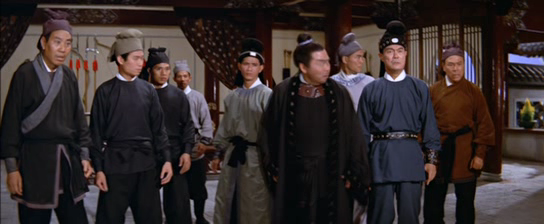
This is Heaven Sword and Dragon Sabre, truncated and condensed to fit one hour and thirty minutes. The story opens at Baiyun Mountain Temple where the master has been in isolation for three months, contemplating how to deal with the threat of The Thundering Sword. According to the master, so long as it exists, sects of the martial world will fight to obtain it and use it against one another. He says it will shatter the other two precious swords and cause great disasters that will end with the earth being cracked. He sends two of his disciples, Yu Chien Wan and Chiang Kwan Yuan, to go forth and find the sword. 
So Chau-wu cripples Chiang Kwan

The Baiyuan Mountain Temple sect is peaceful and orthodox, they believe in using violence to further peace and do not kill lightly. Both Yu Chien and Chiang Kwan adhere to this principle but their lives intersect with So Jiau Jiau who belongs to a less discriminating sect that is trying to find the Thundering Sword. First she meets Yu Chien, who witnesses her attacked by bandits. She fends them off with ease, slaughtering each one without mercy. Yu Chien admonishes her lightly and encourage her to only kill when necessary. He inquires about the Thundering Sword and she claims to have no knowledge of it. They part ways but it is clear that she has fallen in love with Yu Chien. 
Cheng Pei-pei as So Jiau Jiau

Chiang Kwan encounters her after he finds and removes the Thundering Sword from a booby trapped tomb. She steals the sword with her whip and hits him with poisoned darts. After he succumbs to the toxin and passes out, she realizes he is a martial brother of Yu Chien and attempts to save him by masquerading as Yu Chien and hiring the Yue Escort agency to take him back to Baiyun Temple. On the way they meet So Chau-wu, So Jaiu Jaiu's brother and the son of the Wu Du Clan chief. The chief's son and his men attack the Escort caravan, driving them off. Believing Chiang Kwan knows the the Thundering Sword's location So Chau-wu interrogates him and cripples his body when he refuses to talk. 

So Jaiu Jaiu learns about the Yue agency failure and goes to their headquarters to kill them all. Dressed again as Yu Chien, she slaughters everyone, leaving only one man alive (though gravely wounded). After the massacre  and So Jiau Jaiu's departure from the scene, the real Yu Chien happens by and tries to help. However the remaining members of Yue Escort agency return and accuse him of killing their brothers. He flees and during his flight once again meets with Jiau Jiau. 

Chief Wang
Jaiu Jaiu offers to give Yu Chien the Thundering Sword and takes him to Wu Du Clan's compound while  her father (the chief) is away. There one of the head chief's underlings, Chief Wang, has temporary authority over the sect and the master's seal. In an amusing scene, Jaiu Jaiu attempts to deflect Wang's suspicions as she hides Yu Chien in her bed and feigns illness. She eventually seems to succeed and gives Yu Chien the sword. They attempt to leave together but Chief Wang tracks them down and uses poison to knock them out. 

At this point a bold and aggressive wandering swordsman (who I assume is loosely based on the character Golden Haired Lion King from Heaven Sword and Dragon Sabre) appears from out of nowhere and saves the two, but takes the sword. Even though he takes the Thundering Sword for himself, the wandering swordsman develops a rapport with Jaiu Jaiu and Yu Chien, offering to act as a go between for their marriage. 

The Yue Escort Agency
Because they need both the permission of both their masters to marry, they go to Baiyun Mountain Temple first. There Jaiu Jaiu must confront her first misdeed of poisoning Chiang Kwan (which ndirectly caused his maiming). While Chiang Kwan himself is prepared to forgive her and keep it a secret, his fiancé Gin Hsia overhears and tries to kill Jiau Jiau. She fails but informs their master who demands that Jiau Jiau be brought before him. In a confrontation with Yu Chien, Gin Hsia tells him to kill Jiau Jiau as retribution for the maiming of Chiang Kwan. He refuses and the two flee to Wu Du Clan headquarters. 

There, Jiau Jiau's second crime follows her, as the Yue Escort agency comes to her father asking for justice. They want Yu Chien executed. To avoid causing trouble, Yu Chien leaves but is ambushed by Yue, drugged and brought to Baiyan Temple where his master is expected to help render a verdict. In the meantime, Jiau Jiau's brother has found another Thundering Sword. It becomes unclear which one is real and which is the fake. 
Jiau Jiau swallows poison

At Mount Baiyan Temple, they are preparing to execute Yu Chien when Jiau Jiau intervenes and takes responsibility for her actions. The wandering swordsman also arrives to defend them, but it is too late as she has taken poison to punish herself for her crimes. When her brother arrives with his father, he has a duel with the swordsman to see which weapon is the true Thundering Sword. As the swords clash together they break and crack the ground. The master of Baiyun Mountain announces that the martial world will no longer feud over the sword and seems satisfied. 

As a last request, Jiau Jiau asks to be married to Yu Chien and her wish is granted. Perhaps moved by his sister's actions, So Chau-wu cuts off his own leg before Chiang Kwan and declares that they are even. 

In the final moments of the film, Yu Chien and Jiau Jiau have their wedding ceremony and she gives a prolonged farewell as she dies. 


Sword and Melodrama

So Chau-wu looking for the Thundering Sword
I have seen and heard a lot of complaints about the fight choreography. While some of it definitely falls a bit short, some of it is quite good. In particular the massacre at the Yue Escort compound stands out as smooth, flowing and elegant. There are not a lot of fight scenes in The Thundering Sword though and there is certainly much more emphasis on the melodrama. If you want more solid sword play, there are better movies like Lady Hermit and Come Drink With Me. But I don't think I share some of the consensus that what little swordplay that does occur in The Thundering Sword is wholly unimpressive. There simply isn't much of it to go around, so you have fewer moments that shine. 

This is a melodrama, which wasn't uncommon in much of the earlier wuxia (you also see plenty of this in more recent wuxia television series). The basic focus is on the redemptive arc of Cheng Pei-pei's character So Jaiu Jaiu. It is a classic situation of personal desires and wants being impeded by the codes, alliances and grudges of the martial world. In the end her character willingly pays the ultimate price for her crimes to save her husband's life and restore peace in the Jianghu. 
Yu Chien wrongfully condemmend


While some of the plot points and twists feel a bit out of the blue, they make more sense if you know the Heaven Sword and Dragon Sabre story. For example, while it seems like they just inserted a duplicate sword midway through for little reason other than lengthening the plot, this actually fits the source material and is a very important piece of the backstory. The problem is, that is difficult to convey in a one hour and thirty minute time frame. 

For gaming there is actually a lot here. The trapped tomb, the two swords that fulfill a sort of prophecy, and the feuding sects all make for great adventure material. This isn't the best version for the story to go to for that, but there is still a lot to pull from the film. 

Thundering Sword does have its flaws. Some of the edits feel abrupt and I suspect it might be a bit confusing if you are not already familiar with Heaven Sword and Dragon Sabre. I was familiar enough with that storyline that it wasn't a problem to follow but I don't know how the movie would play for someone who hasn't seen a more complete adaptation of the story. I might advise watching one of the television versions of Heaven Sword and Dragon Sabre before viewing The Thundering Sword. This is a soaring melodrama with infrequent but occasionally elegant swordplay scenes. I recommend this but cautiously. It feels dated and it is heavy on the sentimentality (though not always in a bad way). Some of the action sequences are nice, some less so. 

Wednesday, August 13, 2014

FASHIONS AND TRENDS IN GAME DESIGN

I see a lot of statements about game design that treat it as technology, where there is objective improvement over time, or at the very least people talk in terms of "good design" versus "bad design". I think there are some things that can be pointed to as clear improvements and that you can talk about the quality of design. At the same time, I think mostly what people are describing when they invoke these things are trends rather than objectively better or worse approaches. I see game design a bit more like music than tech, mostly there are fashions or preferences that change over time, though there are also important changes in technique and approach that can be called improvements (the latter happens much less frequently than the former). 


Rather than talk abstractly about this let me give an example of what what I mean. People will sometimes say things like "this mechanic allows for undramatic deaths in the game and therefore it is bad design", "this mechanic involves three steps rather than one, so it is bad design", or "this mechanic creates something outside genre expectations so it is bad". These are not good arguments. The first one could be bad design if the game was meant to avoid undramatic deaths, but the argument begins by assuming a certain set of preferences that not all games or gamers need to share. The second may or may not be a good argument, depending on how much you sacrifice for the simplification and what your goals happen to be. The third claim only matters if you are concerned about genre fidelity and just because something like Conan is a source of inspiration for a game that doesn't mean you want to follow all of Howard's conventions in terms of outcomes and internal physics. 

Here is an an example outside of RPGs, in many modern boardgames it is simply taken for granted that systems where players can be eliminated from play for the remainder of the game, or where players can be crushed so badly early on they have virtually no hope of recovery, are instances of bad design because they are not "fun". I accept that this is a trend, that many people enjoy games that protect players from being removed from play and from boredom. But I do not accept that this is an objectively better approach than games that allow for such things. It is a trend. It is a fashion. 

That isn't bad. There is nothing wrong with the trend. But it is definitely a trend and could change over time. Personally I don't like playing these sorts of games. I would take something like Axis and Allies, Risk or Samurai Sword over games like Puerto Rico any day of the week. I see why people like Puerto Rico and why they like modern Eurogame design (it certainly fills a demand). I just don't care for it myself and I know a lot of folks who feel similarly. I find the possibility of elimination increases my overall enthusiasm and excitement. True in a game where you fall behind and get bored watching others dominate the table, that can be painful when it happens to you...but knowing that is a possible consequence of play keeps me much more engaged and interested than if I am always assured a fighting chance. 

Now some trends are permanent trends, some are passing. It may be that we don't see a game like risk take the hobby by storm for another two or three hundred years. More likely, people will become too familiar with the Eurogame trend and there will be another shift. It could be in a completely unexpected direction or it could look back at games that presently seem "unfun" but get viewed in a different light. This happens in all mediums. 

Again, look at music. After the 80s, for years people shied away from twin guitar harmonies and rising staccato as grunge replaced what came before. The 1980s music had a baroque quality to it. There was complexity but also a strong formula. The 90s felt like a reaction against that, a desire to simplify and get back to something less predictable. We had the grunge era and it reverberated for some time, but then people once agains started drawing on the 80s. It would have been a mistake to discount twin guitar harmonies as bad music. Certainly I don't expect to see it used to the extent it was in the 80s any time soon, but it was a perfectly legitimate musical tool. 

None of this is meant to discount approaches in game design that favor the current trends. It is useful to participate in trends because that is a good indication of what your audience expects and where it is going. The peril is in mistaking trends for permanent rules of what constitutes good design. 

Presently it seems we are in a period where things have been moving more and more toward simplicity and streamlining. My own games tend to be simple and streamlined. I have enjoyed simple and streamlined games for ages now. But everything has a trade-off. And more and more, I find myself missing complexity, missing roundabout or multi-stepped solutions that give you more precise results. For all its strengths, simplicity does have its drawbacks. 

So I think it is important to understand, that you are always in the middle of a trend. This can make it hard to see things clearly. And often it is the ones who see the trend, sense its faults, and break away from it, that create something truly new and interesting. Sometimes they do this by looking to fashions that have long been out of style, then refit them for a new context, sometimes they go in a wild and unexpected direction. Mistaking fashion and trends for progress can limit our potential as designers and players. 


Tuesday, August 12, 2014

KEVIN CRAWFORD INTERVIEW

Kevin Crawford, author of Spears of the Dawn, Stars Without Number and Scarlet Heroes, was kind enough to let me interview him. Here is what he had to say: 
Scarlet Heroes cover by Eric Lofgren

BD: You have worked on of Old School RPGs, including Spears of the Dawn and Stars Without Number. What does OSR mean to you and why are you drawn to that type of design?

KC: I consider myself an "OSR publisher" in a purely pragmatic sense. It's a label that conveys a clear message to my audience: "If you get this thing, you can use it with a lot of things you already have." While a lot of other great games have come along over the years, literally millions of people know how to play an old version of D&D. Even people who don't especially care for it can understand the mechanics well enough to translate them into their own preferred system. It's the closest thing the hobby has to a lingua franca.

I find this useful because my games aren't normally about mechanical innovation, barring exceptions like Scarlet Heroes. I'm not really trying to find a better way to fight an orc or swing from a chandelier. Instead, my games are about providing the GM and players with the right framework for accomplishing certain things- sandbox sci-fi, or free-roaming post-apocalyptic play, or African-flavored classic adventuring, or whatever else the book is trying to do. For that, I need a solid, reliable game system that can be understood and remixed easily by my readers. Old-school mechanics work perfectly for that.

BD: Your current project is Scarlet Heroes, can you tell us a little bit about it?

KC: For Scarlet Heroes, the premise is simple. It's a game meant for a GM and just one or two players, for those times when you can't get a full group together or want to introduce a particular friend or family member to the hobby. It allows you to use existing old-school adventures and content, and you can even run your own favorite OSR games using Scarlet Heroes' system to allow for lone adventurers with a halfway-decent chance of survival. Aside from the mechanical core, it also includes a self-contained write-up of my Red Tide campaign setting, sixty adventure tags for building your own content, and a sheaf of resources for running the game in GM-less solo adventure mode.

BD: What is the Red Tide Setting and how does it relate to Scarlet Heroes?

KC: The Red Tide campaign setting is one I built several years ago to support a campaign that eventually ran from D&D 3.5 to 4th edition. I had a huge number of players for it, and players being who they are, they wanted a wide variety of concepts. As a consequence, I had to build a setting that could support that kind of variety. The result was the Red Tide world.

In a nutshell, it's a post-apocalyptic fantasy world where the nations of the world were forced to flee for refuge to a remote archipelago of islands. The remnants of dozens of different nations now find themselves pressed together, fighting the local Shou tribes for land and survival, while others seek to explore yet-untouched islands in the chain and find the resources and room the exiles need to live. The main island is balkanized into several major city-states, some of whom are almost in a state of war, while others are hard-pressed by the Shou and their own troubles. It's been three hundred years since the exiles first arrived in the Isles and the first flush of panicked cooperation is now starting to break down into mutual suspicion and hostilities. Worse still, the apocalypse that devoured the rest of the world is now starting to extend its tendrils to the Isles, and the exiles have no better idea how to deal with it now than they did then. The PCs are heroes in this land, there to either make things better for a suffering domain or make things much more enjoyable for themselves.

BD: What were you major sources of inspiration while working on Scarlet Heroes?

KC: Classic pulp sword & sorcery. The PCs of Scarlet Heroes are really mini-Conans even at first level. The idea is that they should be capable of the same feats and deal with the same dangers that we see pulp S&S protagonists handle even early on in their development. Evil wizards, jeweled temptresses, inordinate drinking, and the swift loss of large amounts of plunder all needed to play a role in the game.

BD: Scarlet Heroes is designed for the solo-adventure, with one player and one GM; how is it different from other attempts at this in the past? How did you approach it from a design stand-point?

KC: The chief difference is that Scarlet Heroes is seamlessly compatible with your existing old-school material. You don't need to rewrite adventures, or change stats, or even rework a character's sheet. The only thing that changes is how you read and use the numbers. The most important core mechanic is how damage dice are read.

In Scarlet Heroes, when you roll a damage die, you add whatever bonuses would normally apply and then compare the results to a scale. On a 1, you do no damage. On a 2-5, you do one point. On a 6-9, you do two points, and on a 10+, you do four points. Heroes subtract this damage from their hit points. Everyone else subtracts it _from their hit dice_. If a PC does enough damage to kill a target, they can spend the rest of it on any other victim in reach that their attack roll would've hit. In addition, every hero gets a "Fray die" which they can use once per round, even if they use their action to do something else. The Fray die represents their casual blows, passing strokes, minor zots of arcane force, or other heroic fisticuffs. Fighters get 1d8, clerics and thieves get 1d6, and magic-users get 1d4. This Fray die always does damage, but the injury it does can only be applied to monsters of equal or fewer hit dice than the hero's level, save that magic-users can zot foes of any level.

As a example, you can grab a generic 1st level fighter from your OSR game of choice. He's got 13 Strength, a 1d8 sword, 7 hit points, and he's fighting a pack of six 1 HD orcs. In most OSR games, that fighter's probably going to get chopped to kibble in short order. With Scarlet Heroes, however, things work differently.

First, he's a hero, so he always wins initiative. He rolls his Fray die and gets a 4, for one point of damage. He applies it against an orc, who dies automatically from the mighty backhand of a gauntleted fist. He then rolls an attack, hitting and rolling a modified 7 on his damage die, doing two points of damage and butchering another two hit dice worth of orcs. The panicked orcs then stab him three times, rolling 1, 4, an 6 for their damage rolls. Lights out for the hero? No, because those rolls end up doing zero, one, and two points of damage, leaving the fighter with 4 hit points left. Another round of butchery and the one remaining orc vainly attempts to flee before being brought down by the Fray die's representation of a hurled knife. The fighter then uses Scarlet Heroes' first aid rule to bind up two hit points of his wounds and soldiers on with 6 hit points remaining, ready to deal with the other perils of the adventure.

BD: In your opinion what is the biggest challenge to solo play?

KC: The speed of play. With a conventional table of four PCs, a GM has time to catch their breath. Even simple decisions usually need a few seconds of conversation among the players, and choices have a certain kind of momentum. The tacit dynamics discourage sudden and drastic changes of focus, and even players who aren't entirely sold on a course of action will usually play along with the majority of the group. These factors add up to a certain amount of warning and prep time for the GM even while the game is underway.

It doesn't work that way with a single player. There's no need for conferring with other players and no tacit social contract to go in a particular direction. If they want to do something, they can just do it, and they usually do. Single-PC gaming moves _fast_ compared to a group, and a GM needs to be properly supported by the system if they're going to be able to cope with that. They need a simple, familiar system, game content they're comfortable with, and enough structure that they can build out ad-hoc content when the player takes one of their inevitable zags into the unknown.

BD: Were there any surprises in playtesting?

KC: Not really, no. It's one of the main advantages of sticking with such a battle-tested game system. Even in the places where it's 'broken', people have had plenty of time to decide whether they can deal with those bits or not. Any weird edge-case situations were discovered thirty years ago and argued to death online during the Clinton administration.

The only fine-tuning that was needed was with the damage die scaling, which I originally had at 0/1/2 progression. I added the 4-point damage result when it turned out that two-handed weapon fighters and huge monsters needed more teeth.

BD: Scarlet Heroes is meant to be a stand-alone game but can also work with other OSR systems. How easy is it to fit mechanics of Scarlet Heroes to other old school games?

KC: It's trivially simple. Just use your game system of choice, but read the damage dice the Scarlet Heroes way. You can optionally bring aboard the Scarlet Heroes saving throw rolls and trait checks if you like. And as usual with my books, the adventure-creation and resource sections of the book are system-neutral and can be used regardless of the game you're running.

BD: What are Traits in Scarlet Heroes?

KC: A replacement for skills and class proficiencies. Each one is simply a label chosen by the player- "Former Mine Slave", "Unnaturally Persuasive", "Many Tong Friends", with a rating of 1 to 3. Whenever you try to do something that someone with that trait would be good at, you roll 2d8 and add your Trait and the most relevant ability modifier. If you beat the task's difficulty, you succeed, and if roll under, then things somehow go wrong or get complicated- because heroes do not normally just flatly fail at a task.

Traits take the place of racial and class proficiencies. Are halflings sneaky? They've got Halfling Stealth: 1. Are dwarves good at coping underground? They've got Dwarven Senses: 1. Is your hero a thief with a specialty in tomb plundering? She's got Tomb Raider: 3. Traits normally run only to a maximum of 3, but the special ability of the thief class is their ability to exceed this limit. A high-level thief who focuses their advancement exclusively on their specialty can eventually start throwing such huge bonuses at it that only magical opposition has any chance of slowing them down.

BD: In what other ways does Scarlet Heroes stand apart from standard OSR game systems?

KC: The adventure tags, really. People who've played my Stars Without Number or Other Dust games have seen the idea before. You have a set of basic trope labels, such as "Corrupt Magistrates" or "Buried Treasure", each providing a list of friends, enemies, places, things, and complications that fit that trope. You then pick two, grab some components out of them, and synthesize them together- so you have a corrupt local judge who's also digging for the treasure of a man he unjustly had executed, and his victim's vengeful daughter is looking for help to uncover his malfeasance.

The GMless gaming section is also a novelty in OSR games. It's a set of oracles, tables, and procedures to let a lone player take their hero through urban, dungeon, or wilderness adventures, generating events and using the oracles and their own choices to answer questions about the specifics.

BD: You did a Kickstarter for Scarlet Heroes, and it exceeded the funding goal by a considerable amount; why do you think it received such a positive response? 

KC: Two factors were most important, I suspect. First, I have a very large audience willing to listen to me. At the time, I had more than sixteen thousand people willing to take my email on DTRPG's mailing list, and this number has doubled since then. People know what kind of material they're going to get when they buy Sine Nomine books. They're going to get OSR content involving a lot of system-neutral GM helps and campaign material, with an emphasis on sandbox gaming and easy content prep. A lot of people want that and they're willing to drop ten bucks to get immediate access to a PDF.

The second factor was a proven track record of delivery. My first Kickstarter for Spears of the Dawn delivered a month early. With Scarlet Heroes, I had print copies shipping less than a month after the Kickstart ended. The goal of my Kickstarters is to deliver a product, and that means getting the project straight before I go to the public for money. I spend a very large amount of time and effort on my Kickstart project management, and I don't pull the trigger on the campaign until everything is already checked out and in motion.

BD: Now that the Kickstarter for Scarlet Heroes  has been successfully funded, what can people expect now?

KC: I've relaxed since then with a pair of smaller works, both for Stars Without Number: Dead Names gives a GM tools for building vanished or decayed alien races, with their ruins and enigmatic artifacts, and Engines of Babylon is a gear supplement with rules for vehicle construction and slower-than-light starships. But now it's time to turn to bigger projects, so I'm trying to finish up Silent Legions for an autumn Kickstarter.

Silent Legions is a modern Lovecraftian sandbox horror game that's fully compatible with Stars Without Number. The twist to Silent Legions is that it's Lovecraftian, but it doesn't involve the classic Mythos monsters and gods. Instead, it provides the GM with the tools and frameworks for creating their own Mythos. They build their own gods, cults, sorcerers, nefarious artifacts, and hideous monsters. Cthulhu's great, but there are already plenty of books that have handled him, and there's no reason to put out another. Instead, a GM can build their own homebrew abominations and restore a certain sense of mystery to an investigation.

Aside from the homebrew Mythos aspects, it's also built to support sandbox-style horror gaming. Instead of the classic premise of a sequence of adventures doled out to the PCs, the GM creates a region, seeds it with points of horrific interest, attaches hooks to them, and then unleashes the PCs on the setting. They choose the places that interest them, and the GM uses the tools in the book to expand the basic seeds into full horror adventures during the downtime between sessions. The GM advances plots and events as the campaign progresses, and the ultimate fate of the area is up to the heroes and their choices.


Needless to say, these tools need a lot of polish and tuning before they're going to be ready for public release, but I'm still hope to get it all written in time to Kickstart it in October or November.

--------------------


To learn more about Scarlet Heroes visit the Sine Nomine Publishing website.