Showing posts with label Cheng Pei-pei. Show all posts

Tuesday, July 14, 2015

THAT FIERY GIRL (WUXIA INSPIRATION)

Wandering Heroes of Ogre Gate draws on a number of sources for inspiration. I watch a lot of wuxia movies and TV shows, and these have had a big influence not only on Ogre Gate, but on Sertorius and many of my d20 campaigns. I am hoping to share some of my favorite movies and shows in the genre here as we work on WHOG.

Note: I am writing these as a fan of the genre. I am not a movie expert or an expert in asian cinema. These are my own observations based on what I have learned by watching wuxia and kung fu movies, and by reading about them through interviews and books. But my knowledge is quite limited and I am an English speaker. So understand that my commentary comes from this perspective. 

Note: This review contains many spoilers.

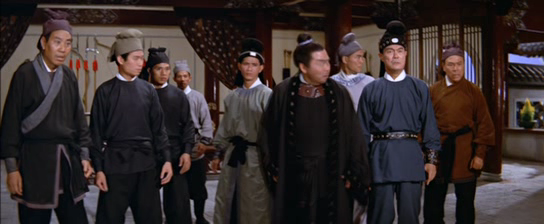
That Fiery Girl is a 1968 Shaw Brothers release directed by Chun Yen. It stars Cheng Pei-pei (Red Chili/Pearl), Chan Leung (Mei Fengchun), Cheng Liu (3rd Chief), Tang Ti (Chief Han Lung-Feng), and Fan Mei-Sheng (2nd Chief). 
Cheng Pei-pei as Red Chili

This movie was recommended to me by Gareth Skarka when he posted a Cheng Pei-pei meme online. I managed to get a decent copy of it and sat down for a viewing the other night. I enjoyed the film quite a bit. Gareth did mention he tends to prefer the later Shaws Brothers films and after seeing That Fiery Girl, I think I understand what he was getting at. While this is a good movie, it is very much in a style that harkens back to when the choreography had more of a swash-buckly feel. I do enjoy movies in this style (I think a lot of them feature a good deal of athleticism), and many of the ones I like feature Cheng Pei-pei. however, this movie was a lot less focused on the action and more interested in the characters and story. There were plenty of fight scenes, some of them quite entertaining, but I just didn't get the impression that the director was as invested in those as he was in other aspects of the film. So my review will focus more on those elements. 
Tang Ti as Chief
Hun Lung-Feng

The premise of That Fiery Girl is fairly straight forward. The Hulu Valley Bandits have been terrorizing the local population and attack the Mei Clan, killing their chief, to obtain a secret treasure map. Surviving brothers of the Mei Clan, led by Mei Fengchun, hatch a plan to infiltrate Hulu Valley and get their revenge. Their aims are complicated when Red Chili (called Pearl by her allies), the daughter of the Hulu chief, falls in love with Fengchun. Most of the film takes place in Hulu Valley after Fengchun convinces them he is a disaffected member of the Mei Clan who wants to join their organization. He becomes their fourth chief when he impressed Chief Han Lung-Feng (the leader of Hulu Valley). This creates tension between him and 3rd chief, who resents his sudden advancement in the ranks and is jealous for Red Chili's affection, establishing a key conflict that drives the film. 
The Wedding

Hulu Valley is basically a group of bandits, but it is clear that Red Chili doesn't see them that way. She feels out of place somehow and it becomes clear why by the closing scene. Early in the movie when she leads a group of her father's men to take the treasure map from Mei Clan Ancestral Shrine, she quickly loses control of them as they murder the chief and burn down the building. She reprimands them when they go too far, and demands that they stop, but they ignore her orders. 

Tang Ti as the chief of Hulu Valley and the father of Red Chili is perfect. He isn't your typical cruel and evil villain (though he can be cruel when he needs to be). There is more of a comedic, boisterous edge to his character that works. You don't hate him. You want him to be defeated in the end, but there is something a touch sympathetic about his personality and situation that I can't quite put my finger on. He is a bit of a loud buffoon and this is echoed by the demeanor and appearance of his number two, played by Fan Mei-Sheng. 
Red Chili leaning back

The relationship between Chief Hun Lung-Feng and his daughter, Red Chili, works well. The dynamic is a pretty common one in wuxia, where you have the daughter of the sect dotted on by a generous father. In a brilliant scene, when the clan has arranged for Fengchun to marry another woman, she trades places with the bride and conceals her face in the ceremonial phoenix crown so she can wed him. An endless stream of comedy flows from this absurd situation. 

Following the wedding fiasco, Fengchun's identity is revealed and he is imprisoned. Red Chilli starts to question her father's character shortly after. There is a big reveal that gives the film a tremendous pivot and helps it wrap up perfectly in the end (which I won't give away for those who haven't seen the movie). 
The towering phoenix crown,
a memorable moment

Cheng Pei-pei is great as always. Red Chili is an interesting character. Initially she is presented as hot tempered and violently confrontational but this is balanced out by an underlying goodness and naiveté. I think she has a good range as an actress and you see that here. 

The film opens with the attack on Mei Clan Ancestral Shrine and we have a few more big fight scenes throughout the film. As I said in my introduction, this is more on the swashbuckling side of things and I had the impression the director was more focused on other aspects of the movie than fight choreography. This isn't a criticism, I just don't think it is a film where the clash of swords are the most memorable part of the fights. For example I think the costuming and the building tension was one of the most memorable things about the wedding fight. There is a stark moment when Red Chili towers over Fengchun in full bridal regalia that is simply stunning (it reminded me of the wedding scene in Heavenly Sword and Dragon Saber). The blades in That Fiery Girl feel hefty and dense. That was my first impression and it remained every time swords clashed. Sometimes the blades feel light and airy but in this film it felt like they were meant to hack deep. I also liked that there was some emphasis on leaning away to evade sword strikes and spears. With Fengchun we get a fair amount of jumping in and out of melee, which is always fun.
Cheng Liu as
Fengchun's rival in love, 3rd Chief

One area where the movie really works is the intrigue and adventure elements. The reason Fengchun and his men can't just storm Hulu Valley and have to infiltrate it first, is the place is heavily forested and filled with traps. Some of these traps are things like nets that snatch the unwary, but there are always dozens and dozens of archers waiting in the trees to fire at intruders. So Fengchun's  strategic aim is to map the layout of the headquarters and identify trapped areas. This means he has to send regular messages to his allies which creates a number of opportunities for suspense and clever exchanges of dialogue. 

As a gamer it was these setting elements that grabbed my interest the most. Hulu Valley is the kind of place you can port right into a campaign and it would afford hours or days of challenge for the party. It also gives the viewer a clear window into the Hulu Valley hierarchy and command structure, as well as their daily life. There is usually a good deal of this in wuxia, but I found the presentation in That Fiery Girl clicked with me. I think a lot of GMs trying to run martial sects in their campaigns but having trouble wrapping their head around the inner workings, could get some good guidance from a viewing of this movie. 
Chan Leung as
Fengchun 

I definitely recommend That Fiery Girl for wuxia fans and particularly for gamers. It is a bit hard to obtain. If you do want to buy it, I'd recommend going to ebay rather than amazon (on ebay I found it for a reasonable price but amazon was selling it for 100 dollars). Unfortunately it is also only available in region 3 in DVD format from what I've seen. 

If you can check this one out. 


Friday, August 22, 2014

CHENG PEI-PEI REVIEWS

We have some big things going on at Bedrock and hopefully some exciting news soon, so sadly haven't had time for a proper blog entry in the past couple of days. Hopefully we will get back on track over the weekend. In the meantime I thought it would be nice to consolidate all my Cheng Pei-pei reviews into a single post. 
Cheng Pei-pei in Legendary Amazons


For those who haven't been following the Wuxia Inspiration articles, I started doing reviews of movies starring Cheng Pei-pei. She is a phenomenal actress and is a notable wuxia star from the 60s and 70s known as the "Queen of Swords". She has also starred in a number of more recent wuxia movies, including Crouching Tiger, Hidden Dragon (as Jade Fox) and Legendary Amazons (as She Saihua). But she isn't just a wuxia actress, Cheng Pei-pei appeared in comedies like Flirting Scholar and in the modern drama, Lilting. I've been strictly reviewing her wuxia movies, but her other roles are also definitely worth checking out. 

Here are the Cheng Pei-pei films I've reviewed so far. I still hope to add this list as time goes on but further reviews may require finding harder to obtain films like Jade Raksha. 

Come Drink With Me
Golden Swallow
Brothers Five
The Lady Hermit
The Shadow Whip
The Golden Sword
The Thundering Sword 
Dragon Swamp
Raw Courage

Tuesday, August 19, 2014

WUXIA INSPIRATION: RAW COURAGE

Wandering Heroes of Ogre Gate (WHOG) draws on a number of sources for inspiration. I watch a lot of wuxia movies and TV shows, and these have had a big influence not only on Ogre Gate, but on Sertorius and many of my d20 campaigns. I am hoping to share some of my favorite movies and shows in the genre here as we work on WHOG.

Note: I am writing these as a fan of the genre. I am not a movie expert or an expert in asian cinema. These are my own observations based on what I have learned by watching wuxia and kung fu movies, and by reading about them through interviews and books. But my knowledge is quite limited and I am an English speaker. So understand that my commentary comes from this perspective. 

This review contains many spoilers.

This is part of my Cheng Pei-pei review series. You can see my other reviews of her movies here: Come Drink With MeGolden SwallowBrothers Five,The Lady Hermit,The Shadow WhipThe Golden Sword, The Thundering Sword and Dragon Swamp 


Introduction
I don't think Lo Wei gets his due sometimes. That seems to be changing somewhat in recent years and hopefully continues. While no King Hu, his movies always seem to hit the right notes for me and Raw Courage is no exception. The film is a highly entertaining adventure, that has a steady pace and well done fight choreography featuring a large number of combatants. But the story itself is also engaging and epic. It draws on the familiar, a quest to save the true heir to the imperial throne, and it executes it well, using starkly drawn characters to make you care about the outcome. Above all I think the pacing is exceptional. In wuxia, where there is the need to weave story and combat, that can be tricky. I found this had exactly the right mixture of swordplay, storyline, humor and drama.

It is also a simple tale and the the whole thing feels like it orbits around this simplicity. While I have seen some criticisms of the simple plot structure and the sometimes redundant plot elements, I watched it twice in a row to see if my initial impression was flawed and I came away greatly appreciating the simple approach it takes. 

Raw Courage
Raw Courage was released in 1969 by Shaw Brothers Studio. It was directed by Lo Wei, with action choreography by Little Unicorn and Simon Chui Yee-Ang. The film stars Cheng Pei-pei (Xiuyi), Yueh Hua (Zhou), Ng Fung (Zhenxiong), Tien Feng (Yancang), Poon Oi-Lun (Huajiao), Lee Sau-Kei (Old Monster), Ou-Yang Sha-Fei (Mrs. Bai) and Yeung Chi-Hing (Old Beggar). 
Emperor Jianwen hands his son to Shangguan


The film opens with the fall of Nanjing and Emperor Jianwen, second ruler of the Ming Dynasty following a conspiracy by the Prince of Yan (who becomes The Yongle Emperor). As his city is taken, Emperor Jianwen passes his infant son to Hero Shangguan of the Black Dragon Society and asks him to keep the child safe. Calmly the emperor awaits his doom and instructs his remaining loyal ministers to flee for their lives. 

Some time later the Prince of Yan has become The Yongle Emperor and is consolidating his hold on power using a group of warriors led by Yancang to enforce his will in the martial world. The group (briefly called The East Sea Gang in the subtitles), under the direction of emperor's chief Eunuch, goes to Black Dragon headquarters following rumors that the former Emperor's son is hiding there. They promise Chief Shangguan wealth and power if he simply hands over the child. Shangguan rebukes them and tells the guests to leave. Yancang's right hand, Huajiao, reprimands the chief, saying he should fear the consequences if he refuses. Shangguan's daughter, Xiuyi becomes furious at this and demands they conduct themselves politely. 

As Yancang's prepare to leave through the courtyard, Huajiao lights off a signal (a sort of hand held firework) which alerts soldiers surrounding the Black Dragon Society to attack. A huge battle ensues and it is unclear who will win, when Huajiao hits Chief Shangguan with one of her poison darts, forcing him to retreat with his daughter and his senior disciple, Jin Zhenxiong. They hide in secret passages below the headquarters, where Chief Yancang tells Xiuyi to leave him behind as he is dying, go to his sister and take Emperor Jianwen's son to safety with his brother and their counterpart in Quanzhou, The White Dragons. Initially Xiuyi refuses, wanting to stay and fight to the death beside her father but he tells her to do so would be unfilial and unpatriotic, then kicks her aside as Zhenxiong presses her to leave and perform her father's final request. This is a tear-filled scene that works really well and gives us a sense of the main characters' virtues and loyalties.  
Chief Shangguan Poisoned by Huajiao's Dart


Xiuyi and Zhenxiong make their way to the child. After handing them the baby and the former Emperor's seal, Xiuyi's aunt commits suicide because she knows her presence will just slow them down and put the prince in danger. They depart but are attacked by soldiers as they try to make their escape to the south. During the fight a beggar in a tree leaps down and comes to their aid, helping them drive their attackers off. After the fight their savior tells them simply to call him Old Beggar. Upon hearing that they plan to head south to find the White Dragons, Old Beggar says they are too unskilled to make it on their own, and that they should go to a nearby city and meet Mrs. Bai who will instruct the hero Zhou Feiyun to help them. Stealing one of the soldier's horses they head south.
Farmer (Zhou), Xiuyi and Zhenxiong 

On their way they stop at a small cabin in the wilderness. There they meet a bumbling farmer who offers to share his table with them for the evening and serves them some of the most delicious looking stewed goat meat to appear on film. It was actually striking how enticing the meal looked, and that is a rarity in some of these older wuxia movies. The farmer is kind and timid, and cowers when Zhenxiong demands he give them his clothes (which they need to disguise themselves in the next city). As they take the clothing off his back, the farmer asks why they repaid his kindness with such cruelty and Xiuyi offers an apology. Zhenxiong says he will trade him their horse for the clothes, which doesn't satisfy the farmer, but it is the only deal on the table. 

Xiuyi and Zhenxiong arrive in the next city, where they must pass through the gates posing as local farmers. Just as are passing through, after having sweet talked the guards, the baby cries and the alert is raised. However the farmer they had robbed also arrives at the gates and creates a ruckus, screaming that he has just been robbed. This disturbance allows the heroes to escape and find their way to Mrs. Bai. They follow Old Beggars instructions but are intercepted by a singing beggar on their way to the address at Muzi Alley who warns them through song that a trap lays ahead. They ignore his instructions and are are attacked, causing the beggar (who we later learn is Little Beggar) to flee. 
Xuiyi


After a difficult fight they manage to break away, and Little Beggar points them toward an alley way, which they duck into. He then points their pursuers in the opposite direction and takes them to Mrs. Bai's current residence (Mrs. Bai is played quite convincingly by Ou-Yang Sha-Fei). There they meet Mrs. Bai's niece, Nui Nui and are told that the new emperor had her evicted. She wants revenge and agrees to help. 

Back in the city, Yancang and his men interrogate the farmer, learning that his assailants were carrying a baby. They release him and he goes to Mrs. Bai's house where he is revealed to be Zhou Faiyun. Xiuyi and Zhenxiong apologize for taking his clothes and he accepts with good humor, then says he will help escort them to the White Dragons. 

Mrs. Bai, LIttle Beggar and Nui Nui escort them to the edge of the city, where the newly formed trio departs for their next check point. The Emperor has set up a number of these and they are an important part of the plot, where the heroes have to pass through several narrow areas that are heavily guarded in order to reach their destination in the south. 

Mrs. Bai then instructs Little Beggar to retrieve his master (Old Beggar) and returns to her home with Nui Nui. There they encounter Yancang and his men, who were having Zhou Faiyun followed. We don't actually see the fight, but when Old Beggar and Little Beggar arrive after, they find Mrs. Bai dead and Nui Nui seriously injured. This was an effective decision in my opinion, because I imagined all kinds of scenarios where the great Mrs. Bai faces off with Yancang, Huajiao and the others. It also lent weight to Mrs. Bai's death. 
Mrs. Bai and Nui Nui face Yancang


Xiuyi, Zhou and Zhenxiong arrive at their next check point, trying to masquerade as mourners for their mother (which I thought was an interesting choice since it mirrors Bai's death, something they haven't learned about yet). Again they almost make it trough but a dog catches the baby's scent and the alarm is sounded. A massive skirmish unfolds with dozens of participants. The heroes easily fend off their opponents now that they've added Zhou to their ranks, and the guards back off, with their commander summoning Yancang because he knows the trio is too powerful for his men to handle on their own. 

The three heroes take shelter in a cave, as it rains. Zhou convinces them they should press through the rain to get a lead over their pursuers. Pointing out that Yancang and his men will likely take shelter from the rain as well. It takes some convincing but they eventually relent. At this point, it is clear there is a love triangle emerging between Zhou, Xiuyi and Zhenxiong, with the latter becoming increasingly jealous. 

Some time later, the baby comes down with a fever and Zhenxiong reprimands Zhou for talking them into traveling through the stormy weather. Zhou takes them to Doctor Ko, in the next city. Unfortunately Doctor Ko and his wife are crafty and working with the new Emperor. The Doctor betrays the heroes and Yancang arrives with his thugs at the doctor's residence for a marvelous swordplay scene.

At doctor Ko's, the heroes fighting skills prove superior, so much so that Yancang and his men decide to ask Huajiao's master, Old Monster, to help them. This is classic wuxia where skill level is absolute and in the face of a greater opponent you must either improve your own kung fu or find a stronger ally. 

Yancang and Huajiao ply Old Monster with drink, food and women, offering to let him marry Xiuyi if he helps them. Old Monster is a blue faced master with heavy appetites and no moral scruples. He is the perfect counter part to Old Beggar. Convinced by their offers, Old Monster agrees to work with them and they plan to ambush the heroes at an upcoming dragon dance festival in one of the cities on their way south. It is not immediately clear from the subtitles why his face is blue, but he does mention living in a cave so it could have to do with that (or there is an assumption in the genre I am simply missing and will say more about this below).
Old Monster


After they flee from the battle at doctor Ko's, Xiuyi, Zhenxiong and Zhou happen upon a cabin deep in the snowy mountains. The residence have all been slaughtered and left naked. When Xiuyi asks Zhou who did it, he simply says "It is wartime, this is unavoidable." At the cabin the heroes get a much needed respite and we see the jealousy between Zhenxiong and Zhou reach a peak, as it becomes clear Xuiyi is falling for the latter.

When the snow clears, the group continues on and arrives at the festival where they disguise themselves and talk their way into being part of the dragon dance parade. During the celebration, Yancang, Old Monster, Huajiao and their men attack the parade and the heroes flee. They nearly make their escape but Yancang guards an important pass, so Zhou creates a distraction allowing the other two to make it through. 
Trio in Disguise

In a grueling battle with dozens of men and the three evil warriors, Zhou is nearly defeated by Old Monsters, whose Kung Fu is too powerful for him, and he plunges off a cliff, leading the villains to believe him dead. 

Expecting to rendezvous with Zhou in a nearby forest, Zhenxiong and Xiuyi wait and wonder whether he is still alive. Zhenxiong confesses his love for Xiuyi who gently redirects him, saying she is promised to fulfill her father's will. This seems only to fill Zhenxiong with undo optimism. Zhou then arrives and tells them he survived a fall down the cliff when his clothes caught on a branch. 
Standing before Siwen of the White Dragons

Finally they make it to the temple of the White Dragons, Xiuyi exchanges a secret signal and gets an audience with her uncle's nephew, Siwen. In the audience she shows him her Black Dragon seal, which combines with the White Dragon Seal to form a key. Siwen's mood changes and he laughs. It becomes clear he may have evil intentions as he tells them to give him the baby and imperial seal. When they inform him they were instructed to hand the child to her Uncle directly, he says that the Uncle died. Siwen is now head of the White Dragons and plans to become emperor himself. He demands they give him the child and imperial seal. When they refuse, the White Dragons swarm and attack at the directions of Siwen. 

This is one of the best fight scenes in the movie and I will go into more detail about it below. In the end, the heroes survive and Zhou kills Siwen. They take the key from him and use it to open an underground lair that reveals a massive horde of treasure. 


In the lair, the three argue over what course to take next. Zhou suggests they raise a rebellion using Xiuyi as the leader and figurehead. Zhenxiong seems tired and worn down, wanting to give up. The exchange clearly has more to do with their affection for Xiuyi than their situation and results in a duel between the two men. Zhou wins but spares Zhenxiong as Yancang and his men arrive in the lair. 
Old Beggar Arrives to Defeat Old Monster


When the two sides clash, it is obvious the heroes can't beat the kung fu of Old Monster. Zhenxiong is impaled against a rock and it seems the other two will be next when Old Beggar arrives with Nui Nui and Little Beggar, reversing the tide. The two great masters face off, and Old Beggar spears Old Monster in the back with his staff, killing him. They then cut down Yancang, Huajiao and the rest. 

After the battle they thank Old Beggar, who apologizes to Zhou for giving him such a dangerous mission. They decide the best course of action is to take the child north to King Ling of Nancheng, who has a reputation for bravery. The film ends with them in a caravan heading to King Ling. 

Epic Wuxia
Raw Courage is an epic adventure with large scale combat and wide range of locations. Like The Golden Sword, the film spans great distance, and treats the viewer to wilderness, city and snowy mountains. I think it has all the elements of a great Wuxia movie. 

This is is a wuxia movie that has all the trappings of the genre and for that reason resembles a full wuxia television series more than some of films. I think this is largely because it has all the major stock characters. Old Beggar, Mrs. Bai, Nui Nui, Little Beggar, Zhou, Xiuyi and Zhenxiong feel like a complete team or family. And they area balanced out, to some degree by counterparts in the East Sea Gang. It is not perfectly symmetrical but it still seems to be the intention. 

There is a lot of mirroring in the movie actually, not just between the main heroes and villains but between scenes and between organizations like the Black Dragons and White Dragons, or characters like the good emperor and the Yongle Emperor. I think this was intuitional. One interesting contrast is the difference between Xiuyi who is filial and obeys her father's orders and Siwen who follows the letter but not the spirit of uncles' wishes (it is a bit unclear from the subtitles in my version if this is his uncle or his father). 

There is also plenty of humor sprinkled throughout Raw Courage. One of my favorite scenes is when Little Beggar tries to warn them through song about the trap set by their enemies at Mrs. Bai's former address. Lo Wei makes good use of music in his movies, and in each of the Cheng Pei-pei films I've reviewed that he has directed there has been at least one musical performance. This one was striking in its wit and its use of rhythm. 

The battles are large scale with lots of fighters involved. This can appear chaotic, and certainly the movie lacks the precision of Lady Hermit or Come Drink with Me, but it is still well done. In some ways I like these kinds of swordplay scenes better than those with fewer participants because the broader frame gives you the complete picture of peoples' movements. Again if you pay attention to stuff like footwork, it is still quite impressive in my view. In terms of aesthetics it doesn't appear as stylistic, but still quite athletic. This isn't the pinnacle of wuxia swordplay but it also isn't as weak as I've seen some folks say. I found much of the combat captivating.
White Dragons Circle the Heroes

Also because of the large scale fight scenes, it makes excellent use of the mass choreography. Particularly in the battle between the trio and the White Dragons, where the enemies are a swirl of white surrounding the heroes, then at the command of Siwen, encircling them individually like schools of fish in the ocean. I've seen things like this in later movies, but I believe this is one of the earlier films I've ever seen this sort of movement in and it was enchanting to watch. It was a beautifully organized scene. 

This is also a movie where it is clear you are dealing with wuxia heroes who are so skilled they can defeat dozens of troops on their own. This is firmly entrenched in the assumptions of the genre, where powerful heroes stand apart and are the artillery of bigger political players. So it isn't enough to have 10,000 guys, The Yongle Emperor needs powerful men and women like Tancang and Huajiao to stop the heroes. 

In terms of gaming this has a lot. Hiding a prince from usurpers and escorting him to safety is a standard trope in fantasy RPGs and so much of this would work for that sort of campaign. The hidden lairs, the characters, and all the rest just scream RPG to me. So I highly recommend Raw Courage for gamers on the look out for inspiration. 

In the end, I think this is a very strong movie, quite well done. 


Thursday, August 14, 2014

WUXIA INSPIRATION: THE THUNDERING SWORD

Wandering Heroes of Ogre Gate (WHOG) draws on a number of sources for inspiration. I watch a lot of wuxia movies and TV shows, and these have had a big influence not only on Ogre Gate, but on Sertorius and many of my d20 campaigns. I am hoping to share some of my favorite movies and shows in the genre here as we work on WHOG.

Note: I am writing these as a fan of the genre. I am not a movie expert or an expert in asian cinema. These are my own observations based on what I have learned by watching wuxia and kung fu movies, and by reading about them through interviews and books. But my knowledge is quite limited and I am an English speaker. So understand that my commentary comes from this perspective. 

This review contains many spoilers.

This is part of my Cheng Pei-pei review series. You can see my other reviews of her movies here: Come Drink With MeGolden SwallowBrothers Five,The Lady Hermit,The Shadow Whip, The Golden Sword and Dragon Swamp 


Introduction
Like my last Cheng Pei-pei film, this is one I hadn't seen until reviewing it. I watched it last night and was unaware until about a quarter of the way through that The Thundering Sword is based on The Heaven Sword and Dragon Sabre, a Louis Cha (Jin Yong) novel that has been made into many movies and series over the years. They took a lot of liberties with the storyline, pretty much focusing on the early part of the story and condensing everything into that portion of it. 

This is a movie that deals with martial sects and the division of them into "orthodox" and "unorthodox" (sometimes labeled "good sects" and "evil sects"). The names of the sects and their characters seem to have been shuffled and tweaked to suit the adaptation, but Cheng Pei-pei's character, So Jiau Jiau, belongs to an unorthodox sect and is the daughter of their rather ruthless chief, So Shing Fung. Her character begins as ruthless as her father, killing with little reason and taking what she wants. But she falls in love with a member of the orthodox Baiyun Temple Sect and is slowly redeemed during the course of the film. I found So Jiau Jiau quite different from other roles I've seen Cheng Pei-pei in from this period, a little more vicious and cruel. 

The Thundering Sword was released in 1967 by Shaw Brothers and directed by Hsu Cheng-hung. It starts Cheng Pei-pei (So Jiau Jiau), Chang Yi (Yu Chien Wan), Lo Lieh (Chiang Kwan Yuan) and Shu Pei-pei (Gin Hsia). It also stars Fang Mian (Chief So Shing Fung) and Wu ma (Chief Wang).


The Thundering Sword

The Master of Baiyan comes out of seclusion
This is Heaven Sword and Dragon Sabre, truncated and condensed to fit one hour and thirty minutes. The story opens at Baiyun Mountain Temple where the master has been in isolation for three months, contemplating how to deal with the threat of The Thundering Sword. According to the master, so long as it exists, sects of the martial world will fight to obtain it and use it against one another. He says it will shatter the other two precious swords and cause great disasters that will end with the earth being cracked. He sends two of his disciples, Yu Chien Wan and Chiang Kwan Yuan, to go forth and find the sword. 
So Chau-wu cripples Chiang Kwan

The Baiyuan Mountain Temple sect is peaceful and orthodox, they believe in using violence to further peace and do not kill lightly. Both Yu Chien and Chiang Kwan adhere to this principle but their lives intersect with So Jiau Jiau who belongs to a less discriminating sect that is trying to find the Thundering Sword. First she meets Yu Chien, who witnesses her attacked by bandits. She fends them off with ease, slaughtering each one without mercy. Yu Chien admonishes her lightly and encourage her to only kill when necessary. He inquires about the Thundering Sword and she claims to have no knowledge of it. They part ways but it is clear that she has fallen in love with Yu Chien. 
Cheng Pei-pei as So Jiau Jiau

Chiang Kwan encounters her after he finds and removes the Thundering Sword from a booby trapped tomb. She steals the sword with her whip and hits him with poisoned darts. After he succumbs to the toxin and passes out, she realizes he is a martial brother of Yu Chien and attempts to save him by masquerading as Yu Chien and hiring the Yue Escort agency to take him back to Baiyun Temple. On the way they meet So Chau-wu, So Jaiu Jaiu's brother and the son of the Wu Du Clan chief. The chief's son and his men attack the Escort caravan, driving them off. Believing Chiang Kwan knows the the Thundering Sword's location So Chau-wu interrogates him and cripples his body when he refuses to talk. 

So Jaiu Jaiu learns about the Yue agency failure and goes to their headquarters to kill them all. Dressed again as Yu Chien, she slaughters everyone, leaving only one man alive (though gravely wounded). After the massacre  and So Jiau Jaiu's departure from the scene, the real Yu Chien happens by and tries to help. However the remaining members of Yue Escort agency return and accuse him of killing their brothers. He flees and during his flight once again meets with Jiau Jiau. 

Chief Wang
Jaiu Jaiu offers to give Yu Chien the Thundering Sword and takes him to Wu Du Clan's compound while  her father (the chief) is away. There one of the head chief's underlings, Chief Wang, has temporary authority over the sect and the master's seal. In an amusing scene, Jaiu Jaiu attempts to deflect Wang's suspicions as she hides Yu Chien in her bed and feigns illness. She eventually seems to succeed and gives Yu Chien the sword. They attempt to leave together but Chief Wang tracks them down and uses poison to knock them out. 

At this point a bold and aggressive wandering swordsman (who I assume is loosely based on the character Golden Haired Lion King from Heaven Sword and Dragon Sabre) appears from out of nowhere and saves the two, but takes the sword. Even though he takes the Thundering Sword for himself, the wandering swordsman develops a rapport with Jaiu Jaiu and Yu Chien, offering to act as a go between for their marriage. 

The Yue Escort Agency
Because they need both the permission of both their masters to marry, they go to Baiyun Mountain Temple first. There Jaiu Jaiu must confront her first misdeed of poisoning Chiang Kwan (which ndirectly caused his maiming). While Chiang Kwan himself is prepared to forgive her and keep it a secret, his fiancé Gin Hsia overhears and tries to kill Jiau Jiau. She fails but informs their master who demands that Jiau Jiau be brought before him. In a confrontation with Yu Chien, Gin Hsia tells him to kill Jiau Jiau as retribution for the maiming of Chiang Kwan. He refuses and the two flee to Wu Du Clan headquarters. 

There, Jiau Jiau's second crime follows her, as the Yue Escort agency comes to her father asking for justice. They want Yu Chien executed. To avoid causing trouble, Yu Chien leaves but is ambushed by Yue, drugged and brought to Baiyan Temple where his master is expected to help render a verdict. In the meantime, Jiau Jiau's brother has found another Thundering Sword. It becomes unclear which one is real and which is the fake. 
Jiau Jiau swallows poison

At Mount Baiyan Temple, they are preparing to execute Yu Chien when Jiau Jiau intervenes and takes responsibility for her actions. The wandering swordsman also arrives to defend them, but it is too late as she has taken poison to punish herself for her crimes. When her brother arrives with his father, he has a duel with the swordsman to see which weapon is the true Thundering Sword. As the swords clash together they break and crack the ground. The master of Baiyun Mountain announces that the martial world will no longer feud over the sword and seems satisfied. 

As a last request, Jiau Jiau asks to be married to Yu Chien and her wish is granted. Perhaps moved by his sister's actions, So Chau-wu cuts off his own leg before Chiang Kwan and declares that they are even. 

In the final moments of the film, Yu Chien and Jiau Jiau have their wedding ceremony and she gives a prolonged farewell as she dies. 


Sword and Melodrama

So Chau-wu looking for the Thundering Sword
I have seen and heard a lot of complaints about the fight choreography. While some of it definitely falls a bit short, some of it is quite good. In particular the massacre at the Yue Escort compound stands out as smooth, flowing and elegant. There are not a lot of fight scenes in The Thundering Sword though and there is certainly much more emphasis on the melodrama. If you want more solid sword play, there are better movies like Lady Hermit and Come Drink With Me. But I don't think I share some of the consensus that what little swordplay that does occur in The Thundering Sword is wholly unimpressive. There simply isn't much of it to go around, so you have fewer moments that shine. 

This is a melodrama, which wasn't uncommon in much of the earlier wuxia (you also see plenty of this in more recent wuxia television series). The basic focus is on the redemptive arc of Cheng Pei-pei's character So Jaiu Jaiu. It is a classic situation of personal desires and wants being impeded by the codes, alliances and grudges of the martial world. In the end her character willingly pays the ultimate price for her crimes to save her husband's life and restore peace in the Jianghu. 
Yu Chien wrongfully condemmend


While some of the plot points and twists feel a bit out of the blue, they make more sense if you know the Heaven Sword and Dragon Sabre story. For example, while it seems like they just inserted a duplicate sword midway through for little reason other than lengthening the plot, this actually fits the source material and is a very important piece of the backstory. The problem is, that is difficult to convey in a one hour and thirty minute time frame. 

For gaming there is actually a lot here. The trapped tomb, the two swords that fulfill a sort of prophecy, and the feuding sects all make for great adventure material. This isn't the best version for the story to go to for that, but there is still a lot to pull from the film. 

Thundering Sword does have its flaws. Some of the edits feel abrupt and I suspect it might be a bit confusing if you are not already familiar with Heaven Sword and Dragon Sabre. I was familiar enough with that storyline that it wasn't a problem to follow but I don't know how the movie would play for someone who hasn't seen a more complete adaptation of the story. I might advise watching one of the television versions of Heaven Sword and Dragon Sabre before viewing The Thundering Sword. This is a soaring melodrama with infrequent but occasionally elegant swordplay scenes. I recommend this but cautiously. It feels dated and it is heavy on the sentimentality (though not always in a bad way). Some of the action sequences are nice, some less so. 

Monday, August 11, 2014

WUXIA INSPIRATION: THE GOLDEN SWORD

Wandering Heroes of Ogre Gate (WHOG) draws on a number of sources for inspiration. I watch a lot of wuxia movies and TV shows, and these have had a big influence not only on Ogre Gate, but on Sertorius and many of my d20 campaigns. I am hoping to share some of my favorite movies and shows in the genre here as we work on WHOG.

Note: I am writing these as a fan of the genre. I am not a movie expert or an expert in asian cinema. These are my own observations based on what I have learned by watching wuxia and kung fu movies, and by reading about them through interviews and books. But my knowledge is quite limited and I am an English speaker. So understand that my commentary comes from this perspective. 

This review contains many spoilers.

This is part of my Cheng Pei-pei review series. You can see my other reviews of her movies here: Come Drink With Me, Golden SwallowBrothers Five,The Lady Hermit,The Shadow Whipand Dragon Swamp 


Introduction
The Golden Sword was released in 1969 by Shaw Brothers Studio and directed by Lo Wei. It stars Cheng Pei-pei (Jin-Feng), Kao Yuen (Bai Yu-Lung), Wang Lai (Lung Xin-Zi), Lo Wie (Bai Chun-Tung) and Wong Chung-Shun (Saintly Swordsman Luke). Action direction by Sammo Hung and Simon Chui Yee-Ang. 

I saw The Golden Sword for the first time right before doing this review and I think it might just possibly be my favorite Cheng Pei-pei. At the very least The Golden Sword sits right beside Lady Hermit and Come Drink With Me. It has also greatly added to my admiration for Low Wei as a director, who also directed The Shadow Whip and Dragon Swamp. Like those movies movies The Golden Sword puts much of its focus on story and has an adventurous quality. Lo Wei seems to make good use of Cheng Pei-pei's talents beyond wielding a sword. For example we are treated to her singing and dancing skills during a music number at the Beggar Sect camp. 

In Golden Sword Lo Wei also delivers romance, secret societies and a vast span of landscapes. It is a film where you get to witness characters develop over years. There is a mystery at the heart of the Golden Sword, and from the very first scene I was intrigued by it, finding myself eager to know the contents of a mysterious box delivered to a great master. The mystery only deepened and the box once open led to more questions I wanted answered. But following the characters over their years long journey through, the answer was worth being patient for. 


The Golden Sword 
The film opens at the Golden Sword Lodge on a stormy night, where two mysterious masked riders approach and demand to see Chief Bai Chun-Tung. When the Chief's men ask for further information, they are simply given a small box and told that Chief Bai will know who they are. With a foreboding look, he walks outside and and joins the riders, saying to his men "don't wait for me" as they take him away. 

Seven years later we are at a meeting of the 36 schools and they are about to elect Chief Ng as his successor after seven years of fruitless searching for their lost master Bai. Chief Ng promises to honor the memory of Chief Bai when his son, Bai Yu-Lung requests permission to go search for his father for three years. The Chief admires Yu-lung's dutifulness toward his father and grants permission. 

Yu-lung travels west, beyond the frontier and into a small mountain community where corruption reigns. By this time he has already been on the road for two years. He meets a young beggar named Jin-Feng who he mistakes for a young boy. Like many movies in this genre, simply donning a cap and wearing plain clothes is enough for women to pass as men. Worried for her safety, he gives Jin-Feng some food and later invites her to his room. Concerned about decorum, Jin-Feng is reluctant but eventually sleeps on the floor and evades joining him in the bed by claiming to have lice. 
Jin-Feng as beggar

That night a gang of thugs led by a man named Black Demon, accuse Bai of stealing silver they were going to transport for a trio of men called The Three Cripples. Black Demon works for Chief Yao, who regularly transports money for corrupt officials in the region. As a fight break out, Jin-Feng reveals she was the thief, and then massacres the Three Cripples. She leaves saying if Chief Yao wants to confront her about the silver he can meet her at Happy Pass. Bai asks the innkeeper where this Happy Pass is, and he says it can be anywhere, as it is the camp of the Beggar Sect. 

Jin-Feng goes back to Happy Pass and joins her fellow beggars at their camp. It seems she is the daughter of the leader, Beggar Chief An (though this might not be an actual blood relationship, it is unclear from the subtitles). Jin-Feng changes into female attire and tells Beggar Chief's wife that she is expecting a visitor. Bai arrives shortly after and they throw a celebration for him, complete with a full musical number. 
Jin-Feng in beggar camp

Chief Yao arrives in the camp the next day, demanding his silver, and Beggar Chief An playfully refuses, claiming he has spent all the money so there is nothing left to give him. Jin-Feng tells the chief that if he wants his silver, she is the one who took it. They fight and she kills him, quite brutally, leading to a battle between beggar sect and Chief Yao's men. The beggars easily defeat the chief's forces and after, as Bai is about to depart to continue his search for his father, Jin-Feng offers to go with him. 

They spend the next year searching together but fail to find Bai's father. Returning to the Golden Swords, Bai and Jin-Feng marry, attended by Chief Ng, Beggar Chief, and Keeper Pang, as well as numerous other guests. The next morning a mysterious iron box arrives as a wedding gift. Too heavy to lift, when they open it, it reveals a smaller box inside, followed by another, then another. The final box contains the Golden Sword of Bai's father. 

As soon as the sword is revealed two masked riders reach the lodge and demand Bai come with them. Bai, Jin-Feng and the rest of the wedding guests try to fight off the riders but their martial skills are too great and they take Bai with them (though not without losing a horse). When Keeper Pang inspects the horse's body he finds an emblem and tells the others it is the seal of Dragon Palace, a place people have only heard whispers about. Pang informs them that Dragon Palace is real and to be feared. In a major twist, he removes his face, which was just a mask, and the others recognize him as a man who disappeared thirty years ago called Saintly Swordsman Luke. According to Swordsman Luke he was trapped in the Palace but escaped, meeting Bai's father in the process, and both changed their identities. Jin-Feng convinces Swordsman Luke to take her to the palace to rescue Bai. 
Keeper Pang reveals he is Saintly Swordsman Luke

On their way they find Red Leaf Valley, Swordsman Luke tells Jin-Feng the tale of his journey to Dragon Palace to learn their superior techniques, that they have severe laws and are ruled by women. After fighting their 7th Lady in Red Leaf Valley,  Luke was sentenced to a lifetime of labor at the palace for trespassing. Bai's father was just a cowherd who saved found a young woman poisoned by a snake. He sucked the venom from her wound and as a reward she took him back to the Palace, taught him her techniques and married him. She was also the master of Dragon Palace: Lung Xin-Zi. However Dragon Palace has a strict rule that all first born males be killed. So Bai's father took his son and fled, meeting Luke and helping him in his escape. 

7th Lady of Dragon Palace easily defeating Luke 
After telling her his story, a strange mood descends on the Red Leaf Valley and Luke panics, flashing back to his time in hard labor. He flees and Jin-Feng vows to find Bai on her own. Eventually she finds a lady of the palace who offers to help, but informs her that Bai has already left. 

As Jin-Feng and Luke were trying to rescue Bai, he had already made his escape and found his way back to the lodge. There he finds everyone has been paralyzed so releases their pressure points to learn that they are under threat from Dragon Palace. A woman called the Executor arrives and her lackeys bring in Saintly Swordsman Luke. She plans to kill him but Bai obstructs her, finding himself on the receiving end of powerful internal energy techniques. A masked woman in black swoops in and rescues Bai, taking him back to Red Leaf Valley to reunite with Jin-Feng. His rescuer is Lung Xin-Zi, who is trying to protect her son, but says according to Dragon Palace law, even the Master must abide by their rules, so she can't do so openly. She tells Bai that his father is alive and was sentenced to 10 years labor, which has almost elapsed. She blesses the marriage and promises to abolish the laws that have torn their family apart. 
Lung Xin-Zi

At a dramatic ceremony she says she wants the laws abolished and asks the executor to inform the sect how that can be done. Pointing to a massive rock with the laws engraved on it, the executioner tells the women of Dragon Palace that the the laws can only be abolished by the blood of the master. They plead with their leader not to sacrifice herself, but she stands atop the rock and strikes own chest, releasing a flow of blood onto the stone inscription. 

The next scene is Bai, his father and Jin-Feng walking up the steps to the rock to pay their respects to Lung Xin-Zi's memory. 

A Mystery within a Mystery
The Swordplay is all very good but this isn't a wuxia film that is only about the fights (again, Sammo Hung was one of the action directors). There is a dense and epic story here, and that is what matters more than the fighting. Still it has some truly great scenes in this department. There is a playful exchange when Bai first goes to the tavern in the mountain village, where he fends off his attackers with chop sticks as they try to take his roasted chicken. Cheng Pei-pei's fight with the Three Cripples ends suddenly with their deaths, and this works well. You are expecting a longer fight but she beats them in under ten moves. In most of Cheng Pei-pei's swordplay scenes she easily outmaneuvers her foes and delivers stunningly lethal strikes. Her battle with Chief Yao is particularly gruesome and stark in this regard. Notably, she goes to rescue Bai from the Dragon Palace, not the reverse. And he is ultimately saved by his mother, rather than his father. 
Jin-Feng facing Chief Yao's men


More than the swordplay, it is the mystery of Dragon Palace that drives Golden Sword. And it is a deep riddle. This secret and widely feared organization is led by women and enforces its laws with great cruelty. In Dragon Swamp, Lo Wei also had a secret society of female warriors, but that one was a force for good. This is the inverse, with a society of women who punish men and live by a code that demands blood. 

One thing I really liked about the Golden Sword is the wide variety of settings. It isn't a martial arts movie that hangs out at the same villa for two hours. We go from villa to wilderness, to snowy village, to beggar camp, to many places along the red before reaching Red Leaf Valley and Dragon Palace itself. It coursed over these environments like a tour. 
Bai fencing with chopsticks


For gamers I think I'd recommend this over all the other Cheng Pei-pei movies. There is just too much here to pull for a game. I found myself taking notes to use for future sessions as I watched. You could easily take this movie and turn it into three or four adventures. 

The trailer below gives a good idea of the kind of swordplay and story to expect.