Monday, January 28, 2013

Arrows of Indra Art Preview

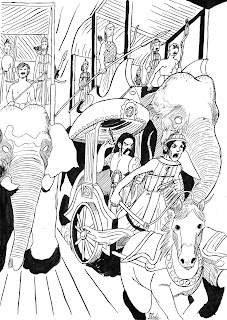
Arrows of Indra is in layout and being prepared for publication. It should be ready soon, though it is a bit too early to give a specific date. For those who are wondering what the setting might look visually, here is a small preview of some wonderful interior images by Federico Pintos .

 
This one is a Giant 7-headed Cobra.


I really like the Vanara in this image.

A Vyala on the rampage.


And finally, chariots and elephants.


Wednesday, January 23, 2013

An Interview with Monte Cook: game design, world building, and Numenera

Monte Cook was kind enough to let me interview him about game design and world building. It was conducted by email and this is the full interview (I did not edit down for space or style).   

On  Design and Gaming


Brendan Davis (BD): What is your design process? Where do you begin and what sorts of questions do you ask yourself early in the project?
Monte Cook (MC): It depends greatly on the type of project; designing a game, designing an adventure, or writing a short story, etc., are all very different. I suppose, however, that I look at what I can do that's new and different. I'm not interested in rehashing things that have already been done. If I can't bring something new and original to the table, I don't want to work on it. Even if it's a new take on something old, that's better than doing "just another ____ ."
That, of course, requires that I become at least passingly familiar with much of what's been done in that area or is being done. I've always tried to keep my finger on various pulses. If I do it right, then I'm not just giving readers/gamers what they want, but what they're going to want later and perhaps don't even know they want yet. I don't want that to sound condescending, but it's not their job to anticipate needs like that. It's mine.

BD: As you keep up-to-date with the RPG industry, are there any trends that you notice and feel particularly excited about? Is there anything new that you put your own twist on in Numenera?
MC: I like that's there's a trend toward innovation. I think people are eager to see new and interesting stuff in both the mechanics and setting. There are far fewer examples of "just another elf book" or "yet another licensed game."
If Numenera twists a trend, it's on player empowerment. I think a lot of games are putting more power in the players' hands, narratively speaking. I think that's great, but personally, I think too often that empowerment comes at the GM's expense. In other words, games are empowering players by making them kind of "mini-GMs."
Numenera empowers players not by taking power from the GM and giving it to players, but by taking power from the game and giving it to players. In other words, players don't exert influence on the narrative by changing or creating things outside their characters, but by having more power over how their own character performs and what happens to him or her. In Numenera, players can choose to prioritize tasks, to help ensure that they have a much better chance to succeed at the ones they deem the most important.
 
BD: What is your approach to playtesting?
MC: I recently wrote at length about this, but to sum it up quickly, it's like that old joke about voting: do it early and do it often.
I start playtesting the moment I've got enough of an idea to play something just to see if it's worth pursuing. That's the alpha test. Then I write up something that's vaguely playable and give it to others to test without contact with me. That's the beta test. At the very end, I also like to send a "ready to go to the printer" version off to some brand new testers to see if I've missed anything.

BD: You got your big break in the industry doing work for I.C.E. (makers of Rolemaster) and you went on to help develop one of the most popular editions of Dungeons & Dragons. Rolemaster and D&D are two strikingly different games. Did your experience with the more realistic Rolemaster shape your contributions to 3E? How did the experience shape you as a designer?
MC: I'm not 100% sure the two games are truly all that different, but I see your point.
All of us that worked on 3E credit the games that we worked on and played beforehand with playing a role in 3E. Jonathan, for example, credits Runequest and Over The Edge. For Skip it was Top Secret and Gamma World, I think. All humans are just the sum of their experiences, and so of course lots of things influenced us. It's very difficult, however, to pull apart a game like 3E and say, "this part comes from this game and that part comes from that one." It just doesn't work that way. At no point did one of us say, "I like the way skills work in this game, so let's do them just like that." It's just a lot more complex and nuanced than that.
Of course, the biggest influences on 3rd Edition D&D were all the prior versions of D&D. People forget about that a lot.
In general, though, I owe a lot to my days at Iron Crown for showing me the basics of doing the job the right way: making deadlines, doing quality work, paying attention to what gamers want, and so on. I worked with a lot of great, creative people there.

BD: You designed Call of Cthulhu d20 with John Tynes. I think a lot of people were surprised that the d20 version of Cthulhu was so good (I know I was). From a design standpoint, what had to be done with d20 to make it work for Cthulu?
MC: Thanks?
Less had to be done than you might think. Classic Call of Cthulhu came out in the early days of RPGs, when every game was heavily influenced by D&D. Stats on a basically 3-18 scale, hit points, making an attack roll and then a damage roll, and so on all equate pretty naturally with d20. Sure, the skill system is different, but skills are skills, and if you understand probabilities you can make them work more or less the same.
Classes had to be ditched (more or less), but I kept levels not so much to show progression but to enable GMs to peg different games or campaigns in different ways. Want the classic CoC feel? Use low levels. Want a pulpy, action-oriented game where you don't run from the deep ones, you mow them down with a machine gun? Use mid-levels. Want a Titus Crow style campaign (a la Brian Lumley), play high level. People play Call of Cthulhu in very different ways, and I wanted to use d20 to make that even easier to pull off.

BD: I phrased that question somewhat poorly, and it came off as a backhanded compliment. What I meant to say is people were surprised to see a new version of a game for a different system rival the original in quality (a bit like the Godfather II equaling or exceeding The Godfather).
From beginning to finish it is an excellent book, but for me the Gamemaster and Stories chapters really stand out. Normally sections like this in an RPG book don’t make much of an impression, they tend to be a bunch of advice we’ve already heard. What do you think you did differently here that worked so well?
MC: Get great thinkers like John Tynes, Ken Hite, Dennis Detwiller, Adam Scott Glancy, and others to contribute. Seriously.
(And for what it's worth, if our positions were reversed, in retrospect I probably wouldn't have expected a d20 Call of Cthulhu to be any good either).

BD: You have mentioned the importance of keeping failure as a risk in games (specifically on the topic of eliminating anything deemed “un-fun” in an RPG system). When it comes to mystery adventures this is a recurring issue because so much hinges on the acquisition and analysis of clues. What are your thoughts on this subject in regards to investigative modules? Is there a place for adventures in which the players might fail?
MC: I think the key is to give multiple avenues for success. If the PCs have to find the secret compartment in the study or the adventure is over, that's probably a poorly written adventure.
This is true of any kind of scenario, though. If the PCs can't sometimes sneak or talk their way past the monster, and must fight, that's just a different kind of railroad. I'm reminded of when Return to the Temple of Elemental Evil came out, some people complained that it was too much of a slog with battle after battle. I was initially surprised, because in the playtests, the characters bypassed the vast majority of that through subterfuge, deception, and diplomacy. What Gygax probably would have called "intelligent play."
The problem was that 3E was this new, very tactical system that practically begged you to put miniatures on a battlemat. As soon as you do that, for many players, that means "fight." In that way, I think 3E unintentionally changed the expected way the game was played. In many ways, at least for some people, it was the game system itself that railroaded the way adventures went. And then 3.5 and 4.0 embraced that tendency rather than eschewed it, and the modules all intentionally became just fight after fight (interesting fights, to be sure, but still combat was clearly the only focus).
But I digress.I do think that you can design an adventure that players might not finish. I've done so.
The Labyrinth of Madness was a 2E style adventure a la the Tomb of Horrors that was designed with the idea in mind that very few people would actually get to the end. This was not because the fights are so hard, but because the mystery/puzzle of the whole thing is so difficult. What I did wrong (and what Gary did right with Tomb of Horrors) was that I didn't build in a lot of places where it was easy for a group to just say, "Okay, we're done here." If I was going to do an adventure like that again, that's what I'd do.

BD: What elements of design are most important to you?
MC: Creativity and fun. What those often translate into is, "give the players an experience that they haven't had before" and "do the GM's work for him or her."
If I design an adventure that's just another orc lair that anyone could have come up with, that fulfills the second goal but not the first. If I design something that's a jumble of cool ideas, and that's it, then I've fulfilled the first goal but not the second. If I have to err on one side or the other, however, I'd go with the jumble of cool ideas rather than just another orc lair.

BD: Not everyone is sold on modules, and it seems there was a period of time when they were not as valued as they once were. Personally I really think they add to a game line, but people often point to the shortcomings of the module format (which can pose challenges when in use at the table). In your opinion, what do modules contribute to the hobby?
MC: I'm a huge proponent of pre-made adventures. For one thing, it just shows you via example the kinds of things players can (should?) do in a game.
I also think that just reading adventures written by other people makes us better GMs. You wouldn't, for example, want to read a book written by someone who never reads books, right? GMs (and designers) fall into ruts quite easily, often without knowing it. There's a lot of inspiration to be found in reading modules—and I can't stress this enough—even if you're not going to run them, or run them as written. If even just one encounter, one plot thread, or one NPC inspires you to create some cool adventure of your own that you never would have imagined before you read it, you're better off. I know that's worth my money right there.

BD: What kinds of RPGs do you personally prefer? If some other designer out there were to make a game specifically for Monte Cook, what ingredients would it need to have?
MC: Nowadays, I like games that are streamlined and elegant, with rules that focus on how the game is actually played—in other words, making sure the table's needs are being met. I roll my eyes at mechanics that are new just to be new, but I adore mechanics that are new because someone's figured out how to do something a better way. Ultimately, that's what good RPG design is about today. Not about always doing something new, it's about doing something we've been doing for 30 years in a better way.
The elements it would need to have would be something really imaginative and cool. Orcs and elves have been done. And yes, I'm certain that there are still new and better ways to do them, but you said that someone was going to design a game specifically for me, and in that case, it's going to be something other than Tolkien fantasy, Lovecraftian horror, or Star Wars space opera.
This is not because I don't love those things (I absolutely ADORE them!), but because I already have them. You can buy me the best green sweater in the world for Christmas but if I already have a closet full of fantastic green sweaters, just how excited am I going to be?

BD: You launched the A+ campaign (a one-month commitment to stay positive) back in July. In an interview around that time, you also mentioned the problem of some gamers not accepting the tastes of others as valid.
I can certainly remember gamers being passionate since I started playing in the 80s, but it does seem like gamer’s opinions are a lot more intense and hostile lately. How do we, as a gaming community, preserve constructive debate and discussion as we tone down the rhetoric? Where is the line between constructive and destructive criticism?
MC: Here's my rather harsh viewpoint on this. There has always been a lot of thoughtful discussion about RPGs. It's just that now, with the Internet, that discussion is being done in public rather than in small, self-selective groups. In the 80s and early 90s, these discussions were located in APAs, in game stores, in game company meeting rooms, or around game tables. Those older, closed, venues were self-selective, so people who didn't gel with the others weren't welcomed back in.
In the open arena, for every one person interested in thoughtful discussion, there seems to be at least one person interested simply in putting forth an agenda. In other words, many people just don't understand the difference between examining something critically and tearing it apart. They don't understand the difference between analysis and advocacy. "Discussing rpgs" becomes "proving that the RPG I enjoy is the best."
When I started playing RPGs, and even for the first 10 years of my professional career, sure, there were discussions about whether Traveller was better than MegaTraveller, or whether the Hero System was better than GURPS. There wasn't the idea, though, that if you played one game, people who played other games were playing RPGs wrong.
That kind of strange, defensive way of looking at the hobby is relatively new. Frighteningly, it creates the kind of self-destructive toxicity that may one day destroy tabletop RPGs. If that happens, people will say that computer games finally killed tabletop games, but you, I, and a few others will know that's not true. Tabletop RPGs weren't murdered. They committed suicide.
But it doesn't have to be that way.
This toxic atmosphere among gamers started about 15 years ago, and it's escalated since then. It worsened even more a few years ago, when some professionals in the industry believed that they should get involved in those kinds of discussions.  They used this kind of "you're playing games wrong" sort of approach to try to sell their games (or the new edition of their existing game).
I don't know how to push us back from this brink, but I know that a lot of people quietly want to see it happen. They've all but dropped out of the endless edition wars and old school versus storygame labeling nonsense, so you rarely hear from them, but I think there's an eager part of the RPG audience that just wants to get back to having fun the way they want to have fun without worrying about what someone else has to say about their game or play style.
I think that smart publishers will start catering to them more and more. If they don't, those level-headed gamers will eventually get tired and fade away. All we'll be left with are the argumentative assholes, and I don't want to design games for assholes.

World Building


BD: Can you talk a bit about the microscope approach?
MC: You can look at any kind of setting material at different magnifications of your "microscope." I can write up an entire kingdom in three paragraphs, mentioning the ruler, the largest cities, maybe some geography or political information, and that's it. That's low magnification. Or I can crank it up, and write about the same kingdom in 3 pages, and in those pages you might learn the previous info, plus the king's sons' names and personalities, lots of history, the main exports, details about the haunted woods in the middle of the kingdom, and so on. Or I can increase the magnification to its highest and write a whole book on that kingdom. You might get all the above and also learn about the king's eldest son's dog, get maps of all the largest cities, and get entire adventures set there.
The level of magnification isn't related to the size of the location. I can write three paragraphs about a kingdom, and then three pages about a tiny village in that kingdom. The point is that different areas need different levels of magnification based on how they will be used. Some GMs don't want a lot of detail, and they want to run with their own stuff just based off a few general ideas. Some want or need a lot more detail due to ability or time. Sometimes, you present certain things with greater magnification because those details are needed. I might design the product in question so that the players aren't expected to get involved with kingdom politics but will start the campaign and spend a lot of game time in that village. Thus, the village gets three pages and the kingdom gets three paragraphs.
The only reason this is important is that it doesn't seem logical at first. Logic might suggest that every location of a particular type or size should get the same treatment, and that larger areas should get more verbiage. This leads us, however, to game products where all the kings and epic-level wizards are statted up, but we get no detail on the stuff that characters (particularly starting characters) spend most of their time dealing with.

BD: Do you have any other world design principles you incorporate into your work?
MC: If it's not necessary to what goes on at the table, it's probably not worth putting in the book. And if it's worth putting it in the book, it needs to be really interesting both at the table AND to read.
Oh, and one more principle: in a world of fiction, it's okay to have one "thing" that needs doing: one dark lord to overcome, one evil artifact to destroy, or whatever. But in an RPG setting, you need many things that need doing, because PCs need to do a lot of different things, and they need the freedom to choose which things to do.

BD: What areas of knowledge are important to world building?
MC: All of them.
Okay, that's kind of a flippant answer, but it's also kinda true. World building is one of those things that kind of forces you to know a little about a lot, or at least where to get the information.

I think, however, that one area is often overlooked: what do the normal people do in a particular place? For traditional fantasy games, that means not only knowing about Medieval-style warfare, politics, etc, but also about daily life. This is so important because a large number of the people that the GM will end up portraying are "common folk."
Even the players need to know what the alternative is to the adventuring life. They need to understand (at least a tiny bit) what the real world is like if for no other reason than to contrast it to a life of monster slaying and dungeon delving.

BD: This seems to be the biggest challenge for many GMs and designers (finding the daily life details). It can be a challenge to research this sort of information and it can be so easy to invent stuff that doesn’t feel grounded in something real. Do you have any tricks or techniques for finding that believable street level view of a setting?
MC: The trick, I think, is to somehow get the point across that your average Joe or Jane in the fantasy world's daily life is pretty different from the players', without making it so different that it's un-relatable. Is it important for someone playing D&D to truly understand feudalism? Is that going to enhance their game experience? Probably not. Is it important for the players to realize that the huge bags of coins they are carrying are likely more than most people will see in a year, or perhaps even their lifetime? Yeah, I think so. That actually gives useful perspective.
The other issue is immersion. I think understanding what life is like in between the dungeon exploration (or the shadow missions for the megacorp, or hunting deep ones, or whatever) helps with immersion, and that's something that a lot of players feel is really rewarding.
There's a great book called Life in a Medieval Village by Francis and Joseph Gies that I really like. They also did Life in a Medieval City and Life in a Medieval Castle. I recommend them to anyone running a traditional fantasy game.

BD: A lot of GMs draw on history, particularly for fantasy settings, but even for science fiction you can see traces of real world history. Are there historical periods or types of history that you find particularly inspiring as a designer?
MC: I have a degree in Ancient History and find Egypt and Greece to be two favorites. I'm also fascinated by Sumeria.
BD: Where does most of your inspiration come from?
MC: I started to type "fiction," and then deleted it, then I started to type "real life" and deleted it. I'm now tempted to say "gaming." I guess I'm influenced by the creations of others, the real world, and by things that come up spontaneously in games. I don't know which one provides the "most" Inspiration.

BD: Ptolus is very large. It is one of the most ambitious world building efforts out there. What did you learn working on Ptolus? Anything you would do differently if you did it again?
MC: Ptolus is where the microscope approach that we discussed comes from. It also really crystalized the kinds of things a GM needs as opposed to the kind of thing that game designers want to write about. You know how the players will often say, "we find someone on the street to tell us what's going on." Ptolus needed sections on "random people in the street" for GMs. It needed something to tell the GM how long it takes to get from Oldtown to Midtown on foot as opposed to in a carriage. It needed a layout that allowed GMs to find out more about a particular name mentioned in one location without flipping through 100 pages of other info. In other words, it needed information that really came up at the table. Ultimately, a game designer is there to fill the needs of the GM and players. I guess I keep coming back to that.

BD: It seems like you relish the research aspect of world design, can you talk about your approach to research?
MC: I am an avid reader, and love having a good excuse for learning new things. I don't know that I do anything different in that regard than anyone else.
 
BD: There is a lot of advice out there on world building. What advice, if any, do you think people should ignore? What do you find the most useful?
MC: I think it depends on what you're doing it for. If it's just for yourself and/or your home RPG campaign, do whatever you wish. Go nuts. Creation is fun. Sometimes, making stuff up for your homebrew world is an end unto itself. It's a part of the game that the GM can play by himself or herself, and there's nothing wrong with that.
If it's for a work of fiction, you can still have that fun, but make sure that what you put *on the page* is only what the reader absolutely needs. I don't need to know the political history of every village that the main character travels past.
If it's for an RPG, you need to fall somewhere in between. The GM needs to know more than the fiction reader, and truthfully, more than is ever going to likely show up at the game table. However, if it might actually come up at the table, give him or her the information. Different GMs will need different information as their campaigns progress. Arm them both either with the information, or at least with enough of an idea so that they can make it up themselves.

BD: How important is it for the flavor of a setting and the mechanics to support each other?
MC: I think it's vital. That doesn't mean that one set of mechanics can't apply to multiple settings or vice versa. But the designer or the GM has to give a lot of thought to how the two speak to each other.
The example I always pull out is this: in 3E D&D, invisibility is only a 2nd level spell. It's not that rare. The people who live in a world dictated by those rules aren't going to be shocked if a character can be invisible. They're going to have at least heard of such a thing. Conversely, if I'm running a game set in Middle Earth, I shouldn't see a bunch of clerics running around. It's not true to the setting. Those are both obvious, but they illustrate the point that setting and mechanics need to speak to each other and inform each other.

BD: How has your work on Numenera’s Ninth World been different from your previous world building efforts?
MC: Two things come to mind. First, I've never spent so much time trying to really define what is true to a setting and what isn't. It's always been clear in my mind, but trying to convey "that's too fantasy" or "that's too sci-fi" to artists, editors, and readers has been a challenge. But I like a challenge.
Second, it's weird to have a setting that has so little grounding in its own history. That is to say, there is so MUCH history in the Ninth World —a billion years— that the individual details of history have little meaning. The history of the world is strange, mysterious, and unknown in the Ninth World (it's part of the setting's conceit), so it's not like we say, "this ruin is from the time of Emperor Blahblahblah who fought the great wars of Such-n-Such 10,000 years ago." In the Ninth World, it's an ancient ruin filled with mysteries, wonders, and oddities. The historical context carries no import—the weirdness and wonder are what is important.
I guess another way to put it is, in the Ninth World, even though it is filled with mysteries of the lost aeons, it is the present that matters, not the past.


Friday, January 18, 2013

Stay Tuned for Monte Cook Interview

Just finished an interview with Monte Cook and will put it up on the blog soon. Stay tuned.

Saturday, January 5, 2013

Playtest Report Friday, January 4, 2013


This was a short session with three players. All were Sertori. They were engaged in a diplomatic mission with Queen Sabeen of Besra trying to negotiate favorable terms with Ronia for her upcoming invasion of Khata.

In an attempt to learn more about Khata, player C attempted to use Thekla’s Secret Pathway to travel there. He failed and the failure resulted in two ghouls attacking him and player B. By the book these should have been spirits, but we do not have a spirit entry in the monster section. The combat was challenging. If they were not in the palace, where the guards were able to save them, at least one of them would have died.

Before the invasion they traveled to Chun, a key trade city that was to be the first step in the invasion. Everything went smoothly until they were attacked by Hasri. One of the Hasri was a Sertorius. This combat proved easy for the players. Again it was player B and C, as player A was back at the inn.

The party returned to Queen Sabeen’s army. They had learned that Khata was ruled by a council of 13 Sertori, so they secured 20 Sertori from the Fellowship of Promestus to aid the Queen on the condition that she give them exclusive access to the Khatan tea fields.

Chun fell without blood. The Khatan army advanced but Queen Sabeen destroyed it with the Rain of Fire Thauma (a miracle), leaving the 13 Khatan Sertori. We left off as the two groups of Sertori were about to fight (13 for Khata, 25---including Sabeen and the PCs---for the Marites).

Observations
Open Skills and Spells: We need to specify for spells that use open skills, what happens when there isn’t an exact match. For instance, if a Spell calls for Talent, what talents can be used and what happens if the player has the wrong talent. In the case of Thekla’s Secret Pathway this was an issue. I am inclined to require the correct skill, otherwise 2d10 take the lowest.

Heal: Emotions don’t really impact the non-cathartic casting. We should remedy that. Also there should be some ability to overflow the healing onto other characters.

Emotion ranks and spells: We have been a touch sloppy with some of our spells. They do not all factor in emotion ranks thoroughly. So we need to make sure we do this.

Spell Clarity: We should go over our spells and examine them for clarity.

Powerful Sertori NPCs: Thauma are powerful. Very, very powerful. This is good. It works as intended. But when you have a strong Sertori NPC (Queen Sabeen became Divninity rank 4 this session) it can result in the PCs being observers and the character becoming something of a Mary Sue. Nothing mechanically need be done about this, but it will be important to address in the GM section. In this case the players chose to ally themselves with Queen Sabeen, so it wasn’t forced on them. But running it I was a aware that her being so powerful meant they could just sit back at times and let her take care of things. On the other hand, this did serve as good incentive for the players to attract followers and grow in power.

Spirits: We need spirit entries in the monster section.

New Ideas: Players proposed some new ideas. The first was to include a way for Sertori to change existing spells. While I understand the desire for this, and see nothing wrong with an optional rule for it, I feel it would be highly disruptive to the setting concept to allow in the core rules. So if we do include this sort of thing, we should carefully look at how we explain Sertori. 

Saturday, December 29, 2012

PLAYTEST REPORT, FRIDAY DECEMBER 28

PARTY: halfing with potent agape spells, a Kash human (who replaced their orc) who is strong in Deimos, and an elf with a knack for penthos. A new player also joined and made an Ogre, which will be useful in playtest.
 
Events
In this game the characters just finished defeating Tohireo the dragon and went to the Marite Kingdoms to negotiate with Queen Sabeen of Besra, who had recently refused tribute to the Ronian Empire. On the way they encountered slave traders but avoided them. A few days later they encountered halfling tea merchants who told them that Queen Besra is preparing for war with Khata and has announced herself a goddess.
Player C used Thekla’s secret pathway to report this information to the Fellowship of Promestus. On his return, he attracted the attention of a Guardian Beast of Lorgo while in the ethereal realm. It followed and attacked, nearly killing player B. The Guardian Beast, an 18 foot tall white mammoth, demanded a sacrifice to Lorgo in the form of the character’s horses (because it deemed this a fair exchange for abusing the ethereal realm).
After the battle the party arrived in Talyr and tried to get free horses from the stable master by reading his fortune. The stablemaster was infatuated with a woman named Druna and wanted the Sertori to help him win her over. Player C cast Tearing the Veil and had a vision of the stablemaster beheaded by Druna’s brothers (presumably fed up with his efforts to win her love). In the end the stablemaster agreed to go with the players and bring his horses along (since it was clear his only real option was to flee Talyr before the beheading).
In Besra they met with Queen Sabeen who said she wanted Ronia to pledge soldiers for her war, wanted a temple in Rostanba and wished for the Church of Light to stop spreading inside her kingdom. Before the party left to take the terms to their superiors, Player D expressed doubts about Queen Sabeen’s divinity, calling for proof. She had the Stablemaster run through with spears. When it was clear he had died she raised her hands and the skies darkened, within moments he stirred back to life. She had performed the Raise Dead Thauma.
Ronia agreed to the terms (again Thekla’s Secret Pathway was used to get there quickly) and the party was sent back to help manage the auxiliary troops and investigate Queen Besra further.

Thursday, December 13, 2012

Interview with Paco Garcia Jaen

Paco is the founder of G*M*S Magazine, a website dedicated to gaming news, reviews and articles. It is perhaps most well-known for its podcasts (hosted by Paco), which feature interviews with gaming industry leaders. He is also a professional graphic designer and photographer.

On himself and the industry
BD: For those who may not be familiar with it, can you describe what G*M*S Magazine is?
PJ: G*M*S Magazine is a website that aims to promote tabletop games in all its forms. It has an extremely talented group of contributors and in the last two years I started the podcast and unboxing videos to bring gaming industry leaders in many fields closer to the players. The unboxing videos aim to showcase the production value of games to help people in the decision-making process when considering a game.
BD: Why did you make the decision to start a gaming news website and podcast?
PJ: To be honest, because I wanted to get free games for reviews and get closer to the people who make them. Then it turned into something else, much more involved and much more important than I expected. Now getting free games is the least of my worries, in fact I buy most of the games I read and play, and I concentrate in promoting the games I love (and some I don’t) in a constructive way.
BD: The G*M*S Podcast is different. It feels more professional and more tightly produced than many of the other RPG podcasts we are accustomed to; why do you think that is? What do you do, either during the show or in production, that sets G*M*S apart?
PJ: Oh… thank you! That is very nice to hear! Probably is because I wanted to be different from the type of podcasts you describe. As much as I appreciate those podcasts and the effort it goes into them, I thought there was room for improvement. I thought I’d use the expertise I acquired when I worked at a local TV station as a news reader in my youth and produce a podcast with thorough interviews to give it a higher level of professionalism.
BD: How much preparation and effort goes into each episode?
PJ: A fair bit, though there is a much greater deal of work that has to be done afterwards. The pre-production stage is mostly deciding what to talk about, learn a bit about the subject, form opinions and about the interviewee so I can formulate questions. Arranging a slot with my co-hosts can be difficult. Since I have co-hosts in the USA, time difference can be tricky to coordinate a time that’s convenient for everyone.
Then comes the audio editing. I try to get rid of as many “ahms”, “uhmms” and other repetitive wording as I can. Then I have to put it all together, add the music, section inserts, etc. Then write the show notes and publish. On average, it takes four times the length of the episode in post-production work.
BD: Tell us a bit about your contributors. How do you recruit talented writers for the website? What type of personalities do you look for?
PJ: Knowledgeable, likeable, honest, thorough and professional, basically. I don’t do trolls, can’t stand them. I also don’t do destructive criticism. If you’re doing to say something negative about a game or product, then you have to be able to back it up with facts and knowledge.
Oh, and passionate. They have to be truly passionate about games and gaming. Passion and dedication often come hand in hand and I like to see both!
BD: Tell us a bit about yourself; how did you get into gaming?
PJ: The short answer is because I was looking for something to escape from a pretty horrific few years as a teenager. I stumbled upon the Dragonlance novels at a point when I was considering suicide and the joy of reading those books helped me a great deal. A couple of years later I dislocated a knee doing martial arts and had to spend a few weeks at home. One of my friends who knew about RPGs brought a LOTR red box game and AD&D books, and lo and behold, the Dragonlance box-set was there.
Needless to say, I was hooked. That was over 20 years ago and I haven’t looked back.
BD: What type of gamer are you?
PJ: Depends who you ask! My friends say I am annoying! Usually I try to explore weird and quirky characters, but never take it too seriously.
BD: What is your essay “The Barn” about?
PJ: That started as an assignment at the Creative Writing course I was taking. We were meant to write about a building from the point of view of a father who’s lost his son in a war. With me being gay and my love for fantasy, I thought it’d be a good time to draw from some personal experience to write the story, but not as anyone else expected!
BD: Has your work in photography and graphic design shape your website and your views about the industry?
PJ: Totally! Anyone who’s worked as a graphic designer has to learn about attention to detail and how to be professional if one wants to survive. It has also taught me that, nowadays, there is absolutely no excuse for sloppy design. With a little bit of effort and looking around in the Internet, anyone can get some ideas and expertise to produce decent material. Even Word, if you know how to use it, can turn a boring document into something nice to look at. Don’t get me wrong, it won’t produce anything to win a prize, but it will produce something worth looking at.
For me a product that has no well thought out design fails as a product. Badly.
Firstly because it means the author didn’t care enough about the product or the reader to make an effort. Secondly because, with so many products out there, a book or game truly has to stand out if it is to survive in the long run.
BD: What kind of graphic design and layout do you look for in an RPG?
PJ: First of all it has to be accessible and easy on the eye, but it also has to fit with the theme of the game. Good art direction is very important to me.
I have a bit of dyslexia and a lot of dyscalculia, so for me typography is a very key issue. A font that can’t be read easily means I have to read the same thing several times before I get the meaning fully. Novelty fonts are something I frown upon quite badly.
I also look for attention to detail. For example if there are sub-section headers at the bottom of a page, the margins have been properly applied, if footnotes break the reading flow, etc.
BD: What trends in RPGs have you observed since starting the podcast?
PJ: Quite a few things are changing, methinks. For starters there have been a good number of new licenses which, to be honest, surprised me. The Dragon Age box-set was one of these. Supernatural, Primeval, The One Ring are some that spring to mind. Secondly the box seems to be making a return. Warhammer Fantasy RPG, again Dragon Age, D&D…
But I think the biggest trend is Kickstarter. Crowdfunding has given a shot in the arm to an industry that’s going through some very, very tough times!
BD: How has the internet altered our relationship with gaming?
PJ: I think the Internet has been both a blessing and a curse. The blessing is in how easy it’s made it for gamers to find each other and communicate. Online communities can be truly remarkable and I really can’t imagine what would happen if they went away.
However it’s also been a curse because it’s made it so easy for people to bring out their own products and inundate the market to the point of over-saturation. If product numbers keep increasing at a much higher rate than new players arriving to the hobby, a lot of companies will be in very serious trouble very soon.
BD: Where is gaming today?
PJ: Gaming itself is at the brink of main-stream notoriety. I think board games will be the “next thing” within 5 years and numbers of players, or at least games sold, will increase dramatically.
RPGs today are in a very, very bad way. A combination of lack of press, lack of business acumen by many companies (though there are some extremely business savvy out there), lack of marketing and a lack of effort and enthusiasm from the community to promote gaming (effort and enthusiasm that was there 20 years ago, by the way), paired with a number of products and games that’s not sustainable, means the industry is in serious danger, even if the choice is better than ever.
BD: Do you think there is anything the RPG Industry can do to improve the situation?
PJ: Yes, but not sure what, to be honest.
Although I feel the community needs to step up somewhat and do its bit to promote the hobby, ultimately it’s the publishers’ responsibility to create the right marketing for their games. The difficulty is finding a formula that will work, and I doubt there is one formula that will fit every single game.
The problem is that finding that formula requires two things: taking risks and spending some money. Companies can be very risk adverse for fear of failure (and hence losing money) and it’s difficult to spend money where there is little.
Thinking out of the box and doing things differently (for example attending a Sci-Fi convention with a Sci-Fi game) would help a great deal!
 
Debates and Hot Button Issues in Gaming
BD: You are quite comfortable expressing your views about RPGs and the RPG industry. Does this ever affect your ability to attract readers/listeners or guests to the show? Do you think it is important for contributors to the gaming community (podcasters like yourself for example) to be honest about their feelings on these issues?
PJ: It certainly affects the number of listeners and readers. One of the things I promised myself I’d NEVER do is to be dishonest about my views and I am very uncompromising. As much as I am respectful with my opinions, if I can see, or think I can see, a better way of doing things, or a way things are done in the wrong way for me, I will say it.
I am rather vehement, though, and I understand that puts some people off. As much as it’s not my intention to put anyone off, I feel honesty and passion are very much a part of me and people can always rely on hearing the truth from me. It might not matter to some people, but it matters a lot to me to be sure what I hear is totally honest.
BD: You wrote an article called “Homosexuality in Gaming” which dealt with issues ranging from sexual orientation to gender and sexism in RPGs; what made you decide to write about this topic?
PJ: The fact that few people have done it and it’s a very dear subject to me.
I am a gay man and, although the gaming community is very accepting, I also felt there are a lot of people who, simply, won’t look into it for whatever reason. I also felt some people simply don’t dare tackle the subject because they are concerned or scared they’ll lose readers or, in the case of professionals, customers.
I don’t have that problem. If people feel uncomfortable talking about homosexuality, having homosexual characters or players at their table and they want to go and listen to another podcast or read another website, so be it.
However, if with publishing a controversial article I’ve made some people think and reconsider, and that means someone out there will feel more aware about gay people in gaming, I consider my job done!
BD: You raised a number of points about homosexuality in RPGs. For publishers there is the question of including homosexual characters in settings, for players there is the issue of being willing to play gay characters and to go beyond simplistic stereotypes, you even talk about some of the problems that emerged for you in a campaign playing a gay Elf Cleric; there is a lot here, but what do you think publishers and players (and gamemasters) could do to address some of your concerns?
PJ: I tell you what they shouldn’t do: make an issue out of it.
Publishers could do with including gay NPCs without making a fuss about it. Gay people are out there and 90% of the population around them is none the wiser. No reason why it shouldn’t be the same in an RPG.
For players I’d simply say try it! Take it a bit seriously and play a character who is gay. See what happens! It’s not going to make you gay as if by magic… it will simply give you a perspective you never considered before. And it might surprise you!
BD: My impression of the article is you are asking for gay characters to basically be treated like any other. For publishers I think this is an important point and raises a key question: how do you address the issue without being exploitative and without pandering?
PJ: I think one of the key issues is to leave the graphical aspect of gay relationships out of the question. One of the issues most people had with the notion of gay characters in their games was the concept of gay sex. People assumed that one is gay because you have sex with members of the same sex. However there is a great deal more to the gay identity than sex. By showcasing those aspects without becoming sordid, one can easily bring homosexuality into gaming without starting unwanted controversy.
Of course understanding gay identity is a complex issue, and if a writer is not experienced in the subject, it can be both difficult to do well, and easy to stereotype. Talking to gay people about it, asking opinions and taking their advice can go a long way to avoid all those pitfalls.
BD: What about historical RPG settings; in your opinion is there a better or worse way to address issues of sexual orientation, racism and sexism in games set in times with very different attitudes than our own?
PJ: In historical settings is probably easier because the author can be backed by the fact that things were like this. In that case I would probably spend some time telling the reader how to handle the issue around the table.
To give you an example, a few months ago I ran a Trail of Cthulhu adventure in which a group of investigators had to travel to Mexico to stop the uprising of a rather unpleasant creature. The person who hired the investigators was a former army general. One of the investigators was a woman with very feminist ideals. She is also like that in real life. To start with I played the character of the general as I felt he’d be in the 1920s; sexist, over protective of women, cynical about a woman’s ability to perform in the field. My friend did feel a bit uncomfortable at times about this, so we discussed it. She understood what I was trying to do and I adapted the character’s perception of women so he wouldn’t be so obnoxious.
Later, when we arrived in Mexico, she had the chance to empower some women who were being mistreated, or simply disempowered by the Mexican society of the time. That allowed her character to develop and my friend to have a good time.
I think sometimes it  is just a matter of discussing things and being sensitive about the people you have around the table.
BD: In your article “Is it WOTC’s Responsibility to Bring People to the Hobby?” you challenge a lot of assumptions about the industry, criticize WOTC and other industry leaders, but also take gamers to task. What problem were you trying to address and what was the reaction to this piece?
PJ: The problem I was trying to address is the lack of promotion that RPGs are suffering, and the apathy of the community. The core problem I was trying to address is the terrible state the industry is in at the moment.
The reaction was very mixed, but also highly disappointing. Answers along the lines of “I don’t care what happens to the industry. I have enough games to last me the rest of my life”, “I can’t dedicate time to this because I can’t dedicate time to all my hobbies” or “why should I?” were many, and pretty much all of them translated into “I just can’t be bothered”.
It would seem that people have become extremely comfortable in their small circles and, since obtaining information is so easy these days, networking is no longer a necessity to learn about new games or products. Thus the apathy has settled in and people stop caring because they don’t perceive the demise of RPG companies, or even the industry, as something that would affect them.
BD: I suppose this gets at one of the core concerns for people who play table top RPGs: the player pool. Do you think it is getting harder to find people to play with today?
PJ: It is where I live, though I think this deserves some specifics.
I don’t think it’s difficult to find players from a pool of people who already play. I think it’s very difficult to find new players to who’ve never played before.
For some reason the stigma of being societal outcasts still lingers on and people look at us askance when we mention our hobby. I’m afraid only we, as players, can change that.
BD: I noticed you post some of your articles in RPG forums, and you don’t shy away from participating in the discussions they generate. In your opinion, how important are these forums and do publishers need to become more involved in them?
PJ: Forums are extremely important from many points of view. In my case I participate sometimes to gauge what people like and what sort of attitude the community has. Basically, if I receive congruent and respectful responses in a forum, but the opposite in another, I will take feedback and criticism differently and will make an effort to improve my website and podcast for those who gave me useful feedback.
A publisher who doesn’t pay attention to reviews and forums is a fool. I don’t think publishers should live by forum people’s opinions, but they should keep a very close eye and understand their audience.
BD: Are we as publishers missing the boat when it comes to social media?
PJ: That is a very difficult question for me to answer. I think mostly yes, but I also think that keeping up with social media when one has two jobs (the one you do to bring food to your table and then the publishing job) is extremely difficult.
Social media is very, very time consuming. Tweeting takes a lot of time if you want to do it properly. Keeping your network of followers, Tweeter or otherwise, fed with news and items of interesting material only adds up to the workload.
So, whereas I think social media is one of the best ways to reach a dedicated number of people who are genuinely interested in your product, I also understand it might not be the easiest to keep up with.
BD: How reflective are these forums of the wider gaming community?
PJ: I think it depends on how often you’re out there interacting.
People will always have a level of cynicism. If you’re a publisher and are in forums all the time, some people will think you’re just after the free advertising. If you are not often enough in the forums, people will forget about you.
I think, though, if people in forums get to like you, the publisher yourself, not just your products,  and you’re there often enough, it can have a very positive impact.
BD: What is your take on the various debates raging over playstyle, editions, etc? Have we grown more tribal?
PJ: Those sort of conversations bore me to death, to be honest. Anyone who engages in playstyle or edition wars hasn’t grown more tribal, he/she’s grown stupid. I understand RPGs do raise some passions and they matter a lot to a lot of people, but to let a set of rules turn you into a rules or edition fascist is just stupid.
I remember a few years ago, before the new edition of Dark Sun for 4E came out, there was a heated discussion (surprise!) in Athas.org. One particular individual whose name I can’t (or want to) remember went into a horrid rampage of insults and aggressive posts towards anyone who suggested that we should wait and see what the final product was like. Those sort of attitudes on different issues still happens and, unsurprisingly, they don’t do the hobby any favours…or to the community as a whole.
I’m not sure we’re more tribal. I think we’ve become more cliquey. Twenty years ago groups used to seek each other. At least we did in Spain. It was great to meet other groups of gamers and we didn’t have the Internet to the same extent we have today. Yet, when we meet at conventions, it is usually a fantastic experience, so we’re still a very warm and welcoming crowd.
Yet, when we “communicate” in forums, manners degrade very quickly, and is very common that conversations eventually turn sour.
BD: Do you think this is just a byproduct of the internet and the anonymity it affords, or is it indicative of bigger issues in the gaming community?
PJ: Probably a bit of both. Distance and anonymity do play a factor because our immediate surroundings won’t be affected. As soon as we turn away from the computer we detach ourselves from the problem and forget there is a person on the other side.
However there is also an element of communication difficulty on forums. And I say that from the point of view of someone who tends to come across as aggressive when I am just being passionate. Reading something we don’t like to read means we give our own slant in our heads, so what in a real-life situation would sound perfectly normal, when read sounds bad.
Partly not knowing how to edit our own text to make sure it comes across as we intend, and partly that we forget too often that the other person is probably not attacking our views, are factors that contribute greatly to the downfall of forum threads.
BD: How important are companies like WOTC and PAIZO today?
PJ: WOTC is fairly important because they run the flagship of D&D. I believe that is diminishing every single month, though, and it is very noticeable outside the USA. The success or failure of 5th Edition (or however they decide to call it) will determine how important they remain in the future, if at all.
PAIZO though, is extremely important. Although I’m not sure the Pathfinder core book is the right format for the future, they seem to be making one right decision after the other. Their products are as professional as they can be, and their books are a benchmark that pretty much every other publisher out there should strive to match.
Their race for the MMO market will also play well to their printing products. Releasing the MMO will be the easiest way to raise awareness of the game to an extent that would be difficult to match any other way with the same money. Assuming producing the video game doesn’t strain the company finances to the point of bringing it down, and if they leave the production of tabletop RPG coming even if the video game fails (and I hope it won’t fail), PAIZO could be the company to create enough stir to bring RPGs to an approximation of the mainstream status they used to have.
BD: Is it WOTC that is diminishing outside the USA or is it the D&D brand itself? Do you think there is a difference between the RPG community in the USA and in places like Europe?
I’m not sure if WOTC is diminishing outside the USA. We must remember that Magic: The Gathering and their other CCGs do very well indeed and they are the main earner for the company. The D&D side of WOTC is certainly diminishing outside the USA, and the D&D brand is shrinking so fast it will feel retro in no time.
There is a massive difference between the gaming community in the USA and anywhere else in the world, I think. When I lived in Chicago, it took me but three days and five emails to find a group of people to play with. I was welcome without hesitation and I played until the week I left. Generally speaking, Americans are very sociable and welcoming, whereas other parts of the world takes a bit more to break in and be accepted.
Comparing it with Europe, though, would be a mistake. If anything, because Europe is made of a lot of countries, each one has its idiosyncrasies. I can talk of the two countries I know, Spain and the UK. The differences between the USA and Spain in terms of gaming community are much narrower than between the USA and the UK.
The UK can be pretty weird and cynical. Players here are very friendly and, if you meet them at conventions, you can be totally sure you’ll have a great time. However those who don’t attend conventions tend to be very reclusive. Yet, there are a lot of small conventions going on all the time and they tend to be *really* good fun.
In Spain, befriending players is a matter of minutes, but conventions are few and far between, also helped by the fact that it is a bigger country than the UK and cities are far from each other. Maybe that is what makes people be friendlier, the fact that you have to get to know what you have near you or you get to know nothing at all!


Tuesday, December 4, 2012

Bedrock Updates

We conducted another Playtest of Sertorius this Saturday and it went well. Some minor issues were uncovered but for the most part things worked as anticipated. We know what spells need to be added before the next playtest and have made a few more revisions of the rules. The game is really shaping into something wonderful.

Arrows of Indra is coming along nicely. It is in the final stages of editing and will go into layout once that is complete. It should be available early 2013.

Last week I interviewed Tommy Brownell and the response was tremendous. Each month I hope to post one or two interviews following a similar format.

Over at TheRPGsite, I reviewed Scourge of the Demon Wolf by Robert S. Conley. It is a great module/sourcebook and the review can be found here: http://www.therpgsite.com/showthread.php?t=24954

The Secret of Actium is finished and ready for revisions after I do more playtests. As always we are looking for feedback from our audience so feel free to contact me at BedrockBrendan@gmail if you have any interest in reading or playtesting the initial manuscript.

Also, while I cannot yet confirm it, another Terror Network module may be in development.